$31k Misleads: Car Accident Settlements by Injury & State, Free Check
Learn why the $31,000 median misleads. See settlement ranges by injury and state, and start a free privacy first eligibility check.


A single meaningful “average” car accident settlement does not exist. The Insurance Research Council reports a median closed bodily-injury claim near $31,000, while broader surveys that include many minor claims put the typical payout closer to the low tens of thousands. Most non-catastrophic claims settle somewhere between a few thousand dollars and the low tens of thousands, though catastrophic injuries push well into six and seven figures.
TL;DR:
- Most non-catastrophic claims settle between a few thousand dollars and the low tens of thousands, with catastrophic injuries reaching into six or seven figures.
- Published averages vary widely depending on whether they reflect median figures, survey responses, or include extreme claims, making specific injury details crucial.
- Settlement values are heavily influenced by injury severity, fault proof, insurance limits, state laws, and damage types, often shifting by tens of thousands of dollars.
- Legal representation tends to increase net recoveries, especially for complex, disputed, or high-value cases, but depends on clear fee and cost understanding beforehand.
- Estimating an accurate case value requires collecting detailed medical, wage loss, and injury documentation, along with avoiding social media comments that could hurt claims.
Table of Contents
- Why published averages vary so widely
- Key factors that determine settlement value
- Typical settlement ranges by injury severity
- Why settlement amounts vary by state
- Does hiring an attorney improve net recovery?
- Typical settlement process and timeline
- How to estimate your case value and protect it now
- How CaseClosedFL helps you find legal support
- A practical take on reading these numbers
- Start your free eligibility check
- FAQ
- Sources
Why published averages vary so widely
Two claims can both be called “average” and describe completely different realities. A median figure sits at the exact middle of a data set, so extreme highs and lows barely affect it. A mean, or statistical average, adds every value together and divides by the count, so a handful of seven-figure catastrophic injury claims can drag the number upward even when most claims are modest.
The source of the data matters just as much as the math behind it. Closed insurance claims reflect what insurers actually paid out, verified by claims files and medical billing. Survey-based averages, by contrast, rely on self-reported figures from claimants who respond voluntarily, which tends to skew toward people willing to discuss their results, often those who recovered more than average.
Mixing severity levels compounds the confusion. A data set that blends whiplash claims worth a few thousand dollars with spinal fusion cases worth half a million dollars produces an average that describes neither group accurately.
When deciding which number applies to your situation, consider:
- A median closed-claims figure is usually more representative of a typical outcome than a mean.
- A survey average skews toward the experiences of people who chose to respond.
- Neither number accounts for your specific injury severity, liability facts, or state law.
The most useful approach treats published averages as a starting orientation, then adjusts based on the factors covered next.
Key factors that determine settlement value
Adjusters and juries do not simply look up an average and apply it. They weigh a specific set of variables that can swing a claim’s value by tens of thousands of dollars in either direction.
- Injury severity, medical records, and permanency. Documented diagnoses, imaging results, surgical history, and any finding of permanent impairment carry far more weight than pain complaints alone.
- Liability proof and percentage fault. Clear fault evidence, such as a police report or dashcam footage, strengthens a claim, while shared fault reduces the payout under most state formulas.
- Available insurance coverage. A claim’s value is capped in practice by the at-fault driver’s policy limits and any stacked or underinsured motorist coverage you carry.
- State legal rules. Comparative fault standards, damage caps, and no-fault thresholds all change how a nearly identical injury gets valued from one state to another.
- Economic versus non-economic damages. Medical bills and lost wages are calculated directly, while pain and suffering is often estimated through a multiplier applied to economic damages or a per-day rate.
Pro Tip: Ask for a copy of your medical records as treatment progresses rather than waiting until your case closes; gaps or inconsistencies are easier to explain while they’re fresh.
Typical settlement ranges by injury severity
Matching your injury type to a realistic bracket is more useful than anchoring to a single national figure.
- Minor soft-tissue injuries (whiplash, bruising, short-term physical therapy): a few thousand dollars up to around $20,000, depending on treatment duration and documentation.
- Moderate injuries requiring imaging, specialist visits, or months of treatment: often in the $20,000 to $75,000 range.
- Injuries involving surgery or permanent impairment: commonly reach the higher five figures to low six figures, reflecting future care costs and lasting functional loss.
- Catastrophic injuries (spinal cord damage, traumatic brain injury, amputation): six figures to seven figures, though the final recovery is limited by the at-fault party’s collectible insurance and assets.
The Insurance Research Council’s median closed bodily-injury claim sits near $31,000, a figure that falls squarely in the moderate injury bracket and helps explain why that range captures so many real-world claims.
A case can also exceed every typical bracket when litigation and jury verdicts enter the picture. Reuters reported that Tesla rejected a $60 million settlement before losing a $243 million verdict in a high-profile autopilot case, a reminder that outsized jury awards can reshape how insurers approach similar claims going forward, even if such outcomes remain rare for an individual crash case.
Why settlement amounts vary by state
State law changes how an identical injury translates into a dollar figure. Comparative negligence rules determine how much your recovery shrinks if you share fault, damage caps limit non-economic awards in some states, and no-fault thresholds in certain jurisdictions require meeting a seriousness standard before you can sue outside the insurance system at all.
Claim severity data backs this up at the state level. A Triple-I state report found New York’s average personal auto injury claim severity is substantially higher than the U.S. average, reflecting higher medical and litigation costs.
- New York claims run significantly above the national average, reflecting higher medical and litigation costs.
- California combines a pure comparative negligence rule with high regional medical costs, which tends to push claim values upward even when fault is shared.
- Texas follows a modified comparative fault bar, so a claimant found more than 50% at fault recovers nothing, making liability proof especially consequential.
Does hiring an attorney improve net recovery?
Aggregated data presented by FairSettlement.org points to represented claimants reporting substantially higher average recoveries than unrepresented ones, though these figures reflect gross settlements before fees and costs are deducted, and the underlying case mix likely differs between the two groups.
- Contingency fees typically run a set percentage of the gross recovery, plus case costs for records, expert review, and filing.
- Net recovery after fees can still exceed what a claimant would have accepted alone, particularly in disputed liability or high-value cases.
- Catastrophic injuries, contested fault, or low policy limits requiring underinsured motorist claims tend to benefit most from legal representation.
Pro Tip: Ask any attorney you consult to walk through a sample fee and cost breakdown on a hypothetical settlement before you sign a representation agreement.
Typical settlement process and timeline
Most claims move through a predictable sequence, though timing depends heavily on how long treatment takes and how quickly liability gets resolved.
- Medical treatment and stabilization, which should generally be substantially complete before a demand is sent.
- Claim filing and insurer investigation, including review of police reports and medical records.
- Demand letter outlining damages and supporting documentation.
- Negotiation, which often starts with a low initial offer designed to test how firmly you’ll hold your position.
- Release and payment, or filing suit if negotiation stalls.
Insurers tend to move faster once treatment has clearly concluded and liability is no longer in dispute.
How to estimate your case value and protect it now
Start by matching your injury type to the severity brackets above, then adjust downward if you share partial fault or if the at-fault driver carries minimal insurance coverage.
- Gather medical records and bills documenting every treatment, referral, and diagnosis tied to the crash.
- Collect wage-loss proof, such as pay stubs or an employer letter, if the injury kept you from working.
- Take photos of vehicle damage, the accident scene, and visible injuries as soon as possible.
- Record witness contact information while memories are still fresh.
Pro Tip: Avoid gaps in treatment, resist accepting a first offer before you understand your full medical picture, and stay off social media about the crash since insurers routinely review public posts.
How CaseClosedFL helps you find legal support
When you need professional guidance, a free eligibility check gathers details about your accident, including injury, fault, current treatment, and any existing legal representation, before asking for personal contact information. This sequencing protects your privacy and limits unwanted solicitation.
Every submission goes through human review before being routed to an attorney, and coverage includes multiple states. Legal advice is not provided, nor is there a guarantee that a case will be accepted or any particular outcome will follow.
A practical take on reading these numbers
Headline averages tell you almost nothing about your specific case. What matters is your documented injury, who holds fault, and the insurance available to pay a claim. Build your records carefully, weigh counsel against the complexity of your facts, and use a free eligibility check when you are unsure which path fits your situation.
— Luis
Start your free eligibility check
If you are trying to figure out whether your case warrants legal help, our free eligibility check walks through the accident details first and only asks for contact information once your case fits our intake criteria.
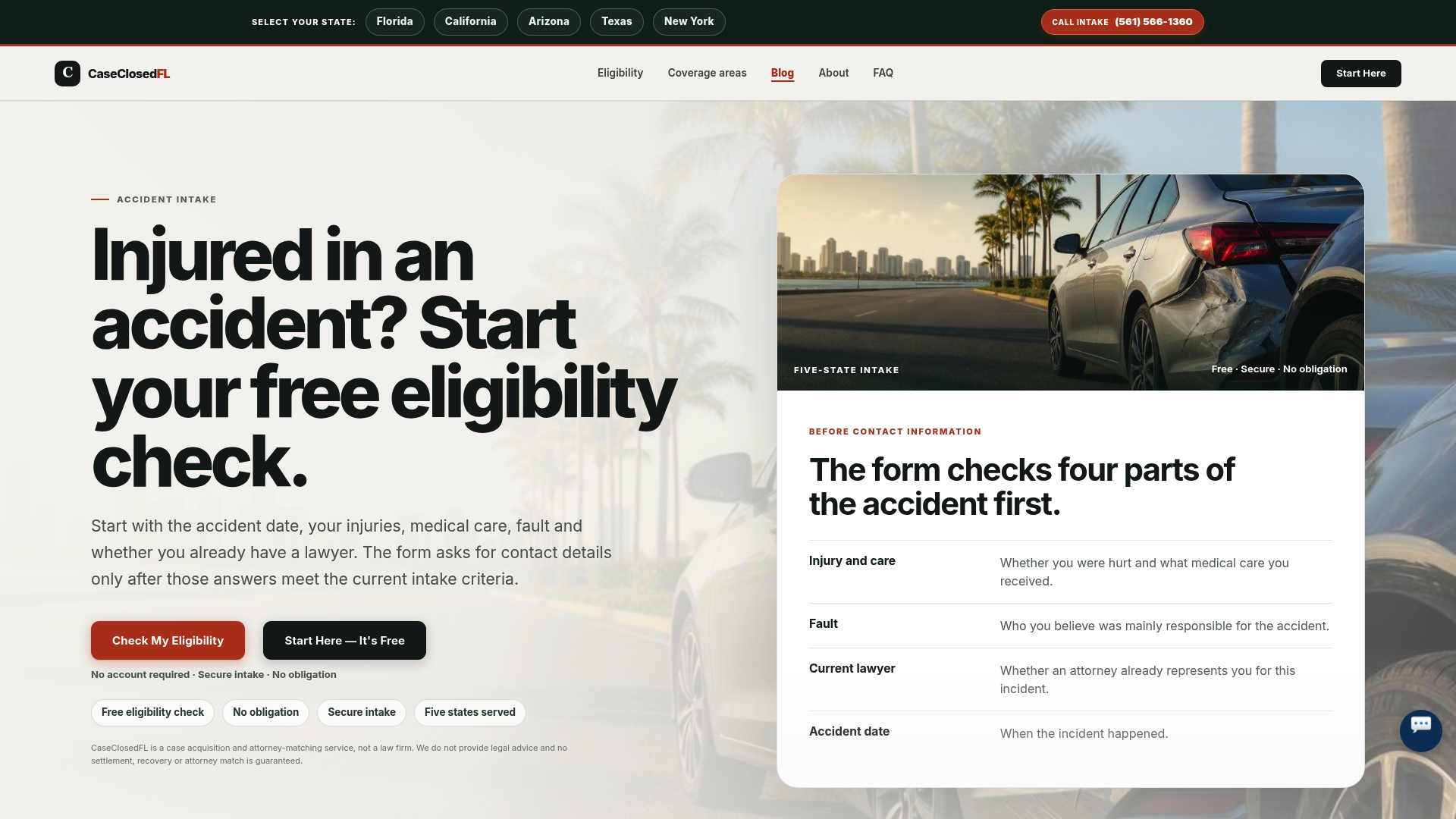
The process is built around privacy, not pressure: every submission gets a human review step before any attorney referral happens. If you’re ready to see where you stand, start your free eligibility check today.
This article is general information, not a substitute for advice from a qualified lawyer. Consult a qualified legal professional about your own circumstances before acting on anything here.

FAQ
How much should you settle for in a car accident?
A fair settlement reflects your documented medical costs, lost wages, and the severity of your injury rather than a single published average. Minor soft-tissue injuries often settle in the low thousands to low tens of thousands, while surgical or permanent injuries can reach well into six figures.
Is $50,000 a good settlement for a car accident?
Settlements in the moderate injury range often cover cases requiring imaging, specialist care, or months of treatment. Whether a specific amount is fair depends on your actual medical bills, lost wages, and whether any permanent impairment was documented.
How much of a $200,000 settlement will I get?
Your net recovery depends on attorney fees, case costs, and any liens from health insurers or medical providers, each of which gets deducted before you receive your portion. Contingency fees typically take a set percentage of the gross amount, so reviewing a fee breakdown with your attorney before settling is the clearest way to know your net figure.
How much will I get from a $50,000 settlement?
As with larger settlements, your net amount depends on contingency fees, case costs, and outstanding medical liens that get paid from the gross recovery. Asking for an itemized breakdown before you sign a release is the most reliable way to confirm your actual take-home amount.
Sources
Frequently asked questions
Table of Contents Why published averages vary so widely Key factors that determine settlement value Typical settlement ranges by injury severity Why settlement amounts vary by state Does hiring an attorney improve net recovery? Typical settlement process and timeline How to estimate your case value and protect it now How CaseClosedFL helps you find legal support A practical take on reading these numbers Start your free eligibility check FAQ Sources Why published averages vary so widely Two claims can both be called “average” and describe completely different realities. A median figure sits at the exact middle of a data set, so extreme highs and lows barely affect it. A mean, or statistical average, adds every value together and divides by the count, so a handful of seven-figure catastrophic injury claims can drag the number upward even when most claims are modest. The source of the data matters just as much as the math behind it. Closed insurance claims reflect what insurers actually paid out, verified by claims files and medical billing. Survey-based averages, by contrast, rely on self-reported figures from claimants who respond voluntarily, which tends to skew toward people willing to discuss their results, often those who recovered more than average. Mixing severity levels compounds the confusion. A data set that blends whiplash claims worth a few thousand dollars with spinal fusion cases worth half a million dollars produces an average that describes neither group accurately. When deciding which number applies to your situation, consider: A median closed-claims figure is usually more representative of a typical outcome than a mean. A survey average skews toward the experiences of people who chose to respond. Neither number accounts for your specific injury severity, liability facts, or state law. The most useful approach treats published averages as a starting orientation, then adjusts based on the factors covered next. Key factors that determine settlement value Adjusters and juries do not simply look up an average and apply it. They weigh a specific set of variables that can swing a claim’s value by tens of thousands of dollars in either direction. Injury severity, medical records, and permanency. Documented diagnoses, imaging results, surgical history, and any finding of permanent impairment carry far more weight than pain complaints alone. Liability proof and percentage fault. Clear fault evidence, such as a police report or dashcam footage, strengthens a claim, while shared fault reduces the payout under most state formulas. Available insurance coverage. A claim’s value is capped in practice by the at-fault driver’s policy limits and any stacked or underinsured motorist coverage you carry. State legal rules. Comparative fault standards, damage caps, and no-fault thresholds all change how a nearly identical injury gets valued from one state to another. Economic versus non-economic damages. Medical bills and lost wages are calculated directly, while pain and suffering is often estimated through a multiplier applied to economic damages or a per-day rate. Pro Tip: Ask for a copy of your medical records as treatment progresses rather than waiting until your case closes; gaps or inconsistencies are easier to explain while they’re fresh. Typical settlement ranges by injury severity Matching your injury type to a realistic bracket is more useful than anchoring to a single national figure. Minor soft-tissue injuries (whiplash, bruising, short-term physical therapy): a few thousand dollars up to around $20,000, depending on treatment duration and documentation. Moderate injuries requiring imaging, specialist visits, or months of treatment: often in the $20,000 to $75,000 range. Injuries involving surgery or permanent impairment: commonly reach the higher five figures to low six figures, reflecting future care costs and lasting functional loss. Catastrophic injuries (spinal cord damage, traumatic brain injury, amputation): six figures to seven figures, though the final recovery is limited by the at-fault party’s collectible insurance and assets. The Insurance Research Council’s median closed bodily-injury claim sits near $31,000 , a figure that falls squarely in the moderate injury bracket and helps explain why that range captures so many real-world claims. A case can also exceed every typical bracket when litigation and jury verdicts enter the picture. Reuters reported that Tesla rejected a $60 million settlement before losing a $243 million verdict in a high-profile autopilot case, a reminder that outsized jury awards can reshape how insurers approach similar claims going forward, even if such outcomes remain rare for an individual crash case. Why settlement amounts vary by state State law changes how an identical injury translates into a dollar figure. Comparative negligence rules determine how much your recovery shrinks if you share fault, damage caps limit non-economic awards in some states, and no-fault thresholds in certain jurisdictions require meeting a seriousness standard before you can sue outside the insurance system at all. Claim severity data backs this up at the state level. A Triple-I state report found New York’s average personal auto injury claim severity is substantially higher than the U.S. average, reflecting higher medical and litigation costs. New York claims run significantly above the national average, reflecting higher medical and litigation costs. California combines a pure comparative negligence rule with high regional medical costs, which tends to push claim values upward even when fault is shared. Texas follows a modified comparative fault bar, so a claimant found more than 50% at fault recovers nothing, making liability proof especially consequential. Does hiring an attorney improve net recovery?
Aggregated data presented by FairSettlement.org points to represented claimants reporting substantially higher average recoveries than unrepresented ones, though these figures reflect gross settlements before fees and costs are deducted, and the underlying case mix likely differs between the two groups.
Typical settlement process and timeline Most claims move through a predictable sequence, though timing depends heavily on how long treatment takes and how quickly liability gets resolved. Medical treatment and stabilization, which should generally be substantially complete before a demand is sent. Claim filing and insurer investigation, including review of police reports and medical records. Demand letter outlining damages and supporting documentation. Negotiation, which often starts with a low initial offer designed to test how firmly you’ll hold your position. Release and payment, or filing suit if negotiation stalls. Insurers tend to move faster once treatment has clearly concluded and liability is no longer in dispute. How to estimate your case value and protect it now Start by matching your injury type to the severity brackets above, then adjust downward if you share partial fault or if the at-fault driver carries minimal insurance coverage. Gather medical records and bills documenting every treatment, referral, and diagnosis tied to the crash. Collect wage-loss proof , such as pay stubs or an employer letter, if the injury kept you from working. Take photos of vehicle damage, the accident scene, and visible injuries as soon as possible. Record witness contact information while memories are still fresh. Pro Tip: Avoid gaps in treatment, resist accepting a first offer before you understand your full medical picture, and stay off social media about the crash since insurers routinely review public posts. How CaseClosedFL helps you find legal support When you need professional guidance, a free eligibility check gathers details about your accident, including injury, fault, current treatment, and any existing legal representation, before asking for personal contact information. This sequencing protects your privacy and limits unwanted solicitation. Every submission goes through human review before being routed to an attorney, and coverage includes multiple states. Legal advice is not provided, nor is there a guarantee that a case will be accepted or any particular outcome will follow. A practical take on reading these numbers Headline averages tell you almost nothing about your specific case. What matters is your documented injury, who holds fault, and the insurance available to pay a claim. Build your records carefully, weigh counsel against the complexity of your facts, and use a free eligibility check when you are unsure which path fits your situation. — Luis Start your free eligibility check If you are trying to figure out whether your case warrants legal help, our free eligibility check walks through the accident details first and only asks for contact information once your case fits our intake criteria. The process is built around privacy, not pressure: every submission gets a human review step before any attorney referral happens. If you’re ready to see where you stand, start your free eligibility check today. This article is general information, not a substitute for advice from a qualified lawyer. Consult a qualified legal professional about your own circumstances before acting on anything here. FAQ How much should you settle for in a car accident?
A fair settlement reflects your documented medical costs, lost wages, and the severity of your injury rather than a single published average. Minor soft-tissue injuries often settle in the low thousands to low tens of thousands, while surgical or permanent injuries can reach well into six figures.
Is $50,000 a good settlement for a car accident?
Settlements in the moderate injury range often cover cases requiring imaging, specialist care, or months of treatment. Whether a specific amount is fair depends on your actual medical bills, lost wages, and whether any permanent impairment was documented.
How much of a $200,000 settlement will I get?
Your net recovery depends on attorney fees, case costs, and any liens from health insurers or medical providers, each of which gets deducted before you receive your portion. Contingency fees typically take a set percentage of the gross amount, so reviewing a fee breakdown with your attorney before settling is the clearest way to know your net figure.
How much will I get from a $50,000 settlement?
As with larger settlements, your net amount depends on contingency fees, case costs, and outstanding medical liens that get paid from the gross recovery. Asking for an itemized breakdown before you sign a release is the most reliable way to confirm your actual take-home amount.
Ready to enter the accident details?
The eligibility form asks about the accident, injury, treatment, fault and representation before contact information.
Start Eligibility Check