1 to 6 Years: U.S. Car Accident Statutes by State and Eligibility Check
Find every U.S. state's car accident filing deadline, learn when tolling or government notice shortens the clock, and start a free eligibility check to...


Most states give you a range of years to file a car accident lawsuit, with a common window being a couple of years nationwide. The exact car accident statute that applies to you depends on your state, whether you’re filing for injury, wrongful death, or property damage, and whether a government vehicle was involved. If your accident happened recently, the safest move is contacting a state-licensed attorney or completing an eligibility check before you assume you have plenty of time left.
TL;DR:
- Most states set a one- to two-year deadline for filing car accident injury claims, with some extending up to six years in specific jurisdictions.
- The statute of limitations generally starts on the accident date, but injuries with delayed symptoms or wrongful death cases may have different triggers.
- Tolling can pause deadlines for minors, incapacity, defendant absence, or concealment, but exceptions are limited and require strong evidence.
- Claims against government entities often require notice within 30 to 180 days and are more likely to be dismissed if missed, regardless of the overall deadline.
- Protect your claim by documenting evidence immediately, tracking your deadline, and consulting a licensed attorney early; pre-claim checks can speed up legal help.
Table of Contents
- What Is a Car Accident Statute of Limitations?
- State-by-State Car Accident Filing Deadlines
- When Does the Clock Start Running?
- Tolling: When the Deadline Can Pause
- Suing a Government Entity After a Crash
- What Happens If You Miss the Deadline?
- Steps to Protect Your Claim Before Time Runs Out
- How CaseClosedFL’s Eligibility Check Fits Into a Tight Timeline
- How the Statute of Limitations Affects Your Insurance Claim
- Multiple States, Multiple Deadlines: Which Law Applies?
- Why Attorneys Push Clients to Act Fast
- Get a Free Eligibility Check Before Your Deadline Closes
- Sources
- FAQ
What Is a Car Accident Statute of Limitations?
A statute of limitations is a legal deadline. Once it passes, courts generally refuse to hear your case at all, regardless of how strong your evidence is. This isn’t a suggestion or a guideline attorneys can talk their way around. It’s a hard filing window written into each state’s code, and judges enforce it strictly.
Filing windows for car accident claims typically fall into three ranges:
- One to two years: States like Kentucky and Tennessee cut personal injury claims off at one year, while California, Florida, and Texas typically allow two years for personal injury claims.
- Three to four years: Several states, including many in the Midwest and Northeast, set the statute of limitations within this range.
- Five to six years: A few states, including some in northern regions like Maine and North Dakota, allow longer filing windows.
Personal injury and property damage claims often run on different clocks even within the same state. Wrongful death claims usually start counting from the date of death, not the date of the crash, which matters when a victim survives the initial collision by weeks or months.
State-by-State Car Accident Filing Deadlines
Every state sets its own personal injury and wrongful death deadlines, and the gap between the shortest and longest windows is significant. Kentucky and Louisiana cut claims off after one year, while Maine and North Dakota allow six. The table below reflects general personal injury and wrongful death periods and the statutes that control them.
Kentucky and Louisiana sit at the tight end with just one year, while Maine, North Dakota, and Minnesota stretch out to six. Wrongful death deadlines frequently run shorter than personal injury deadlines in the same state, which trips up families who assume the two clocks match. Property damage claims sometimes carry their own separate statute, so never assume your injury deadline covers your vehicle repair claim automatically. Local exceptions, tolling provisions, and discovery rules can all shift these numbers for an individual case, so treat this table as a starting reference rather than a final answer for your specific situation.
When Does the Clock Start Running?
In the overwhelming majority of cases, the clock starts on the date of the crash itself, not the date you realized how bad your injuries were or the date your insurance claim got denied. Courts call this the “date of accrual,” and for car accidents, it’s almost always the collision date.
The discovery rule changes this in narrow situations. Some injuries don’t show symptoms right away. Consider these examples:
- A driver walks away from a rear-end collision feeling fine, then develops disc herniation symptoms weeks later. In most states, the clock still started on the crash date.
- A passenger dies from crash-related complications six months after the accident. The wrongful death clock typically starts at death, not at the original collision.
- A victim discovers a foreign object or surgical complication tied to crash treatment months later. A handful of states may apply discovery-rule tolling here, but it’s the exception, not the rule.
Pro Tip: Don’t gamble your case on a discovery-rule argument. Treat your accident date as your filing deadline trigger unless a licensed attorney in your state confirms otherwise.
Tolling: When the Deadline Can Pause
Tolling doctrines pause or extend the statute of limitations clock, but they apply in narrower circumstances than most people assume. Courts don’t hand out extensions casually.
- Minors: Many states pause the clock until the injured person turns 18, then start a fresh filing period, though the exact rule varies significantly by state.
- Incapacity: If the injured person is mentally incapacitated at the time of the crash, some states toll the clock until capacity is restored.
- Defendant absence: If the at-fault driver leaves the state before you can serve them with a lawsuit, the clock may pause during their absence.
- Fraud or concealment: If the defendant actively hid facts that prevented you from discovering your claim, equitable tolling may apply, but courts apply this narrowly and demand strong proof.
Suing a Government Entity After a Crash
If a city bus, county vehicle, or state employee caused your accident, forget the standard statute of limitations for a moment. Claims against government entities run on a separate, much shorter clock.
- Notice-of-claim deadlines commonly range from 30 to 180 days from the accident date, depending on the state and agency involved.
- Missing this notice window typically bars your claim entirely, even if you file well within the general personal injury statute of limitations. Courts treat this as a jurisdictional requirement, not a mere formality.
- If a government vehicle or agency is even possibly involved in your crash, contact an attorney immediately. These clocks move too fast to research on your own.
What Happens If You Miss the Deadline?
Filing after your state’s statute of limitations expires almost always results in dismissal with prejudice, meaning the case is thrown out permanently and can’t be refiled. Defense attorneys watch for this specifically. A late complaint is often one of the easiest wins available to them.
Courts rarely grant exceptions once the deadline passes. Equitable tolling exists on paper, but judges apply it in narrow, fact-specific circumstances, not as a general safety net for missed deadlines.
If settlement negotiations are dragging on and your deadline is approaching, attorneys often file a protective complaint. This formally opens the lawsuit and stops the clock while negotiations continue, without forcing you to abandon settlement talks. It costs a filing fee and some paperwork, but it prevents a strong case from dying over a technicality.
Steps to Protect Your Claim Before Time Runs Out
- Document the scene immediately. Call 911, get a police report, photograph the vehicles and your injuries, and collect witness names and phone numbers before people leave.
- Get medical treatment and keep every record. Follow through on treatment plans, keep copies of bills, and make sure your medical file connects your injuries directly to the crash.
- Mark your filing deadline on a calendar. Note the accident date, look up your state’s personal injury statute of limitations, and build in a buffer of several months.
- Consult a state-licensed attorney early. Even if your deadline is years away, evidence and witness memories degrade fast.
Pro Tip: If you’re unsure which state’s law applies or your deadline is close, a protective filing costs far less than losing your entire claim to a missed date.
How CaseClosedFL’s Eligibility Check Fits Into a Tight Timeline
When your filing window is closing, speed matters. Caseclosedfl offers a free, privacy-first eligibility check that gathers details about your injury, fault, and any existing legal representation before requesting your contact information. Every submission goes through human review. The service covers Florida, California, Arizona, Texas, New York, and other states, connecting qualified cases with participating attorneys. Caseclosedfl doesn’t provide legal advice or guarantee outcomes. It simply helps move your case toward the right professional faster.
How the Statute of Limitations Affects Your Insurance Claim
Insurance adjusters know your filing deadline as well as any attorney does, and some use it to their advantage. If a claim drags on close to your statute of limitations without a resolution, an insurer has little incentive to negotiate in good faith. They know that once the deadline passes, your leverage disappears entirely.
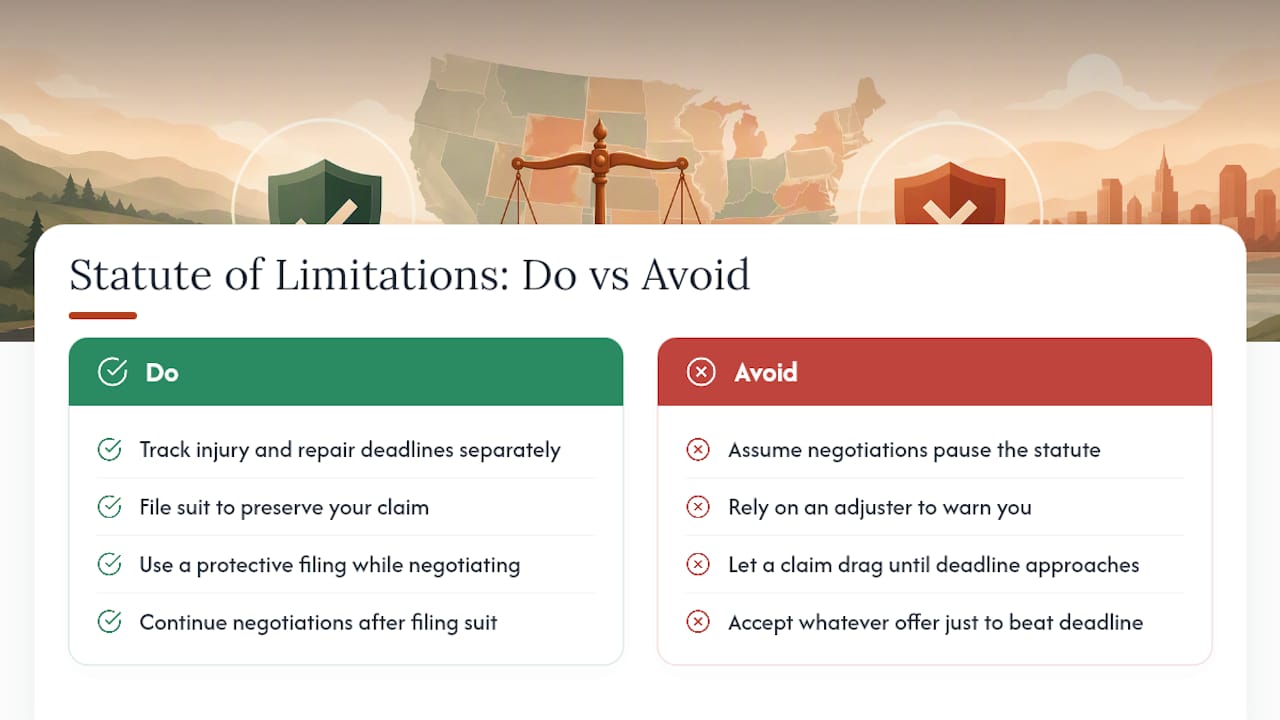
This creates a specific trap: many accident victims spend a year or more negotiating directly with an insurance company, only to realize their filing deadline is now months away with no settlement in hand. Adjusters aren’t required to warn you about this. Their job is to resolve claims for as little as possible, and a ticking clock works in their favor.
A pending settlement negotiation does not pause your statute of limitations. If talks stall and your deadline is approaching, you generally have two options: accept whatever offer is on the table, or file suit to preserve your claim while continuing to negotiate. This is exactly why protective filings exist. They let you keep talking to the insurance company without gambling your entire claim on a slow negotiation.
Property damage claims can complicate this further. Some states apply a different statute of limitations to vehicle repair claims than to injury claims, which means your car repair reimbursement could expire before your injury claim does, or vice versa. Track both deadlines separately rather than assuming one filing date covers everything.
Multiple States, Multiple Deadlines: Which Law Applies?
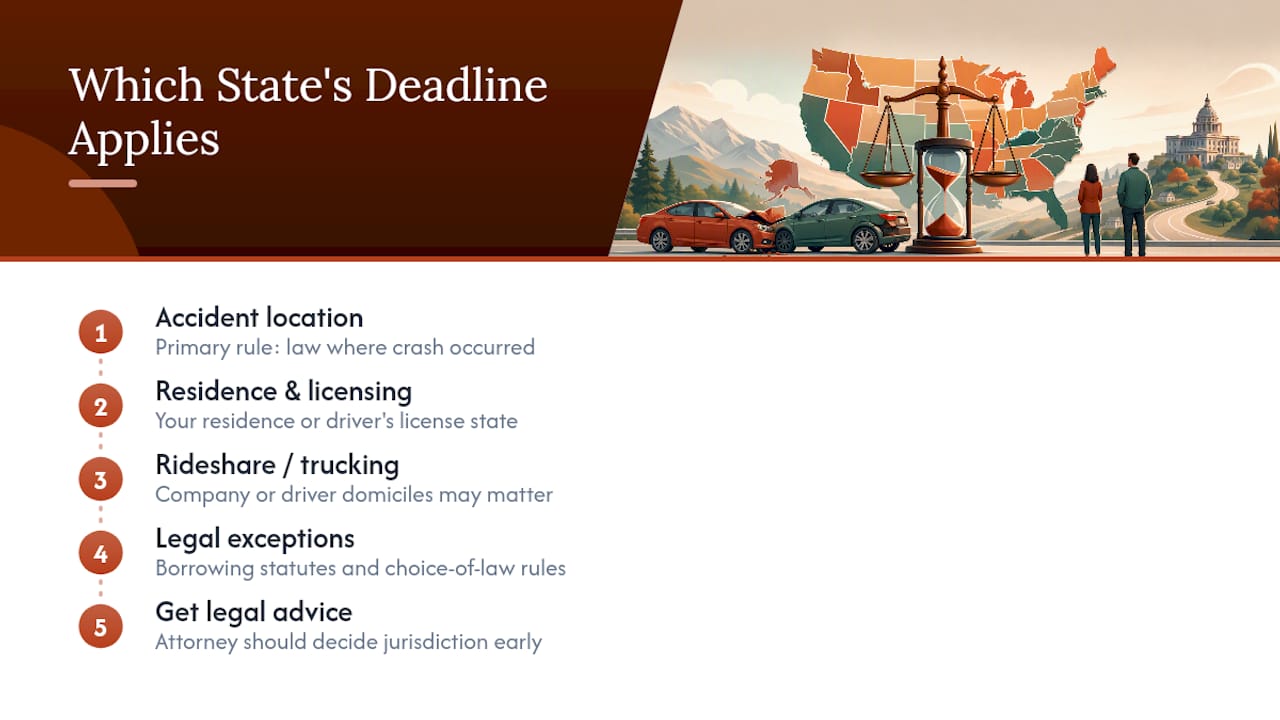
Accidents involving out-of-state drivers, interstate highways, or rideshare trips across state lines raise a genuinely tricky question: whose statute of limitations controls your case?
Courts generally apply the law of the state where the accident physically occurred, not where you live or where the at-fault driver is licensed. If you’re a Georgia resident injured in a Florida car accident, Florida’s statute of limitations typically governs your personal injury claim, even though you’ll likely receive medical treatment back home in Georgia.
Exceptions exist. Some states apply “borrowing statutes,” which import a shorter limitations period from another state involved in the dispute if that state’s deadline would otherwise be missed. Choice-of-law rules can also shift depending on where the lawsuit is filed and which state has the strongest connection to the parties and the incident.
Rideshare accidents add another layer, since the driver, passenger, and rideshare company may all be domiciled in different states. Commercial trucking accidents raise similar questions when the trucking company is headquartered in a state that never touched the actual crash. When jurisdiction isn’t obvious, this is precisely the kind of question a licensed attorney needs to answer early, because guessing wrong could mean filing under the wrong state’s deadline entirely.
Why Attorneys Push Clients to Act Fast
Evidence doesn’t wait for your deadline. Skid marks fade, witnesses move, and traffic camera footage gets overwritten within weeks. Attorneys who’ve handled these cases for years know that a claim filed on day 700 of a two-year window is measurably harder to prove than one filed on day 30, even though both are technically timely.
Protective filings exist because negotiations are unpredictable, and tolling exceptions are not a backup plan. Treat the statute as the real deadline, not the outer edge of some flexible buffer.
— Luis
Get a Free Eligibility Check Before Your Deadline Closes
Unlike a traditional law firm consultation that requires scheduling, paperwork, and often a wait for callback, Caseclosedfl gives you a faster first step. Its free eligibility check asks about your injury, fault, treatment, and any existing legal representation upfront, then only requests your contact details if your case appears to qualify. That means no unwanted solicitation calls and no commitment.

Every submission is reviewed before being sent to an attorney, so the process is not fully automated. If you’re in Florida, dedicated case-review pages exist for Miami, Miami Beach, Fort Lauderdale, and other cities, alongside coverage in California, Arizona, Texas, and New York. If your accident happened recently and you’re unsure how much time you have left, start the free eligibility check today rather than waiting until your deadline is weeks away.
Sources
The state deadlines above draw from primary statute citations, including California Civil Procedure Code § 335.1 and Florida Statutes § 316.027, along with compiled 50-state legal guides. Statutes change, so verify your state’s current deadline through your state legislature’s website or a licensed attorney before relying on any figure here, including this compiled resource.
This article is general information, not a substitute for advice from a qualified lawyer. Consult a qualified legal professional about your own circumstances before acting on anything here.
- Statute of Limitations for Car Accident Claims by State — Sokolove Law
- Personal-injury statute of limitations by state (50-state guide) — CaseWorthNow
- Time limits for a personal injury case: the statute of limitations — FindLaw
FAQ
What Are Florida’s Car Accident Laws on Filing Deadlines?
Florida generally gives injury victims two years from the accident date to file a personal injury lawsuit under Fla. Stat. § 95.11. Florida law also requires drivers involved in injury or death crashes to stop and fulfill reporting duties under Fla. Stat. § 316.027.
How Long Do I Have to Sue After a Car Accident in California?
California’s personal injury statute of limitations is two years from the date of the crash under Cal. Civ. Proc. Code § 335.1. Property damage claims can carry a different deadline, so confirm both dates separately if your vehicle needs repairs.
Are Car Accident Claims Civil or Criminal Cases?
Car accident lawsuits for injury or property damage are civil matters, separate from any traffic ticket or criminal charge that might arise from the same crash. A driver can face a criminal citation for reckless driving while simultaneously facing a civil lawsuit for damages, and the two cases proceed independently.
What Are the Car Accident Laws in Texas?
Texas sets a two-year statute of limitations for personal injury and wrongful death claims arising from car accidents under Tex. Civ. Prac. & Rem. Code § 16.003. This deadline runs from the accident date in nearly all cases, with narrow tolling exceptions for minors or incapacitated victims.
How Do I Find My State’s Exact Statute of Limitations?
Check your state’s official legislature website for the controlling civil procedure statute, since deadlines and exceptions vary by state and claim type. If you’re unsure or your deadline is approaching, a free eligibility check through Caseclosedfl can help connect you with a state-licensed attorney who can confirm your exact timeline.
Recommended
Frequently asked questions
Table of Contents What Is a Car Accident Statute of Limitations? State-by-State Car Accident Filing Deadlines When Does the Clock Start Running? Tolling: When the Deadline Can Pause Suing a Government Entity After a Crash What Happens If You Miss the Deadline? Steps to Protect Your Claim Before Time Runs Out How CaseClosedFL’s Eligibility Check Fits Into a Tight Timeline How the Statute of Limitations Affects Your Insurance Claim Multiple States, Multiple Deadlines: Which Law Applies? Why Attorneys Push Clients to Act Fast Get a Free Eligibility Check Before Your Deadline Closes Sources FAQ What Is a Car Accident Statute of Limitations?
A statute of limitations is a legal deadline. Once it passes, courts generally refuse to hear your case at all, regardless of how strong your evidence is. This isn’t a suggestion or a guideline attorneys can talk their way around. It’s a hard filing window written into each state’s code, and judges enforce it strictly.
State-by-State Car Accident Filing Deadlines Every state sets its own personal injury and wrongful death deadlines, and the gap between the shortest and longest windows is significant. Kentucky and Louisiana cut claims off after one year, while Maine and North Dakota allow six. The table below reflects general personal injury and wrongful death periods and the statutes that control them. Kentucky and Louisiana sit at the tight end with just one year, while Maine, North Dakota, and Minnesota stretch out to six. Wrongful death deadlines frequently run shorter than personal injury deadlines in the same state, which trips up families who assume the two clocks match. Property damage claims sometimes carry their own separate statute, so never assume your injury deadline covers your vehicle repair claim automatically. Local exceptions, tolling provisions, and discovery rules can all shift these numbers for an individual case, so treat this table as a starting reference rather than a final answer for your specific situation. When Does the Clock Start Running?
In the overwhelming majority of cases, the clock starts on the date of the crash itself, not the date you realized how bad your injuries were or the date your insurance claim got denied. Courts call this the “date of accrual,” and for car accidents, it’s almost always the collision date.
Tolling: When the Deadline Can Pause Tolling doctrines pause or extend the statute of limitations clock, but they apply in narrower circumstances than most people assume. Courts don’t hand out extensions casually. Minors: Many states pause the clock until the injured person turns 18, then start a fresh filing period, though the exact rule varies significantly by state. Incapacity: If the injured person is mentally incapacitated at the time of the crash, some states toll the clock until capacity is restored. Defendant absence: If the at-fault driver leaves the state before you can serve them with a lawsuit, the clock may pause during their absence. Fraud or concealment: If the defendant actively hid facts that prevented you from discovering your claim, equitable tolling may apply, but courts apply this narrowly and demand strong proof . Suing a Government Entity After a Crash If a city bus, county vehicle, or state employee caused your accident, forget the standard statute of limitations for a moment. Claims against government entities run on a separate, much shorter clock. Notice-of-claim deadlines commonly range from 30 to 180 days from the accident date , depending on the state and agency involved. Missing this notice window typically bars your claim entirely, even if you file well within the general personal injury statute of limitations. Courts treat this as a jurisdictional requirement, not a mere formality. If a government vehicle or agency is even possibly involved in your crash, contact an attorney immediately. These clocks move too fast to research on your own. What Happens If You Miss the Deadline?
Filing after your state’s statute of limitations expires almost always results in dismissal with prejudice, meaning the case is thrown out permanently and can’t be refiled. Defense attorneys watch for this specifically. A late complaint is often one of the easiest wins available to them.
Steps to Protect Your Claim Before Time Runs Out Document the scene immediately. Call 911, get a police report, photograph the vehicles and your injuries, and collect witness names and phone numbers before people leave. Get medical treatment and keep every record. Follow through on treatment plans, keep copies of bills, and make sure your medical file connects your injuries directly to the crash. Mark your filing deadline on a calendar. Note the accident date, look up your state’s personal injury statute of limitations, and build in a buffer of several months. Consult a state-licensed attorney early. Even if your deadline is years away, evidence and witness memories degrade fast. Pro Tip: If you’re unsure which state’s law applies or your deadline is close, a protective filing costs far less than losing your entire claim to a missed date. How CaseClosedFL’s Eligibility Check Fits Into a Tight Timeline When your filing window is closing, speed matters. Caseclosedfl offers a free, privacy-first eligibility check that gathers details about your injury, fault, and any existing legal representation before requesting your contact information. Every submission goes through human review. The service covers Florida, California, Arizona, Texas, New York, and other states, connecting qualified cases with participating attorneys. Caseclosedfl doesn’t provide legal advice or guarantee outcomes. It simply helps move your case toward the right professional faster. How the Statute of Limitations Affects Your Insurance Claim Insurance adjusters know your filing deadline as well as any attorney does, and some use it to their advantage. If a claim drags on close to your statute of limitations without a resolution, an insurer has little incentive to negotiate in good faith. They know that once the deadline passes, your leverage disappears entirely. This creates a specific trap: many accident victims spend a year or more negotiating directly with an insurance company, only to realize their filing deadline is now months away with no settlement in hand. Adjusters aren’t required to warn you about this. Their job is to resolve claims for as little as possible, and a ticking clock works in their favor. A pending settlement negotiation does not pause your statute of limitations. If talks stall and your deadline is approaching, you generally have two options: accept whatever offer is on the table, or file suit to preserve your claim while continuing to negotiate. This is exactly why protective filings exist. They let you keep talking to the insurance company without gambling your entire claim on a slow negotiation. Property damage claims can complicate this further. Some states apply a different statute of limitations to vehicle repair claims than to injury claims, which means your car repair reimbursement could expire before your injury claim does, or vice versa. Track both deadlines separately rather than assuming one filing date covers everything. Multiple States, Multiple Deadlines: Which Law Applies?
Accidents involving out-of-state drivers, interstate highways, or rideshare trips across state lines raise a genuinely tricky question: whose statute of limitations controls your case?
Why Attorneys Push Clients to Act Fast Evidence doesn’t wait for your deadline. Skid marks fade, witnesses move, and traffic camera footage gets overwritten within weeks. Attorneys who’ve handled these cases for years know that a claim filed on day 700 of a two-year window is measurably harder to prove than one filed on day 30, even though both are technically timely. Protective filings exist because negotiations are unpredictable, and tolling exceptions are not a backup plan. Treat the statute as the real deadline, not the outer edge of some flexible buffer. — Luis Get a Free Eligibility Check Before Your Deadline Closes Unlike a traditional law firm consultation that requires scheduling, paperwork, and often a wait for callback, Caseclosedfl gives you a faster first step. Its free eligibility check asks about your injury, fault, treatment, and any existing legal representation upfront, then only requests your contact details if your case appears to qualify. That means no unwanted solicitation calls and no commitment. Every submission is reviewed before being sent to an attorney, so the process is not fully automated. If you’re in Florida, dedicated case-review pages exist for Miami , Miami Beach , Fort Lauderdale , and other cities, alongside coverage in California, Arizona, Texas, and New York. If your accident happened recently and you’re unsure how much time you have left, start the free eligibility check today rather than waiting until your deadline is weeks away. Sources The state deadlines above draw from primary statute citations, including California Civil Procedure Code § 335.1 and Florida Statutes § 316.027 , along with compiled 50-state legal guides. Statutes change, so verify your state’s current deadline through your state legislature’s website or a licensed attorney before relying on any figure here, including this compiled resource. This article is general information, not a substitute for advice from a qualified lawyer. Consult a qualified legal professional about your own circumstances before acting on anything here. Statute of Limitations for Car Accident Claims by State — Sokolove Law Personal-injury statute of limitations by state (50-state guide) — CaseWorthNow Time limits for a personal injury case: the statute of limitations — FindLaw FAQ What Are Florida’s Car Accident Laws on Filing Deadlines?
Florida generally gives injury victims two years from the accident date to file a personal injury lawsuit under Fla. Stat. § 95.11. Florida law also requires drivers involved in injury or death crashes to stop and fulfill reporting duties under Fla. Stat. § 316.027.
How Long Do I Have to Sue After a Car Accident in California?
California’s personal injury statute of limitations is two years from the date of the crash under Cal. Civ. Proc. Code § 335.1. Property damage claims can carry a different deadline, so confirm both dates separately if your vehicle needs repairs.
Are Car Accident Claims Civil or Criminal Cases?
Car accident lawsuits for injury or property damage are civil matters, separate from any traffic ticket or criminal charge that might arise from the same crash. A driver can face a criminal citation for reckless driving while simultaneously facing a civil lawsuit for damages, and the two cases proceed independently.
What Are the Car Accident Laws in Texas?
Texas sets a two-year statute of limitations for personal injury and wrongful death claims arising from car accidents under Tex. Civ. Prac. & Rem. Code § 16.003. This deadline runs from the accident date in nearly all cases, with narrow tolling exceptions for minors or incapacitated victims.
Ready to enter the accident details?
The eligibility form asks about the accident, injury, treatment, fault and representation before contact information.
Start Eligibility Check