$10,000–$80,000 Concussion Car Accident Settlements and Private Check
Understand evidence-backed concussion car accident settlement ranges ($10,000–$80,000), what raises value, and how to run a private eligibility check.


Most concussion car accident claims settle within a broad range reflective of case complexity and severity, with more severe or long-lasting cases sometimes reaching higher settlement amounts. Amounts swing widely based on treatment length, lost income, and whether symptoms resolve in weeks or persist for months. Because concussion symptoms can worsen or emerge days after a crash, the first move is simple: get evaluated, document everything, and talk to a lawyer or run a free eligibility check before you sign anything from an insurer.
TL;DR:
- Settlement amounts largely depend on the duration and severity of symptoms, with long-term or persistent cases often exceeding $100,000.
- Consistent, thorough medical documentation and evidence of ongoing symptoms significantly increase a claim’s value.
- Filing should only occur after maximum medical improvement and documentation of recovery, as premature demand reduces settlement potential.
- Claims involving long-term issues like post-concussion syndrome can stretch over many years, with median symptom duration around 30 months.
- A private eligibility check can help assess case strength and connect you with legal help before accepting any insurer offers.
Table of Contents
- Typical Concussion Car Accident Claim Settlement Ranges
- What Determines Your Concussion Settlement Value
- How to Prove a Concussion After a Car Accident
- Concussion Claim Timeline: When to File
- Should You Accept a Concussion Settlement Offer?
- Post-Concussion Syndrome and Long-Term Damages
- Economic vs. Non-Economic Damages in a Concussion Claim
- Starting Your Claim: What to Do First
- What I’ve Seen Go Wrong in Concussion Claims
- A Private Way to Check Your Concussion Claim Options
- Sources
- FAQ
Typical Concussion Car Accident Claim Settlement Ranges
Settlement figures for concussion cases cluster into three rough bands, and the difference between them almost always comes down to how long symptoms lasted and how much medical care they required. Published legal explainers commonly cite $10,000 to $80,000 as the general range for concussion claims, with severity, lost wages, future care needs, and available insurance coverage, pushing individual cases toward either end.
Low-end settlements usually involve a brief emergency room visit, a mild concussion diagnosis, symptoms that clear within two to four weeks, and little or no missed work. These cases often land in the $5,000 to $20,000 range because the medical bills are modest and there’s no argument for future treatment costs.
Mid-range settlements typically involve weeks or months of symptoms, follow-up care with a primary doctor or neurologist, some missed work, and documented cognitive or physical effects like headaches, dizziness, or trouble concentrating. These cases often fall between $20,000 and $80,000, depending on how well the treatment history supports the claim.
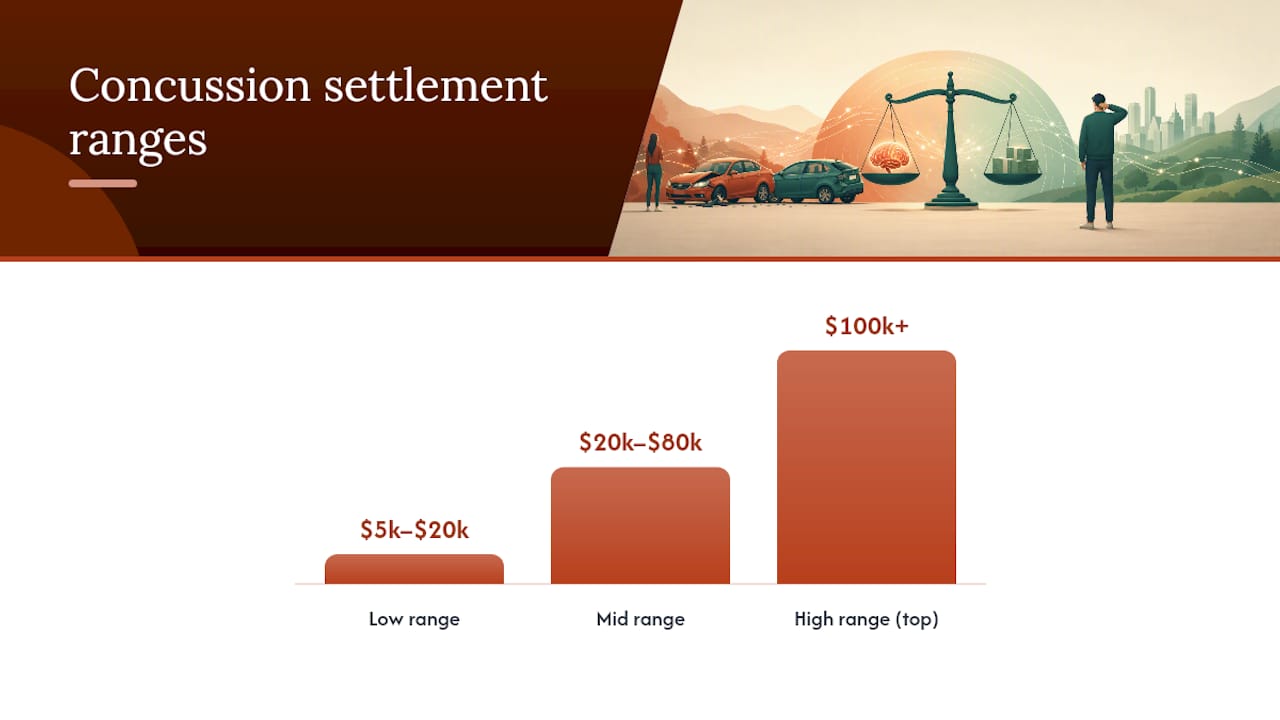
High-end settlements involve post-concussion syndrome, long-term cognitive or vestibular therapy, significant time off work, or permanent limitations. These cases can exceed $100,000, particularly when a neuropsychologist or life-care planner testifies to future treatment costs and reduced earning capacity.
A few things explain why two people with what sounds like “the same” concussion end up with very different settlement checks:
- Geography matters. Jury verdict trends and typical settlement values vary by county and state, and insurers price their offers based on local litigation history.
- Insurer mix matters. A claim against a driver with a minimum-limits policy caps out differently than one against a commercial vehicle with a large liability policy, as noted by the Insurance Information Institute.
- Case selection skews averages. Published averages often blend cases that settled fast and cheap with catastrophic outliers, which makes any single number misleading without context.
- Documentation quality matters more than injury severity. Two people with similar symptoms can get very different offers if one has a thin medical file and the other has consistent specialist visits and a symptom diary.
The takeaway isn’t that you should fixate on a number pulled from a legal blog. It’s that your own file, treatment consistency, and the strength of your evidence will do more to determine your outcome than any published range.
What Determines Your Concussion Settlement Value
Adjusters and attorneys don’t value a concussion claim off a single injury code. They weigh a handful of factors, and understanding them tells you exactly where to focus your energy after a crash.
Medical treatment intensity carries the most weight. A single ER visit followed by silence looks very different from a file showing an ER visit, a follow-up with a primary care doctor, a neurology referral, and documented therapy sessions. Thorough, consistent records tell the story that a thin file can’t.
Work impact matters just as much as medical bills. Missed shifts, reduced hours, or an inability to perform your job duties translate directly into lost wages and, in more serious cases, a claim for reduced future earning capacity.
Liability and comparative fault can shrink or sink a claim regardless of how bad the concussion is. If you’re found partially at fault, most states reduce your recovery proportionally, and some bar recovery entirely past a certain fault threshold.
Policy limits set a practical ceiling. A claim can be worth $150,000 on paper and still settle for the at-fault driver’s $25,000 minimum policy limit if there’s no other coverage, like an underinsured motorist policy, to tap into.
Long-term complications raise value fast. Post-concussion syndrome, comorbid whiplash, or new anxiety and sleep problems documented by a treating provider all push a case toward the higher end of the range.
- Consistent, gap-free medical treatment
- Documented lost wages and reduced work capacity
- Clear liability with minimal comparative fault
- Adequate insurance coverage on the at-fault side (or your own underinsured motorist coverage)
- Objective evidence of long-term or worsening symptoms
Pro Tip: If you were rear-ended, don’t assume the mechanism was “too minor” to cause a real concussion. Research on persisting concussion symptoms after crashes associates rear-end collisions with longer recovery times, which is useful context if an insurer tries to argue your symptoms don’t match the crash.
How to Prove a Concussion After a Car Accident
A concussion doesn’t show up on an X-ray the way a broken bone does, which is exactly why insurance adjusters push back on these claims. The CDC notes that concussions can result from rapid acceleration and deceleration forces alone, even without your head striking anything inside the car. That means “I didn’t hit my head” is not a reason to skip documentation. Here’s what actually builds a provable case:
- Get evaluated immediately, even if symptoms seem mild. ER notes, a neurological assessment, and imaging (when a doctor orders it) create the earliest, most credible record tying your symptoms to the crash.
- Follow up with specialists as symptoms dictate. Vestibular therapy, vision therapy, and formal neuropsychological testing generate objective findings that carry far more weight than self-reported complaints alone.
- Keep a daily symptom diary. Track headaches, light sensitivity, memory lapses, mood changes, and sleep disruption with dates. This becomes powerful evidence when symptoms fluctuate over months.
- Collect employer and time-off records. Pay stubs, HR correspondence, and doctor’s notes excusing you from work connect your injury directly to lost income.
- Gather witness statements early. Coworkers or family members who noticed cognitive or behavioral changes can corroborate what your medical records describe.
- Address delayed symptoms directly with your doctor, not by staying silent. Adrenaline often masks concussion symptoms for hours or days after a crash, and waiting to seek care is common, but you need a doctor’s note explaining the delay so an adjuster doesn’t use the gap against you.
Concussion Claim Timeline: When to File
A concussion car accident claim generally moves through five phases: report the crash, get treated, document your recovery, send a demand, and either settle or file suit. Rushing any one of these phases, especially the treatment and documentation steps, tends to shrink your eventual settlement.
The statute of limitations for personal injury claims varies by state, typically ranging from two to four years from the date of the crash, though some states set shorter windows for claims against government entities. Check your state’s deadline immediately after a crash rather than assuming you have years to spare.
- Report the crash to police and your insurer within days
- Begin and continue medical treatment without gaps
- Document symptoms, work impact, and expenses throughout recovery
- Send a demand letter only after reaching maximum medical improvement (MMI) or a clear treatment plateau
- Negotiate a settlement or file suit before your state’s deadline
Waiting for MMI, the point where your doctor confirms you’ve recovered as much as you’re going to, usually increases settlement value because it lets your lawyer put a real number on future care. It also extends the timeline, sometimes by months, which is a trade-off worth understanding going in.
Should You Accept a Concussion Settlement Offer?
An early settlement offer from an insurance adjuster is rarely their best offer. It’s often a test to see whether you understand your claim’s real value.
Watch for these common insurer tactics before you sign anything:
- A fast, low offer sent before you’ve finished treatment
- A release form that waives your right to claim future medical costs
- Pressure to give a recorded statement before you’ve spoken with a lawyer
- An offer that ignores documented lost wages or only covers past bills
Before accepting anything, ask whether the number covers care you might still need. If your doctor mentioned possible future therapy or if symptoms haven’t fully resolved, an offer based only on bills to date is likely too low. For cases involving long-term care needs, ask your attorney about structured settlements or language that reserves your right to pursue additional treatment costs later.
Pro Tip: Never sign a release while symptoms are still active. Once you accept a settlement, you almost always give up the right to ask for more, even if you’re later diagnosed with post-concussion syndrome.
Post-Concussion Syndrome and Long-Term Damages
Post-concussion syndrome (PCS) changes the entire damages calculation, and it’s more common than most people expect. A 2024 cohort study of 136 vehicle occupants with persisting concussion symptoms after motor vehicle crashes found a median symptom duration of 30.0 months, nearly two and a half years.
By the numbers: In a cohort of 136 crash-related concussion patients with persisting symptoms, the median recovery time was 30.0 months, with headache, anxiety, and light sensitivity as the three most common lingering effects.
The Mayo Clinic notes that while most concussions resolve within two to four weeks, some people develop prolonged symptoms requiring targeted rehabilitation. A related longitudinal study of 600 patients links crash mechanics and demographic factors, including female sex and rear-end collision type, with longer recovery and a higher number of persisting symptoms.
For a claim, PCS is the difference between a settlement covering a few weeks of bills and one that accounts for years of therapy, missed promotions, and reduced future earning capacity. If your symptoms haven’t resolved by the time you’re negotiating, that’s not a weakness in your case. It’s evidence your damages are still accumulating.

Economic vs. Non-Economic Damages in a Concussion Claim
Concussion settlements are built from two categories of damages, and understanding both helps you sanity-check any offer you receive.
Economic damages are the costs you can put a receipt on:
- Emergency room and hospital bills
- Follow-up doctor visits, imaging, and specialist care
- Physical, vestibular, or cognitive therapy
- Lost wages and reduced earning capacity
- Future medical costs, when supported by a doctor’s projection
Non-economic damages cover pain and suffering, and lawyers commonly value them using one of two approaches: the multiplier method (multiplying total economic damages by a factor, often between 1.5 and 5, based on severity) or a per-diem method (assigning a daily dollar value to suffering and multiplying by recovery days).
Policy limits cap what’s actually recoverable regardless of how the math works out. The Insurance Information Institute tracks how common minimum-limits policies remain across the country, which is why checking for underinsured motorist coverage on your own policy matters just as much as valuing the claim correctly.
Starting Your Claim: What to Do First
The steps you take in the days and weeks after a crash shape your claim more than almost anything that happens later. Building your file as if it may eventually go to trial, even if it never does, tends to produce stronger settlement offers.
- Get medical care immediately, even if you feel fine. Tell the provider about any head impact, dizziness, or confusion, however brief.
- Report the crash to police and your own insurer, and request a copy of the police report once it’s available.
- Start a symptom diary the same day, noting headaches, memory issues, mood changes, or sleep problems.
- Keep every record: medical bills, pharmacy receipts, mileage to appointments, and pay stubs showing missed work.
- Follow through on referrals. Skipping a recommended specialist visit gives an insurer an easy argument that your injury wasn’t serious.
- Contact a lawyer or run a free eligibility check before speaking with the at-fault driver’s insurance company. Have your crash date, injury details, current treatment status, and any existing legal representation ready. That information determines how quickly a case can move toward a real attorney match.
What I’ve Seen Go Wrong in Concussion Claims
The single biggest mistake in concussion cases isn’t a bad injury. It’s a bad file. People who feel “off” after a crash but skip the ER, then wait a week to see a doctor once headaches won’t quit, hand the insurance company its best argument for free: if it was that serious, why did you wait? Adrenaline masks symptoms, and that delay is medically understandable, but adjusters don’t grade on understanding. They grade on paper.
The second mistake is treating early low offers as generous because they arrive fast. Speed is a negotiating tactic, not generosity. A human-reviewed intake process exists precisely to slow that instinct down. Screening for injury, fault, treatment status, and existing representation before anyone asks for your contact information means you’re not fielding solicitation calls while you’re still trying to figure out if your headaches are getting worse.
— Luis
A Private Way to Check Your Concussion Claim Options
If you’re still sorting out symptoms, bills, and whether an insurance offer is fair, running a free eligibility check with Caseclosedfl gives you a private next step instead of another cold call from a law firm’s marketing list. The intake platform asks about your injury, who was at fault, whether you already have a lawyer, and your location, all before requesting any personal contact information, so you’re not exposed to solicitation until you decide you want to be.
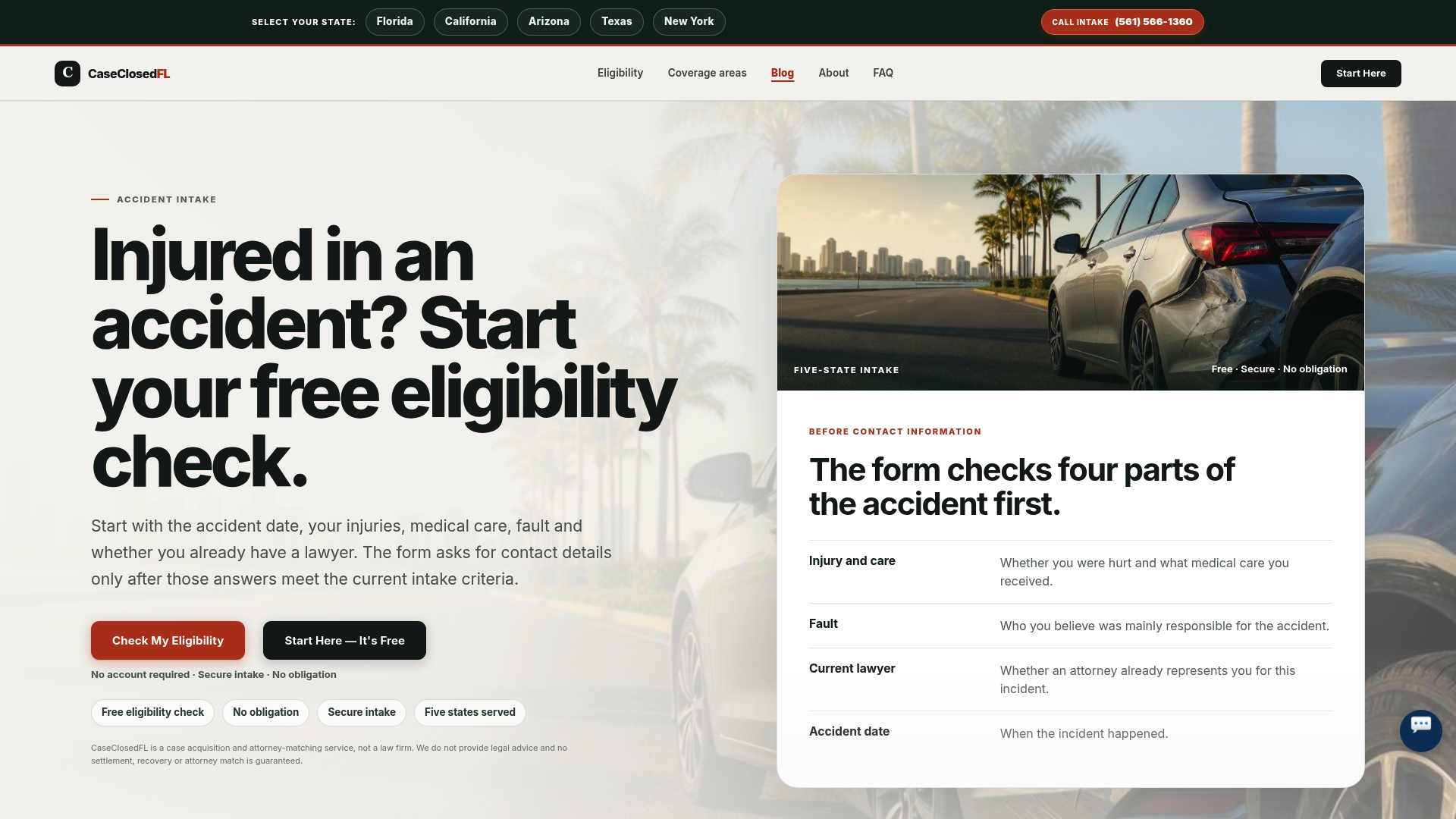
Every submission goes through human review before being matched to attorneys, meaning you are not relying on an algorithm alone to decide whether your case gets seen. If your concussion claim looks eligible, that review process helps speed up the connection to an attorney who can evaluate your treatment records, work impact, and the at-fault driver’s coverage in detail. The platform does not guarantee results or provide legal advice, but the free eligibility check is a low-friction way to find out where you stand. If you’re in Miami and want to see how local car accident claims typically get evaluated, the Miami car accident claims guide walks through what evidence matters most, or you can start your eligibility check now directly.
Sources
Claims about symptom duration and prevalence draw on peer-reviewed research and clinical guidance from the CDC, the Mayo Clinic, and published cohort studies on crash-related concussions cited throughout this guide.
This article is general information, not a substitute for advice from a qualified lawyer. Consult a qualified legal professional about your own circumstances before acting on anything here.
- Analysis of Concussions with Persisting Symptoms Caused by Motor Vehicle Crashes in 136 Vehicle Occupants
- Cause of Concussion With Persisting Symptoms Is Associated With Long-Term Recovery and Symptom Type, Duration, and Number in a Longitudinal Cohort of 600 Patients
FAQ
What is the typical settlement for a concussion in a car accident?
Most concussion settlements fall between $10,000 and $80,000, with severe or long-lasting cases, including post-concussion syndrome, reaching six figures. The exact amount depends on treatment length, lost wages, liability, and available insurance coverage.
Can you sue for a mild concussion?
Yes, a mild concussion can still support a lawsuit if it caused medical bills, missed work, or documented pain and suffering. The CDC confirms concussions can occur without direct head impact, so “mild” doesn’t mean the injury isn’t legally compensable.
How much compensation do you get for concussion and whiplash together?
Combining a concussion with whiplash generally increases settlement value because it adds treatment costs, extends recovery time, and strengthens the argument for pain and suffering. There’s no fixed combined figure, but insurers typically account for both injuries separately within the same demand and settlement calculation.
How long can you have a concussion after a car accident?
Most concussions resolve within two to four weeks, according to the Mayo Clinic, but a cohort of patients with persisting symptoms after motor vehicle crashes reported a median duration of 30.0 months. Symptoms that last beyond a few weeks should prompt a medical evaluation and factor into any settlement discussion.
Do I need a lawyer for a concussion car accident claim?
You’re not required to hire a lawyer, but concussion cases are notoriously easy for insurers to undervalue because the injury isn’t visible on standard imaging. A free eligibility check through Caseclosedfl can help determine whether your case is a good fit for attorney representation before you commit to anything.
Recommended
Frequently asked questions
Table of Contents Typical Concussion Car Accident Claim Settlement Ranges What Determines Your Concussion Settlement Value How to Prove a Concussion After a Car Accident Concussion Claim Timeline: When to File Should You Accept a Concussion Settlement Offer? Post-Concussion Syndrome and Long-Term Damages Economic vs. Non-Economic Damages in a Concussion Claim Starting Your Claim: What to Do First What I’ve Seen Go Wrong in Concussion Claims A Private Way to Check Your Concussion Claim Options Sources FAQ Typical Concussion Car Accident Claim Settlement Ranges Settlement figures for concussion cases cluster into three rough bands, and the difference between them almost always comes down to how long symptoms lasted and how much medical care they required. Published legal explainers commonly cite $10,000 to $80,000 as the general range for concussion claims, with severity, lost wages, future care needs, and available insurance coverage, pushing individual cases toward either end. Low-end settlements usually involve a brief emergency room visit, a mild concussion diagnosis, symptoms that clear within two to four weeks, and little or no missed work. These cases often land in the $5,000 to $20,000 range because the medical bills are modest and there’s no argument for future treatment costs. Mid-range settlements typically involve weeks or months of symptoms, follow-up care with a primary doctor or neurologist, some missed work, and documented cognitive or physical effects like headaches, dizziness, or trouble concentrating. These cases often fall between $20,000 and $80,000, depending on how well the treatment history supports the claim. High-end settlements involve post-concussion syndrome, long-term cognitive or vestibular therapy, significant time off work, or permanent limitations. These cases can exceed $100,000, particularly when a neuropsychologist or life-care planner testifies to future treatment costs and reduced earning capacity. A few things explain why two people with what sounds like “the same” concussion end up with very different settlement checks: Geography matters. Jury verdict trends and typical settlement values vary by county and state, and insurers price their offers based on local litigation history. Insurer mix matters. A claim against a driver with a minimum-limits policy caps out differently than one against a commercial vehicle with a large liability policy, as noted by the Insurance Information Institute . Case selection skews averages. Published averages often blend cases that settled fast and cheap with catastrophic outliers, which makes any single number misleading without context. Documentation quality matters more than injury severity. Two people with similar symptoms can get very different offers if one has a thin medical file and the other has consistent specialist visits and a symptom diary. The takeaway isn’t that you should fixate on a number pulled from a legal blog. It’s that your own file, treatment consistency, and the strength of your evidence will do more to determine your outcome than any published range. What Determines Your Concussion Settlement Value Adjusters and attorneys don’t value a concussion claim off a single injury code. They weigh a handful of factors, and understanding them tells you exactly where to focus your energy after a crash. Medical treatment intensity carries the most weight. A single ER visit followed by silence looks very different from a file showing an ER visit, a follow-up with a primary care doctor, a neurology referral, and documented therapy sessions. Thorough, consistent records tell the story that a thin file can’t. Work impact matters just as much as medical bills. Missed shifts, reduced hours, or an inability to perform your job duties translate directly into lost wages and, in more serious cases, a claim for reduced future earning capacity. Liability and comparative fault can shrink or sink a claim regardless of how bad the concussion is. If you’re found partially at fault, most states reduce your recovery proportionally, and some bar recovery entirely past a certain fault threshold. Policy limits set a practical ceiling. A claim can be worth $150,000 on paper and still settle for the at-fault driver’s $25,000 minimum policy limit if there’s no other coverage, like an underinsured motorist policy, to tap into. Long-term complications raise value fast. Post-concussion syndrome, comorbid whiplash, or new anxiety and sleep problems documented by a treating provider all push a case toward the higher end of the range. Consistent, gap-free medical treatment Documented lost wages and reduced work capacity Clear liability with minimal comparative fault Adequate insurance coverage on the at-fault side (or your own underinsured motorist coverage) Objective evidence of long-term or worsening symptoms Pro Tip: If you were rear-ended, don’t assume the mechanism was “too minor” to cause a real concussion. Research on persisting concussion symptoms after crashes associates rear-end collisions with longer recovery times, which is useful context if an insurer tries to argue your symptoms don’t match the crash. How to Prove a Concussion After a Car Accident A concussion doesn’t show up on an X-ray the way a broken bone does, which is exactly why insurance adjusters push back on these claims. The CDC notes that concussions can result from rapid acceleration and deceleration forces alone, even without your head striking anything inside the car. That means “I didn’t hit my head” is not a reason to skip documentation. Here’s what actually builds a provable case: Get evaluated immediately, even if symptoms seem mild. ER notes, a neurological assessment, and imaging (when a doctor orders it) create the earliest, most credible record tying your symptoms to the crash. Follow up with specialists as symptoms dictate. Vestibular therapy, vision therapy, and formal neuropsychological testing generate objective findings that carry far more weight than self-reported complaints alone. Keep a daily symptom diary. Track headaches, light sensitivity, memory lapses, mood changes, and sleep disruption with dates. This becomes powerful evidence when symptoms fluctuate over months. Collect employer and time-off records. Pay stubs, HR correspondence, and doctor’s notes excusing you from work connect your injury directly to lost income. Gather witness statements early. Coworkers or family members who noticed cognitive or behavioral changes can corroborate what your medical records describe. Address delayed symptoms directly with your doctor, not by staying silent. Adrenaline often masks concussion symptoms for hours or days after a crash, and waiting to seek care is common, but you need a doctor’s note explaining the delay so an adjuster doesn’t use the gap against you. Concussion Claim Timeline: When to File A concussion car accident claim generally moves through five phases: report the crash, get treated, document your recovery, send a demand, and either settle or file suit. Rushing any one of these phases, especially the treatment and documentation steps, tends to shrink your eventual settlement. The statute of limitations for personal injury claims varies by state, typically ranging from two to four years from the date of the crash, though some states set shorter windows for claims against government entities. Check your state’s deadline immediately after a crash rather than assuming you have years to spare. Report the crash to police and your insurer within days Begin and continue medical treatment without gaps Document symptoms, work impact, and expenses throughout recovery Send a demand letter only after reaching maximum medical improvement (MMI) or a clear treatment plateau Negotiate a settlement or file suit before your state’s deadline Waiting for MMI, the point where your doctor confirms you’ve recovered as much as you’re going to, usually increases settlement value because it lets your lawyer put a real number on future care. It also extends the timeline, sometimes by months, which is a trade-off worth understanding going in. Should You Accept a Concussion Settlement Offer?
An early settlement offer from an insurance adjuster is rarely their best offer. It’s often a test to see whether you understand your claim’s real value.
Post-Concussion Syndrome and Long-Term Damages Post-concussion syndrome (PCS) changes the entire damages calculation, and it’s more common than most people expect. A 2024 cohort study of 136 vehicle occupants with persisting concussion symptoms after motor vehicle crashes found a median symptom duration of 30.0 months, nearly two and a half years. By the numbers: In a cohort of 136 crash-related concussion patients with persisting symptoms, the median recovery time was 30.0 months, with headache, anxiety, and light sensitivity as the three most common lingering effects. The Mayo Clinic notes that while most concussions resolve within two to four weeks, some people develop prolonged symptoms requiring targeted rehabilitation. A related longitudinal study of 600 patients links crash mechanics and demographic factors, including female sex and rear-end collision type, with longer recovery and a higher number of persisting symptoms. For a claim, PCS is the difference between a settlement covering a few weeks of bills and one that accounts for years of therapy, missed promotions, and reduced future earning capacity. If your symptoms haven’t resolved by the time you’re negotiating, that’s not a weakness in your case. It’s evidence your damages are still accumulating. Economic vs. Non-Economic Damages in a Concussion Claim Concussion settlements are built from two categories of damages, and understanding both helps you sanity-check any offer you receive. Economic damages are the costs you can put a receipt on: Emergency room and hospital bills Follow-up doctor visits, imaging, and specialist care Physical, vestibular, or cognitive therapy Lost wages and reduced earning capacity Future medical costs, when supported by a doctor’s projection Non-economic damages cover pain and suffering, and lawyers commonly value them using one of two approaches: the multiplier method (multiplying total economic damages by a factor, often between 1.5 and 5, based on severity) or a per-diem method (assigning a daily dollar value to suffering and multiplying by recovery days). Policy limits cap what’s actually recoverable regardless of how the math works out. The Insurance Information Institute tracks how common minimum-limits policies remain across the country, which is why checking for underinsured motorist coverage on your own policy matters just as much as valuing the claim correctly. Starting Your Claim: What to Do First The steps you take in the days and weeks after a crash shape your claim more than almost anything that happens later. Building your file as if it may eventually go to trial, even if it never does, tends to produce stronger settlement offers. Get medical care immediately , even if you feel fine. Tell the provider about any head impact, dizziness, or confusion, however brief. Report the crash to police and your own insurer, and request a copy of the police report once it’s available. Start a symptom diary the same day, noting headaches, memory issues, mood changes, or sleep problems. Keep every record : medical bills, pharmacy receipts, mileage to appointments, and pay stubs showing missed work. Follow through on referrals. Skipping a recommended specialist visit gives an insurer an easy argument that your injury wasn’t serious. Contact a lawyer or run a free eligibility check before speaking with the at-fault driver’s insurance company. Have your crash date, injury details, current treatment status, and any existing legal representation ready. That information determines how quickly a case can move toward a real attorney match. What I’ve Seen Go Wrong in Concussion Claims The single biggest mistake in concussion cases isn’t a bad injury. It’s a bad file. People who feel “off” after a crash but skip the ER, then wait a week to see a doctor once headaches won’t quit, hand the insurance company its best argument for free: if it was that serious, why did you wait? Adrenaline masks symptoms, and that delay is medically understandable, but adjusters don’t grade on understanding. They grade on paper. The second mistake is treating early low offers as generous because they arrive fast. Speed is a negotiating tactic, not generosity. A human-reviewed intake process exists precisely to slow that instinct down. Screening for injury, fault, treatment status, and existing representation before anyone asks for your contact information means you’re not fielding solicitation calls while you’re still trying to figure out if your headaches are getting worse. — Luis A Private Way to Check Your Concussion Claim Options If you’re still sorting out symptoms, bills, and whether an insurance offer is fair, running a free eligibility check with Caseclosedfl gives you a private next step instead of another cold call from a law firm’s marketing list. The intake platform asks about your injury, who was at fault, whether you already have a lawyer, and your location, all before requesting any personal contact information, so you’re not exposed to solicitation until you decide you want to be. Every submission goes through human review before being matched to attorneys, meaning you are not relying on an algorithm alone to decide whether your case gets seen. If your concussion claim looks eligible, that review process helps speed up the connection to an attorney who can evaluate your treatment records, work impact, and the at-fault driver’s coverage in detail. The platform does not guarantee results or provide legal advice, but the free eligibility check is a low-friction way to find out where you stand. If you’re in Miami and want to see how local car accident claims typically get evaluated, the Miami car accident claims guide walks through what evidence matters most, or you can start your eligibility check now directly. Sources Claims about symptom duration and prevalence draw on peer-reviewed research and clinical guidance from the CDC, the Mayo Clinic, and published cohort studies on crash-related concussions cited throughout this guide. This article is general information, not a substitute for advice from a qualified lawyer. Consult a qualified legal professional about your own circumstances before acting on anything here. Analysis of Concussions with Persisting Symptoms Caused by Motor Vehicle Crashes in 136 Vehicle Occupants Cause of Concussion With Persisting Symptoms Is Associated With Long-Term Recovery and Symptom Type, Duration, and Number in a Longitudinal Cohort of 600 Patients FAQ What is the typical settlement for a concussion in a car accident?
Most concussion settlements fall between $10,000 and $80,000, with severe or long-lasting cases, including post-concussion syndrome, reaching six figures. The exact amount depends on treatment length, lost wages, liability, and available insurance coverage.
Can you sue for a mild concussion?
Yes, a mild concussion can still support a lawsuit if it caused medical bills, missed work, or documented pain and suffering. The CDC confirms concussions can occur without direct head impact, so “mild” doesn’t mean the injury isn’t legally compensable.
How much compensation do you get for concussion and whiplash together?
Combining a concussion with whiplash generally increases settlement value because it adds treatment costs, extends recovery time, and strengthens the argument for pain and suffering. There’s no fixed combined figure, but insurers typically account for both injuries separately within the same demand and settlement calculation.
How long can you have a concussion after a car accident?
Most concussions resolve within two to four weeks, according to the Mayo Clinic, but a cohort of patients with persisting symptoms after motor vehicle crashes reported a median duration of 30.0 months. Symptoms that last beyond a few weeks should prompt a medical evaluation and factor into any settlement discussion.
Do I need a lawyer for a concussion car accident claim?
You’re not required to hire a lawyer, but concussion cases are notoriously easy for insurers to undervalue because the injury isn’t visible on standard imaging. A free eligibility check through Caseclosedfl can help determine whether your case is a good fit for attorney representation before you commit to anything.
Ready to enter the accident details?
The eligibility form asks about the accident, injury, treatment, fault and representation before contact information.
Start Eligibility Check