72-Hour Fix for a Denied Insurance Claim: U.S. Steps & Deadlines
Act fast after a denied insurance claim: save the denial letter, correct billing or paperwork within 24–72 hours, assemble a concise appeal packet, and...


Most insurance claim denials are fixable. The first move is securing the denial letter, noting every deadline it lists, and correcting whatever administrative error caused the rejection. Contact your insurer and provider immediately, then prepare a written internal appeal backed by documentation. If that appeal fails, federal and state rules give you the right to request an external review or file a complaint with your state Department of Insurance.
TL;DR:
- Most insurance claim denials are due to administrative errors like billing mistakes or missing paperwork, which are often correctable within days.
- You have up to 180 days from the denial to file an internal appeal, and a few months to request an external review, which can take several weeks.
- Collect all denial documentation, log your contacts, and submit a factual, organized appeal with supporting evidence for the best chance of overturning a denial.
- External reviews are expedited for urgent medical cases, and clearly state medical urgency when filing to potentially accelerate the process.
- Filing complaints with your state insurance department is a normal step when providers violate claims handling rules or deny claims in bad faith.
Table of Contents
- What to Do in the First 24 to 72 Hours After a Claim Denial
- Common Reasons Claims Get Denied (and What Fixes Each One)
- How Appeals Actually Work: Internal, Expedited, and External Review
- The Deadlines Hiding in Your Denial Letter
- Building an Appeal Packet That Actually Gets Read
- When and How to File a State Complaint
- Deciding Whether You Need a Lawyer
- What Realistically Happens After You Push Back
- Finding Legal Help Through Caseclosedfl
- Where to Go for Official Appeal Forms and Timelines
- Sources
- FAQ
What to Do in the First 24 to 72 Hours After a Claim Denial
Speed matters more than most people realize. Insurers and providers correct administrative errors far more easily when you catch them early, before records get archived or staff turnover buries the details.
Work through these steps in order:
- Locate and save the written denial notice. Every legitimate denial includes a specific reason code and explanation, required under NAIC consumer guidance.
- Identify the exact denial code and reason rather than assuming it was a blanket rejection.
- Start a claim folder or spreadsheet logging every call, email, and letter with dates and names.
- Call your provider’s billing office to check for coding mistakes, duplicate submissions, or missing paperwork.
- Call the insurer directly and ask what specific document or correction would change the outcome.
- Request a supporting letter from your provider if medical necessity is the issue, then decide whether to resubmit or file a formal appeal.
Pro Tip: Ask the insurer’s representative to email you a summary of the call. A written record carries far more weight than your memory of what someone said on the phone.
Common Reasons Claims Get Denied (and What Fixes Each One)
Administrative mistakes account for a large share of initial denials, and they’re often the easiest to reverse. Massachusetts Health Policy Commission research points to billing errors and paperwork gaps as a leading driver of rejected claims that get overturned once corrected.
- Administrative errors: missing forms, wrong billing codes, or duplicate submissions. A provider resubmission often resolves this within days.
- Coverage exclusions: the treatment or loss falls outside your policy’s terms. Pull your Summary of Benefits and read the exact exclusion language before assuming the denial is final.
- Medical necessity or “experimental” labels: ask your physician for a detailed letter or request a peer-to-peer review between your doctor and the insurer’s medical reviewer.
- Eligibility or timing issues: confirm your coverage effective dates, enrollment status, and whether preauthorization was required before you received treatment.
For homeowners, the Texas Department of Insurance notes that excluded perils and deductible disputes are common culprits worth double-checking against your policy language.
How Appeals Actually Work: Internal, Expedited, and External Review
Health insurance denials follow a two-tier system, and understanding both tiers changes how you plan your response.
Internal appeals come first. You, or someone you authorize in writing, can file one, usually in writing, though urgent cases sometimes allow an oral request. Health plans generally give you up to 180 days from the denial to file, and insurers must decide within set timeframes, typically 30 to 60 days depending on the claim type.
External review kicks in once your internal appeal is denied. An independent review organization, unaffiliated with your insurer, examines the case fresh.
- You generally have a few months from the final internal denial to request external review.
- Standard decisions typically arrive within several weeks.
- Expedited reviews, for urgent medical situations, are decided within a few days, according to federal guidance on the external review process.
External review typically applies to disputes over medical necessity, experimental treatment labels, or policy rescission. It usually doesn’t cover plan design choices, like a benefit your policy simply never included in the first place.
When 72 hours matters: if a delay could seriously jeopardize your health or ability to function, ask explicitly for expedited review when you file. State the medical urgency in writing and request that both your internal appeal and external review run on the expedited track simultaneously where your plan allows it.
The Deadlines Hiding in Your Denial Letter
Every denial letter contains four pieces of information you need to extract immediately: the denial code, the insurer’s stated rationale, instructions for appealing, and the specific deadline for each step.
| Claim type | Filing window | Decision timeframe |
|---|---|---|
| Health plan internal appeal | Up to 180 days from denial | Commonly 30 to 60 days |
| Health plan external review | About 4 months from final internal denial | 45 days standard, 72 hours expedited |
| Auto/home complaint to state DOI | Often 30 to 60 days, varies by state | Varies by state agency |
Write down the date you received the denial, not the date it was mailed. When you do appeal, keep proof of submission, whether that’s a certified mail receipt or a portal confirmation screenshot.
Building an Appeal Packet That Actually Gets Read
Reviewers move faster on appeals that are organized and factual. Skip the emotional narrative and lead with documentation.
- Gather the essentials: denial letter, Explanation of Benefits (EOB) statements, claim numbers, medical records or repair estimates, and any provider letters addressing necessity or causation.
- Structure the letter simply: identify the claim number, state the facts in a few sentences, cite the specific policy language or clinical justification, attach your new evidence, and state exactly what remedy you want.
- Send it trackable. Use certified mail or the insurer’s online portal, and request written confirmation of receipt.
- Attach a short timeline of prior contacts, including dates and names, as a one-page appendix.
Pro Tip: Forbes Advisor’s research on filing insurance complaints found that concise letters citing exact policy language outperform long, emotional appeals. Reviewers respond to specifics, not frustration.
When and How to File a State Complaint
Filing a complaint with your state Department of Insurance isn’t a last resort. It’s a normal regulatory step, and it often prompts insurers to give a claim a second, more serious look.
File a DOI complaint when the insurer stops responding, appears to be violating claims-handling rules, or the pattern of denials looks like bad faith rather than a one-off mistake.
- Include a written timeline of every contact with dates.
- Attach the original denial letter and copies of your appeal materials.
- Add your communications log showing names and outcomes of each call.
- Expect the DOI to request the insurer’s claim file and investigate, though remedies vary by state and resolution commonly takes 30 to 90 days.
- For Medicare issues, call 1-800-MEDICARE; for Medicaid, contact your state Medicaid agency directly for appeal assistance.
Deciding Whether You Need a Lawyer
Not every denial needs an attorney. But some situations call for one, and recognizing which is which saves time and money.
- Consider legal representation when you suspect bad faith, when the dollar amount at stake is large, or when liability is genuinely disputed and litigation looks likely.
- A lawyer can request your full claim file from the insurer, evaluate whether the denial pattern rises to bad faith, and negotiate a settlement or prepare for trial if needed.
- For property claims specifically, check your policy for an appraisal clause first. Appraisal provisions offer a formal, often less expensive way to resolve disputes over the amount of a loss without going to court.
- Independent public adjusters, legal aid organizations, and state consumer assistance programs offer lower-cost alternatives worth exploring before committing to litigation.
- Before contacting anyone, assemble your appeal packet and timeline. It’s the first thing any attorney or adjuster will ask for.
What Realistically Happens After You Push Back
Most denials resolve without a lawsuit when someone documents the case thoroughly and moves fast. A tight, factual appeal letter with the right attachments does more to change an outcome than persistence alone. Regulators and attorneys have their place, but they’re tools for the cases that genuinely need them, not the default first step.
— Luis
Finding Legal Help Through Caseclosedfl
Some denials go beyond a documentation fix. If you suspect bad faith, you’re facing a large claim, or an insurer keeps denying a legitimate accident-related injury claim, it may be time to find out whether an attorney can help.
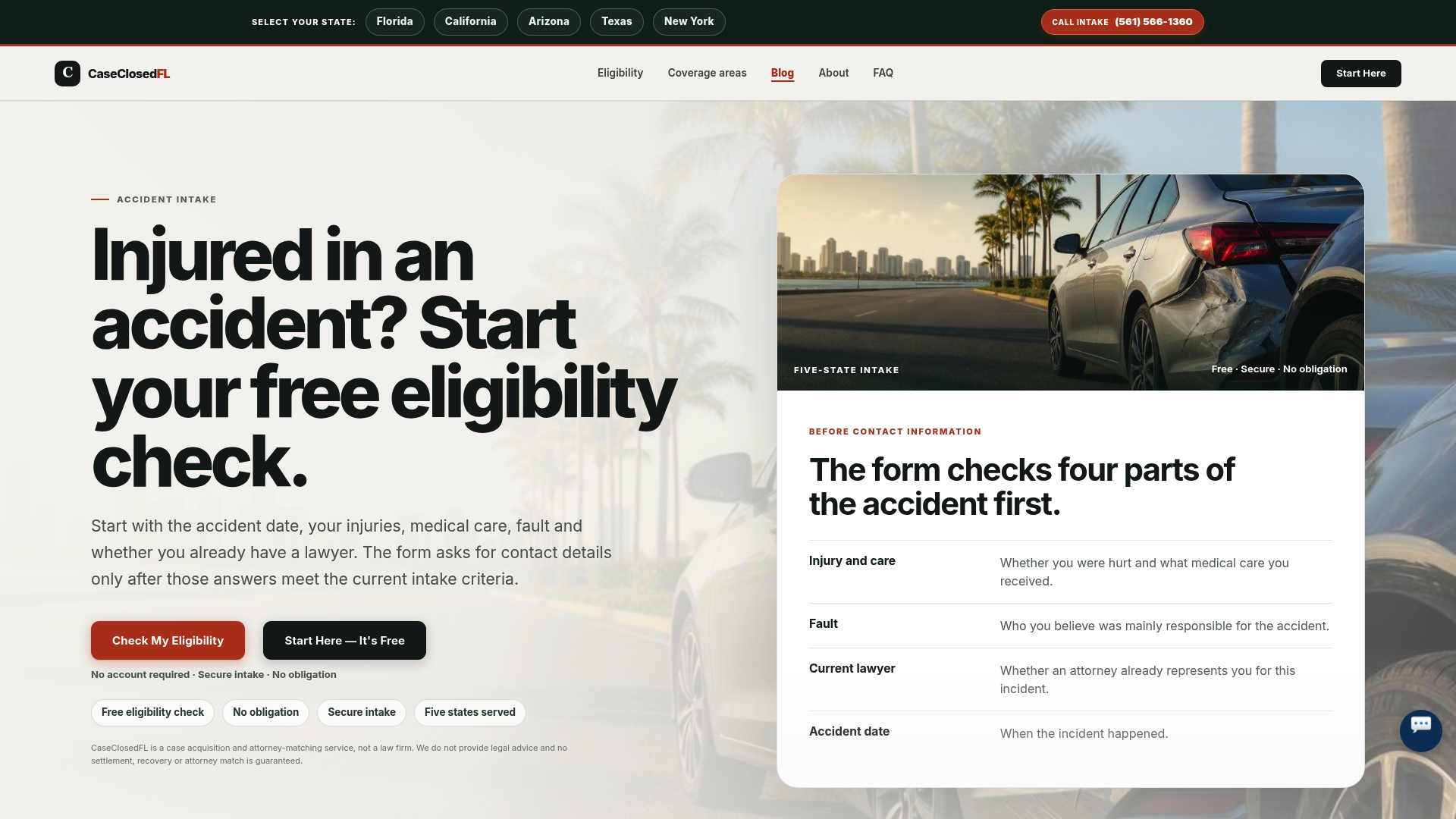
Caseclosedfl runs a free eligibility check that collects the details of your accident, injury, and current claim status before ever asking for your personal contact information. That order matters: instead of selling your information to every firm bidding for leads, Caseclosedfl reviews each submission by hand and only connects you with a participating attorney if your case appears to fit. The intake covers accident types including car, truck, motorcycle, and rideshare incidents, and the service currently covers Florida, California, Arizona, Texas, and New York. Caseclosedfl doesn’t provide legal advice and doesn’t guarantee an attorney match or any particular outcome. If your denial involves a disputed accident claim rather than routine paperwork, start the free eligibility check to see whether an attorney review makes sense for your situation.
Where to Go for Official Appeal Forms and Timelines
For the exact federal rules on your rights, go straight to the source rather than a summary. The CMS overview of internal and external appeals lays out filing windows and insurer decision deadlines in plain terms. The NAIC’s consumer guide to appealing a denial includes a sample appeal letter and step-by-step filing instructions. Every state also maintains a Department of Insurance complaint portal, searchable by state name, for filing formal regulatory complaints.

This article is general information, not a substitute for advice from a qualified lawyer. Consult a qualified legal professional about your own circumstances before acting on anything here.
Sources
- Health Insurance Claim Denied? How to Appeal the Denial (NAIC)
- Why would my home insurance claim be denied or not paid? (Texas Department of Insurance)
- Appraisal clause use in property disputes (academic/practitioner note)
FAQ
Why Are My Insurance Claims Being Denied?
The most common causes are administrative errors like missing paperwork or wrong billing codes, followed by coverage exclusions, medical necessity disputes, and eligibility or timing problems. Many of these are correctable once you or your provider identify the exact reason code on the denial letter.
Which Insurance Has the Most Denied Claims?
Denial rates vary significantly by insurer, plan type, and claim category, and no single company consistently tops every list. Rather than chasing rankings, focus on your own denial’s specific reason code and your plan’s appeal rights, since most denials trace back to fixable administrative issues rather than a companywide pattern.
How Can Insurance Companies Legally Deny Claims?
Insurers can deny claims for reasons tied to policy exclusions, lack of medical necessity, missed deadlines, or eligibility problems, but they must state the specific reason in writing under NAIC consumer protection standards. A denial without a clear, specific explanation is itself grounds for an appeal or a state complaint.
What Should I Do if My Insurance Claim Is Denied?
Save the denial letter, note the deadline for appeal, and contact your provider’s billing office to rule out simple errors. If the issue isn’t administrative, file a written internal appeal with supporting documentation, and if that’s denied, you generally have about four months to request an external review. For claims involving a disputed accident injury, a service like Caseclosedfl’s free eligibility check can help you find out whether attorney involvement makes sense.
Recommended
Frequently asked questions
Table of Contents What to Do in the First 24 to 72 Hours After a Claim Denial Common Reasons Claims Get Denied (and What Fixes Each One) How Appeals Actually Work: Internal, Expedited, and External Review The Deadlines Hiding in Your Denial Letter Building an Appeal Packet That Actually Gets Read When and How to File a State Complaint Deciding Whether You Need a Lawyer What Realistically Happens After You Push Back Finding Legal Help Through Caseclosedfl Where to Go for Official Appeal Forms and Timelines Sources FAQ What to Do in the First 24 to 72 Hours After a Claim Denial Speed matters more than most people realize. Insurers and providers correct administrative errors far more easily when you catch them early, before records get archived or staff turnover buries the details. Work through these steps in order: Locate and save the written denial notice. Every legitimate denial includes a specific reason code and explanation, required under NAIC consumer guidance . Identify the exact denial code and reason rather than assuming it was a blanket rejection. Start a claim folder or spreadsheet logging every call, email, and letter with dates and names. Call your provider’s billing office to check for coding mistakes, duplicate submissions, or missing paperwork. Call the insurer directly and ask what specific document or correction would change the outcome. Request a supporting letter from your provider if medical necessity is the issue, then decide whether to resubmit or file a formal appeal. Pro Tip: Ask the insurer’s representative to email you a summary of the call. A written record carries far more weight than your memory of what someone said on the phone. Common Reasons Claims Get Denied (and What Fixes Each One) Administrative mistakes account for a large share of initial denials, and they’re often the easiest to reverse. Massachusetts Health Policy Commission research points to billing errors and paperwork gaps as a leading driver of rejected claims that get overturned once corrected. Administrative errors: missing forms, wrong billing codes, or duplicate submissions. A provider resubmission often resolves this within days. Coverage exclusions: the treatment or loss falls outside your policy’s terms. Pull your Summary of Benefits and read the exact exclusion language before assuming the denial is final. Medical necessity or “experimental” labels: ask your physician for a detailed letter or request a peer-to-peer review between your doctor and the insurer’s medical reviewer. Eligibility or timing issues: confirm your coverage effective dates, enrollment status, and whether preauthorization was required before you received treatment. For homeowners, the Texas Department of Insurance notes that excluded perils and deductible disputes are common culprits worth double-checking against your policy language. How Appeals Actually Work: Internal, Expedited, and External Review Health insurance denials follow a two-tier system, and understanding both tiers changes how you plan your response. Internal appeals come first. You, or someone you authorize in writing, can file one, usually in writing, though urgent cases sometimes allow an oral request. Health plans generally give you up to 180 days from the denial to file, and insurers must decide within set timeframes, typically 30 to 60 days depending on the claim type . External review kicks in once your internal appeal is denied. An independent review organization, unaffiliated with your insurer, examines the case fresh. You generally have a few months from the final internal denial to request external review. Standard decisions typically arrive within several weeks. Expedited reviews, for urgent medical situations, are decided within a few days, according to federal guidance on the external review process. External review typically applies to disputes over medical necessity, experimental treatment labels, or policy rescission. It usually doesn’t cover plan design choices, like a benefit your policy simply never included in the first place. When 72 hours matters: if a delay could seriously jeopardize your health or ability to function, ask explicitly for expedited review when you file. State the medical urgency in writing and request that both your internal appeal and external review run on the expedited track simultaneously where your plan allows it. The Deadlines Hiding in Your Denial Letter Every denial letter contains four pieces of information you need to extract immediately: the denial code, the insurer’s stated rationale, instructions for appealing, and the specific deadline for each step. Claim type Filing window Decision timeframe Health plan internal appeal Up to 180 days from denial Commonly 30 to 60 days Health plan external review About 4 months from final internal denial 45 days standard, 72 hours expedited Auto/home complaint to state DOI Often 30 to 60 days, varies by state Varies by state agency Write down the date you received the denial, not the date it was mailed. When you do appeal, keep proof of submission, whether that’s a certified mail receipt or a portal confirmation screenshot. Building an Appeal Packet That Actually Gets Read Reviewers move faster on appeals that are organized and factual. Skip the emotional narrative and lead with documentation. Gather the essentials: denial letter, Explanation of Benefits (EOB) statements, claim numbers, medical records or repair estimates, and any provider letters addressing necessity or causation. Structure the letter simply: identify the claim number, state the facts in a few sentences, cite the specific policy language or clinical justification, attach your new evidence, and state exactly what remedy you want. Send it trackable. Use certified mail or the insurer’s online portal, and request written confirmation of receipt. Attach a short timeline of prior contacts, including dates and names, as a one-page appendix. Pro Tip: Forbes Advisor’s research on filing insurance complaints found that concise letters citing exact policy language outperform long, emotional appeals. Reviewers respond to specifics, not frustration. When and How to File a State Complaint Filing a complaint with your state Department of Insurance isn’t a last resort. It’s a normal regulatory step, and it often prompts insurers to give a claim a second, more serious look. File a DOI complaint when the insurer stops responding, appears to be violating claims-handling rules, or the pattern of denials looks like bad faith rather than a one-off mistake. Include a written timeline of every contact with dates. Attach the original denial letter and copies of your appeal materials. Add your communications log showing names and outcomes of each call. Expect the DOI to request the insurer’s claim file and investigate, though remedies vary by state and resolution commonly takes 30 to 90 days. For Medicare issues, call 1-800-MEDICARE; for Medicaid, contact your state Medicaid agency directly for appeal assistance. Deciding Whether You Need a Lawyer Not every denial needs an attorney. But some situations call for one, and recognizing which is which saves time and money. Consider legal representation when you suspect bad faith, when the dollar amount at stake is large, or when liability is genuinely disputed and litigation looks likely. A lawyer can request your full claim file from the insurer, evaluate whether the denial pattern rises to bad faith, and negotiate a settlement or prepare for trial if needed. For property claims specifically, check your policy for an appraisal clause first. Appraisal provisions offer a formal, often less expensive way to resolve disputes over the amount of a loss without going to court. Independent public adjusters, legal aid organizations, and state consumer assistance programs offer lower-cost alternatives worth exploring before committing to litigation. Before contacting anyone, assemble your appeal packet and timeline. It’s the first thing any attorney or adjuster will ask for. What Realistically Happens After You Push Back Most denials resolve without a lawsuit when someone documents the case thoroughly and moves fast. A tight, factual appeal letter with the right attachments does more to change an outcome than persistence alone. Regulators and attorneys have their place, but they’re tools for the cases that genuinely need them, not the default first step. — Luis Finding Legal Help Through Caseclosedfl Some denials go beyond a documentation fix. If you suspect bad faith, you’re facing a large claim, or an insurer keeps denying a legitimate accident-related injury claim, it may be time to find out whether an attorney can help. Caseclosedfl runs a free eligibility check that collects the details of your accident, injury, and current claim status before ever asking for your personal contact information. That order matters: instead of selling your information to every firm bidding for leads, Caseclosedfl reviews each submission by hand and only connects you with a participating attorney if your case appears to fit. The intake covers accident types including car, truck, motorcycle, and rideshare incidents, and the service currently covers Florida, California, Arizona, Texas, and New York . Caseclosedfl doesn’t provide legal advice and doesn’t guarantee an attorney match or any particular outcome. If your denial involves a disputed accident claim rather than routine paperwork, start the free eligibility check to see whether an attorney review makes sense for your situation. Where to Go for Official Appeal Forms and Timelines For the exact federal rules on your rights, go straight to the source rather than a summary. The CMS overview of internal and external appeals lays out filing windows and insurer decision deadlines in plain terms. The NAIC’s consumer guide to appealing a denial includes a sample appeal letter and step-by-step filing instructions. Every state also maintains a Department of Insurance complaint portal, searchable by state name, for filing formal regulatory complaints. This article is general information, not a substitute for advice from a qualified lawyer. Consult a qualified legal professional about your own circumstances before acting on anything here. Sources Health Insurance Claim Denied? How to Appeal the Denial (NAIC) Why would my home insurance claim be denied or not paid? (Texas Department of Insurance) Appraisal clause use in property disputes (academic/practitioner note) FAQ Why Are My Insurance Claims Being Denied?
The most common causes are administrative errors like missing paperwork or wrong billing codes, followed by coverage exclusions, medical necessity disputes, and eligibility or timing problems. Many of these are correctable once you or your provider identify the exact reason code on the denial letter.
Which Insurance Has the Most Denied Claims?
Denial rates vary significantly by insurer, plan type, and claim category, and no single company consistently tops every list. Rather than chasing rankings, focus on your own denial’s specific reason code and your plan’s appeal rights, since most denials trace back to fixable administrative issues rather than a companywide pattern.
How Can Insurance Companies Legally Deny Claims?
Insurers can deny claims for reasons tied to policy exclusions, lack of medical necessity, missed deadlines, or eligibility problems, but they must state the specific reason in writing under NAIC consumer protection standards. A denial without a clear, specific explanation is itself grounds for an appeal or a state complaint.
What Should I Do if My Insurance Claim Is Denied?
Save the denial letter, note the deadline for appeal, and contact your provider’s billing office to rule out simple errors. If the issue isn’t administrative, file a written internal appeal with supporting documentation, and if that’s denied, you generally have about four months to request an external review. For claims involving a disputed accident injury, a service like Caseclosedfl’s free eligibility check can help you find out whether attorney involvement makes sense.
Ready to enter the accident details?
The eligibility form asks about the accident, injury, treatment, fault and representation before contact information.
Start Eligibility Check