Accident Victims: Legal Intake That Keeps Your Contact Private
Learn how a privacy-first legal intake gathers accident facts before asking contact details, reduces unsolicited calls, and uses human review before...


A privacy-first legal intake process is an eligibility screening that collects accident and injury facts before asking for your name, phone number, or e-mail. We built our free eligibility check around this order on purpose: it limits unwanted solicitation and keeps your contact details out of circulation until a submission actually qualifies for a human-reviewed referral to a personal-injury attorney.
TL;DR:
- A privacy-first legal intake form asks injury and incident details before contact information to reduce unwanted solicitations and improve referral accuracy.
- Human review of submissions ensures only eligible cases are referred, preventing low-quality or irrelevant cases from being resold as leads.
- Legitimate forms clearly disclose data sharing policies, require contact info only after eligibility questions, and offer opt-out options to protect user privacy.
- Before submitting, gather accident date, location, police report, witness contacts, and medical info; full medical records and Social Security numbers are unnecessary initially.
- The referral process connects you with an attorney for a consultation, but no legal relationship forms until both agree, and the initial eligibility check is free.
Table of Contents
- How a privacy-first legal intake process works
- What intake forms typically ask for: a privacy-minded checklist
- Privacy, consent, and red flags to watch for
- What happens after you submit your information
- How to prepare before you use an intake form
- Questions to ask if an attorney follows up
- Why we built our intake around privacy first
- Start a free eligibility check with CaseClosedFL
- FAQ
- Sources
- Primary sources and next steps
How a privacy-first legal intake process works
The flow runs in a set order. First, we ask about the incident itself: what happened, when, and where. Next come eligibility questions covering injury type, medical treatment, and whether you already have a lawyer. Only after these answers suggest a case may qualify does the form ask for contact information, and a person reviews the submission before any referral goes out. No step guarantees a match with an attorney.
This sequence is different from standard lead forms, which often ask for your phone number and e-mail on the first screen regardless of whether your situation qualifies for anything. Those forms exist to collect contact details for resale, not to screen for fit.
Asking about injury, treatment, and representation status before contact information serves two purposes: it improves the accuracy of who gets referred where, and it reduces the number of accident victims who end up fielding unsolicited calls after describing a case that never had a real chance of moving forward.

What intake forms typically ask for: a privacy-minded checklist
Most eligibility screens for accident and injury cases ask for a similar set of facts before anything else. Expect questions like these:
- Date, time, and general location of the accident
- Type of injury and whether you received medical treatment
- Whether you currently have legal representation
- Basic details about the vehicles or parties involved
- A short description of how the incident happened
Contact details such as your phone number or e-mail typically come after this preliminary screen, once the answers suggest your case fits the criteria attorneys in your area are looking for.
Some fields should wait. Your Social Security number and full medical records are not needed to determine basic eligibility, and a legitimate intake process will not ask for them up front. Those items may become relevant later, once an attorney has agreed to review your case and needs documentation to evaluate it properly.
Privacy, consent, and red flags to watch for
Not every intake form online is built the way it should be. The FTC’s 2024 settlement with a California-based lead generator describes a pattern worth knowing: so-called “consent farms” collect consumer information, package it as leads, and sell it in ways that have led to illegal robocalls and calls to numbers on the Do-Not-Call Registry.
The FTC has taken enforcement action banning certain lead generators from making or assisting illegal robocalls tied to sold consumer data, which shows regulators are actively policing this corner of the industry.
Before submitting any accident details, check for these signs:
- A privacy policy that clearly states whether your data is sold or shared with third parties
- Consent language that is specific rather than buried in vague legal boilerplate
- No requirement to fill in contact fields before you have answered eligibility questions
- A stated human-review step before any referral is made
- A visible way to opt out of further contact
If a form forces your phone number before asking a single question about your accident, that is a signal to look elsewhere.
What happens after you submit your information
Once a submission comes in, it goes through human review rather than automatic routing to the highest bidder. That step filters out cases that do not meet basic criteria and keeps low-quality submissions from being resold as leads, which is part of why review takes a little longer than an instant auto-match.

Timelines vary, but a reviewed submission that qualifies typically moves to attorney contact within a short window after review. A referral at this stage is not the same as hiring a lawyer. It connects you with an attorney for a consultation, and no attorney-client relationship exists until you and that attorney agree to one.
If you decide you no longer want to be contacted, ask how to opt out or request removal. A legitimate intake process will have a clear answer.
How to prepare before you use an intake form
Gathering a few details ahead of time makes the eligibility check faster and more accurate, without requiring you to hand over anything sensitive.
- Write down the date, time, and location of the accident.
- Note the police report number if one was filed.
- Collect witness names and contact information if available.
- List the names of medical providers and dates of treatment.
- Save photos of the scene, vehicles, or visible injuries.
The NAIC’s guidance on filing an auto claim recommends documenting a crash thoroughly, including using tools like WreckCheck, while sharing only the information that is actually necessary at each step.
Symptom tracking matters too, especially for head injuries. CDC discharge instructions for concussion advise keeping a timeline of symptoms, since some signs appear days after the initial injury and can matter for both medical care and any later legal claim.
Pro Tip: Keep a simple notes file with dates, provider names, and symptom changes. You can share it when an attorney actually asks, rather than reconstructing it from memory later.
Billing statements and insurance correspondence can help an attorney evaluate your case, but there is no need to send them during the initial eligibility check. Share them only once someone specifically requests them.
Questions to ask if an attorney follows up
Once a reviewed submission leads to attorney contact, the consultation is your chance to evaluate fit. The American Bar Association’s guidance for prospective clients frames this plainly: you are hiring someone, so asking direct questions is appropriate.
- Has this attorney or firm handled cases similar to yours before?
- How does the contingency fee work, and what happens if the case does not succeed?
- Who on the team will actually handle your matter day to day?
- How often will you receive updates, and through what method?
- When might you be asked to provide full medical records or billing details?
Confidentiality matters here too. Under ABA Model Rule 1.18 commentary on prospective clients, information you share during intake can carry confidentiality protections even before any formal representation begins. Asking about fees or team structure up front is normal and does not suggest you are uncommitted.
Why we built our intake around privacy first
We ask for accident and injury facts before contact details because that order protects people who are already dealing with enough. Collecting eligibility information first means a submission has to show a real basis before anyone’s phone number enters the picture, and a human reviews every submission before a referral goes out. We serve accident victims across multiple states, and the same sequence applies in each location.
— Luis
Start a free eligibility check with CaseClosedFL
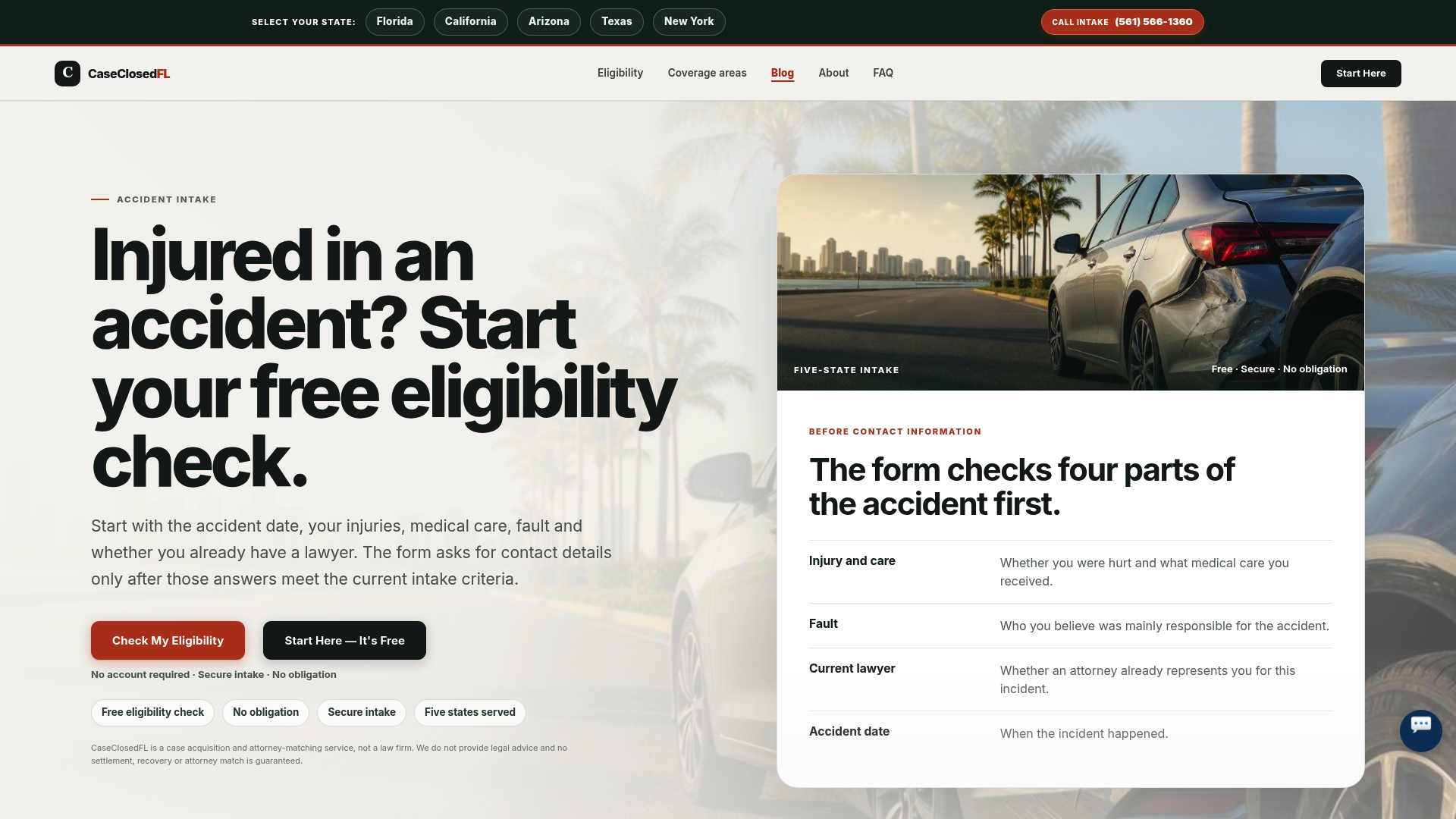
Our free eligibility check asks about your accident, injury, treatment, and current representation status first. There is no cost and no obligation to proceed.
- Answer a short set of questions about what happened and your injuries
- Contact information is requested only after your answers pass the initial screen
- A human reviews your submission before any referral to an attorney
If you are ready to see whether your situation qualifies, start the eligibility check on our landing page.
This article is general information, not a substitute for advice from a qualified lawyer. Consult a qualified legal professional about your own circumstances before acting on anything here.
FAQ
What is a legal intake process for accident claims?
It is an eligibility screening that gathers details about your accident, injury, and treatment before asking for contact information. The goal is to confirm a case fits what participating attorneys are looking for before any referral is made.
Is my information sold to multiple law firms at once?
Legitimate intake processes disclose this in their privacy policy, and you should read it before submitting details. The FTC has taken enforcement action against lead generators that sold consumer data without proper consent, so checking for clear disclosure matters.
Does submitting an intake form mean I have hired a lawyer?
No. A referral connects you with an attorney for a consultation, and no attorney-client relationship exists until both sides agree to one. Many intake disclosures you share beforehand may still carry confidentiality protections as a prospective client.
What should I have ready before starting an eligibility check?
Gather the accident date, location, police report number, witness names, and medical provider details if you have them. You do not need your Social Security number or full medical records for an initial screen.
Does CaseClosedFL charge accident victims for the eligibility check?
No. Our eligibility check is free for accident victims, and we do not guarantee a match with an attorney.
Sources
- FTC press release: California-based lead generator agrees to settlement banning certain activities
- American Bar Association — Questions to ask a prospective lawyer
- CDC — Traumatic Brain Injury & Concussion discharge instructions (PDF)
- NAIC — What you should know about filing an auto claim
- Legal Services Corporation — I need legal help
Primary sources and next steps
Frequently asked questions
Table of Contents How a privacy-first legal intake process works What intake forms typically ask for: a privacy-minded checklist Privacy, consent, and red flags to watch for What happens after you submit your information How to prepare before you use an intake form Questions to ask if an attorney follows up Why we built our intake around privacy first Start a free eligibility check with CaseClosedFL FAQ Sources Primary sources and next steps How a privacy-first legal intake process works The flow runs in a set order. First, we ask about the incident itself: what happened, when, and where. Next come eligibility questions covering injury type, medical treatment, and whether you already have a lawyer. Only after these answers suggest a case may qualify does the form ask for contact information, and a person reviews the submission before any referral goes out. No step guarantees a match with an attorney. This sequence is different from standard lead forms, which often ask for your phone number and e-mail on the first screen regardless of whether your situation qualifies for anything. Those forms exist to collect contact details for resale, not to screen for fit. Asking about injury, treatment, and representation status before contact information serves two purposes: it improves the accuracy of who gets referred where, and it reduces the number of accident victims who end up fielding unsolicited calls after describing a case that never had a real chance of moving forward. What intake forms typically ask for: a privacy-minded checklist Most eligibility screens for accident and injury cases ask for a similar set of facts before anything else. Expect questions like these: Date, time, and general location of the accident Type of injury and whether you received medical treatment Whether you currently have legal representation Basic details about the vehicles or parties involved A short description of how the incident happened Contact details such as your phone number or e-mail typically come after this preliminary screen, once the answers suggest your case fits the criteria attorneys in your area are looking for. Some fields should wait. Your Social Security number and full medical records are not needed to determine basic eligibility, and a legitimate intake process will not ask for them up front. Those items may become relevant later, once an attorney has agreed to review your case and needs documentation to evaluate it properly. Privacy, consent, and red flags to watch for Not every intake form online is built the way it should be. The FTC’s 2024 settlement with a California-based lead generator describes a pattern worth knowing: so-called “consent farms” collect consumer information, package it as leads, and sell it in ways that have led to illegal robocalls and calls to numbers on the Do-Not-Call Registry. The FTC has taken enforcement action banning certain lead generators from making or assisting illegal robocalls tied to sold consumer data , which shows regulators are actively policing this corner of the industry. Before submitting any accident details, check for these signs: A privacy policy that clearly states whether your data is sold or shared with third parties Consent language that is specific rather than buried in vague legal boilerplate No requirement to fill in contact fields before you have answered eligibility questions A stated human-review step before any referral is made A visible way to opt out of further contact If a form forces your phone number before asking a single question about your accident, that is a signal to look elsewhere. What happens after you submit your information Once a submission comes in, it goes through human review rather than automatic routing to the highest bidder. That step filters out cases that do not meet basic criteria and keeps low-quality submissions from being resold as leads, which is part of why review takes a little longer than an instant auto-match. Timelines vary, but a reviewed submission that qualifies typically moves to attorney contact within a short window after review. A referral at this stage is not the same as hiring a lawyer. It connects you with an attorney for a consultation, and no attorney-client relationship exists until you and that attorney agree to one. If you decide you no longer want to be contacted, ask how to opt out or request removal. A legitimate intake process will have a clear answer. How to prepare before you use an intake form Gathering a few details ahead of time makes the eligibility check faster and more accurate, without requiring you to hand over anything sensitive. Write down the date, time, and location of the accident. Note the police report number if one was filed. Collect witness names and contact information if available. List the names of medical providers and dates of treatment. Save photos of the scene, vehicles, or visible injuries. The NAIC’s guidance on filing an auto claim recommends documenting a crash thoroughly, including using tools like WreckCheck, while sharing only the information that is actually necessary at each step. Symptom tracking matters too, especially for head injuries. CDC discharge instructions for concussion advise keeping a timeline of symptoms, since some signs appear days after the initial injury and can matter for both medical care and any later legal claim. Pro Tip: Keep a simple notes file with dates, provider names, and symptom changes. You can share it when an attorney actually asks, rather than reconstructing it from memory later. Billing statements and insurance correspondence can help an attorney evaluate your case, but there is no need to send them during the initial eligibility check. Share them only once someone specifically requests them. Questions to ask if an attorney follows up Once a reviewed submission leads to attorney contact, the consultation is your chance to evaluate fit. The American Bar Association’s guidance for prospective clients frames this plainly: you are hiring someone, so asking direct questions is appropriate. Has this attorney or firm handled cases similar to yours before? How does the contingency fee work, and what happens if the case does not succeed? Who on the team will actually handle your matter day to day? How often will you receive updates, and through what method? When might you be asked to provide full medical records or billing details? Confidentiality matters here too. Under ABA Model Rule 1.18 commentary on prospective clients, information you share during intake can carry confidentiality protections even before any formal representation begins. Asking about fees or team structure up front is normal and does not suggest you are uncommitted. Why we built our intake around privacy first We ask for accident and injury facts before contact details because that order protects people who are already dealing with enough. Collecting eligibility information first means a submission has to show a real basis before anyone’s phone number enters the picture, and a human reviews every submission before a referral goes out. We serve accident victims across multiple states, and the same sequence applies in each location. — Luis Start a free eligibility check with CaseClosedFL Our free eligibility check asks about your accident, injury, treatment, and current representation status first. There is no cost and no obligation to proceed. Answer a short set of questions about what happened and your injuries Contact information is requested only after your answers pass the initial screen A human reviews your submission before any referral to an attorney If you are ready to see whether your situation qualifies, start the eligibility check on our landing page. This article is general information, not a substitute for advice from a qualified lawyer. Consult a qualified legal professional about your own circumstances before acting on anything here. FAQ What is a legal intake process for accident claims?
It is an eligibility screening that gathers details about your accident, injury, and treatment before asking for contact information. The goal is to confirm a case fits what participating attorneys are looking for before any referral is made.
Is my information sold to multiple law firms at once?
Legitimate intake processes disclose this in their privacy policy, and you should read it before submitting details. The FTC has taken enforcement action against lead generators that sold consumer data without proper consent, so checking for clear disclosure matters.
Does submitting an intake form mean I have hired a lawyer?
No. A referral connects you with an attorney for a consultation, and no attorney-client relationship exists until both sides agree to one. Many intake disclosures you share beforehand may still carry confidentiality protections as a prospective client.
What should I have ready before starting an eligibility check?
Gather the accident date, location, police report number, witness names, and medical provider details if you have them. You do not need your Social Security number or full medical records for an initial screen.
Does CaseClosedFL charge accident victims for the eligibility check?
No. Our eligibility check is free for accident victims, and we do not guarantee a match with an attorney.
Ready to enter the accident details?
The eligibility form asks about the accident, injury, treatment, fault and representation before contact information.
Start Eligibility Check