U.S. Drivers: MedPay vs PIP — 4 Questions to Spot Subrogation Risk
MedPay vs PIP for U.S. drivers: learn when $1,000–$10,000 MedPay limits leave gaps, how subrogation can reduce recovery, and when to start CaseClosedFL's...


PIP is the broader coverage where insurers offer it, because it pays medical bills, a share of lost wages, and replacement services like childcare or housekeeping regardless of who caused the crash. MedPay covers medical and funeral costs only, usually with lower limits. If your state does not require or sell PIP, MedPay still fills a real gap by paying first, without a deductible, while your health insurance sorts out the rest. Check your policy’s declarations page to see which one you actually carry.
TL;DR:
- PIP typically offers higher coverage benefits, including lost wages and replacement services, which MedPay does not provide, especially important in serious injuries.
- States with no-fault systems generally require PIP and limit lawsuits for pain and suffering, making PIP more critical where mandated.
- Coverage limits vary widely; low MedPay limits may be exhausted quickly in serious accidents, while high PIP limits can cover extensive medical costs and income loss.
- Carrying both coverages is usually redundant unless your PIP limits are low, and it’s essential to understand subrogation clauses that may reclaim insurer payments from settlement recoveries.
- Verify your specific state requirements and policy details to determine if PIP, MedPay, or both best suit your needs, particularly if you are self-employed or have dependents relying on your coverage.
Table of Contents
- MedPay vs PIP: What Each One Actually Pays For
- Does Your State Require PIP or MedPay?
- Who Pays First: Coordinating With Health Insurance
- How Much Coverage Do You Actually Need?
- MedPay, PIP, or Both? A Decision Checklist
- When a Coverage Gap Points to a Legal Issue
- An Honest Take on the MedPay vs. PIP Debate
- Get a Free Case Review if Your Coverage Falls Short
- Where to Verify These Numbers Yourself
- Sources
- FAQ
MedPay vs PIP: What Each One Actually Pays For
The two coverages sound similar and often get confused, but they solve different problems. PIP covers medical bills, lost wages, and replacement services such as childcare or housework for you and your passengers, no matter who caused the crash. MedPay is narrower by design. It pays medical and funeral expenses up to your policy limit, and nothing else.
The difference shows up fast in real claims. A driver with a broken wrist who needs an ambulance ride and an ER visit might see MedPay handle the whole bill. A driver with a herniated disc who misses ten weeks of work needs the lost-wage and rehab benefits that only PIP provides.
- PIP: medical bills, lost wages (a percentage, not full pay), replacement services, rehabilitation, sometimes death benefits.
- MedPay: medical and funeral expenses only, typically first dollar with no deductible.
- PIP quirk: some states allow deductibles or copays that delay full reimbursement.
- MedPay quirk: limits are low, so serious injuries burn through it fast.
Does Your State Require PIP or MedPay?
Where you live determines whether this comparison even matters. Roughly a dozen states run on a no-fault system that mandates PIP in some form, including Florida, New York, and Michigan. In these states, your own insurer pays your medical bills and lost wages first, regardless of fault, and that structure usually comes with a lawsuit threshold. You typically cannot sue the at-fault driver for pain and suffering unless your injury clears a state-defined severity bar.
MedPay works differently. It is generally optional everywhere, including in no-fault states, where insurers often sell it as a supplement to PIP rather than a replacement for it.
- No-fault states generally require PIP with minimum limits set by state law.
- Tort states let you sue the at-fault driver directly, and PIP is rare there.
- MedPay is optional almost everywhere and stacks on top of whatever else you carry.
- Minimum limits vary widely, so check your state insurance department’s site or your own policy.
Who Pays First: Coordinating With Health Insurance
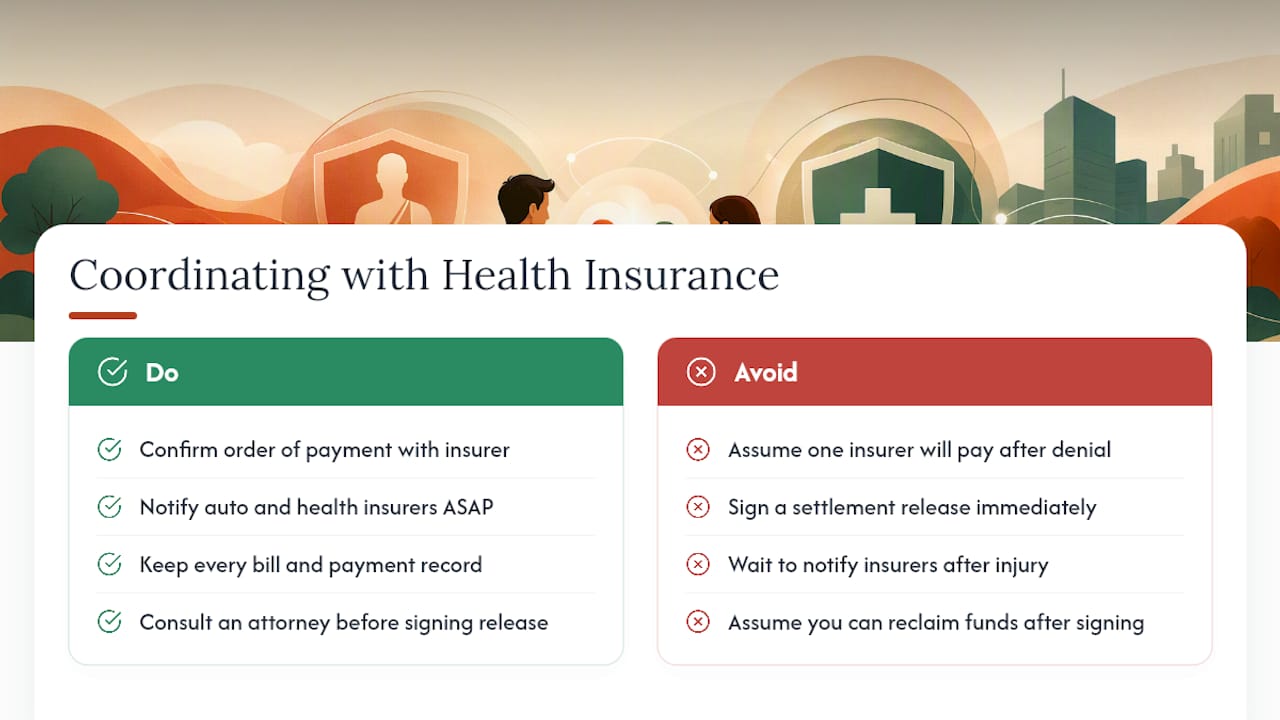
PIP and MedPay generally pay before your health insurance kicks in for accident-related treatment, but the exact order depends on your state and your policy language. Confirm this with your insurer before assuming one will cover a bill the other already denied.
Subrogation is the part most drivers never see coming. If your auto insurer pays your medical bills through PIP or MedPay and you later win a settlement or judgment from the at-fault driver, the insurer may have the right to reclaim what it paid out of your recovery. That can shrink a settlement you were counting on to cover the gaps insurance never touched.
Notify both your auto and health insurers as soon as you’re injured, and keep every bill and payment record. If your PIP or MedPay limits run out before treatment ends, talk to an attorney before you sign a settlement release. Once you sign, you generally cannot go back for more.
How Much Coverage Do You Actually Need?
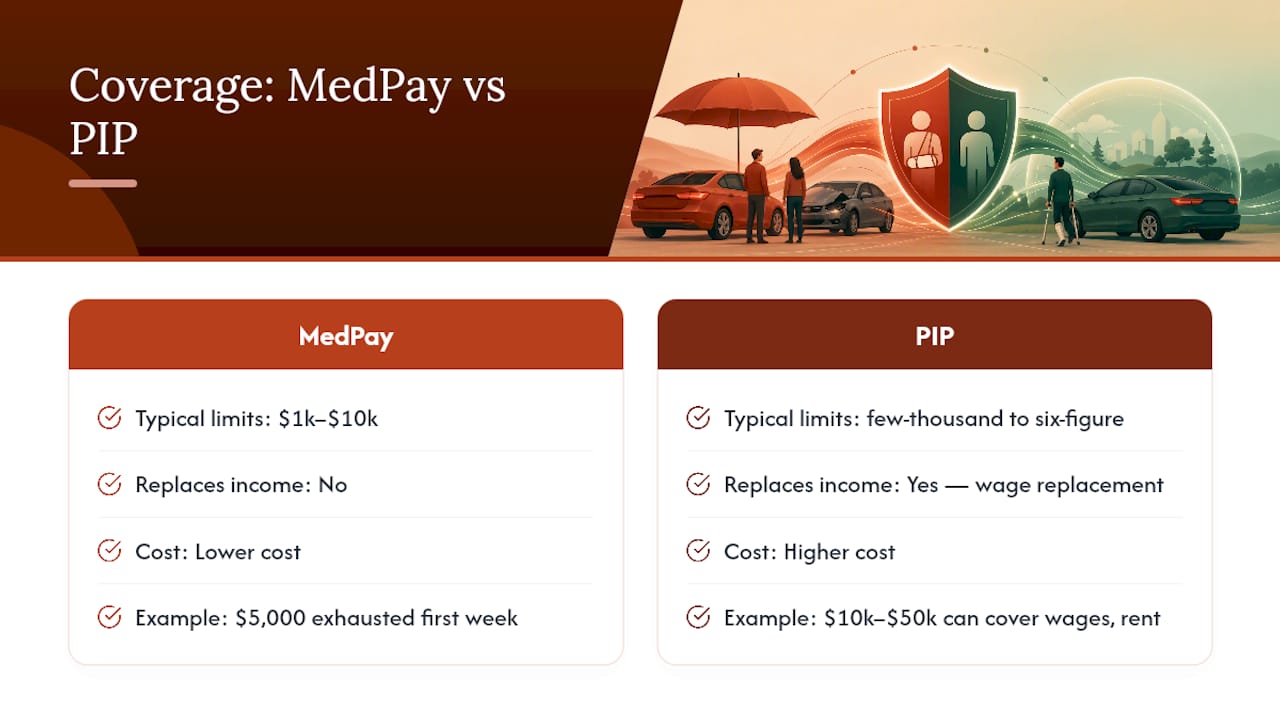
MedPay limits typically run between $1,000 and $10,000, which sounds reasonable until you compare it to a single night in the hospital. PIP limits vary far more by state, from a few thousand dollars in minimum-coverage states to six-figure policies for drivers who buy up.
The trade-off is straightforward: PIP costs more, but it’s the only one of the two that replaces income. Many PIP policies pay a substantial portion of lost wages, up to a policy cap, which matters enormously if you’re hourly, self-employed, or otherwise not collecting a paycheck while you recover.
Picture a driver hospitalized after a highway crash, needing surgery and months of physical therapy. A $5,000 MedPay limit disappears in the first week. A PIP policy with a $10,000 or $50,000 limit, plus wage replacement, is the difference between recovering financially and falling behind on rent while you heal.
MedPay, PIP, or Both? A Decision Checklist
Work through these questions in order, and the right answer usually becomes obvious by the third one.
- Does your state require PIP? If yes, you likely already have it, and the real decision is whether to raise the limit.
- What’s your health insurance deductible? A high-deductible plan makes MedPay or PIP more valuable as first-dollar protection.
- Are you paid hourly, salaried, or self-employed? Hourly and self-employed workers should favor PIP for the wage-replacement benefit; salaried workers with strong sick leave may find MedPay sufficient.
- Do you have dependents who rely on you for childcare or household work? If yes, PIP’s replacement-services benefit matters more than it looks on paper.
Buying both usually creates overlap rather than better protection, since PIP already includes most of what MedPay offers. Stacking both makes sense mainly when your state’s PIP limits are low and you want extra first-dollar cushion for a fast-moving claim.
Pro Tip: Before you count on MedPay as backup coverage, read the subrogation clause in your policy. Some insurers can claw back what they paid you if you later win a settlement, which quietly reduces the safety net you thought you had.
When a Coverage Gap Points to a Legal Issue
If your MedPay or PIP limits run out before your treatment does, or your insurer disputes a claim tied to subrogation, that’s usually the point where a conversation with an attorney pays for itself. Caseclosedfl’s eligibility intake walks you through a brief set of questions about your injury, fault, and current coverage, with no obligation and no pressure. A human reviews your answers before anyone requests your contact information, and the process covers Florida along with several other states.
An Honest Take on the MedPay vs. PIP Debate
Most drivers treat this choice as a coin flip when it usually isn’t. PIP wins on paper almost every time it’s available, because wage replacement is the benefit people underestimate until they’re the ones missing paychecks. MedPay earns its keep in tort states and as a fast, deductible-free backstop, not as a substitute for real income protection. Pull your declarations page today. If the numbers look thin against a real hospital stay, that’s your answer.
— Luis
Get a Free Case Review if Your Coverage Falls Short
If a gap between what your insurance actually pays and what your treatment actually costs is starting to show, a service gives you a faster path to answers than calling around law firms one by one. The intake takes a few minutes, asks about your injury, fault, and current coverage, and never asks for your contact information until a real person has reviewed your answers.
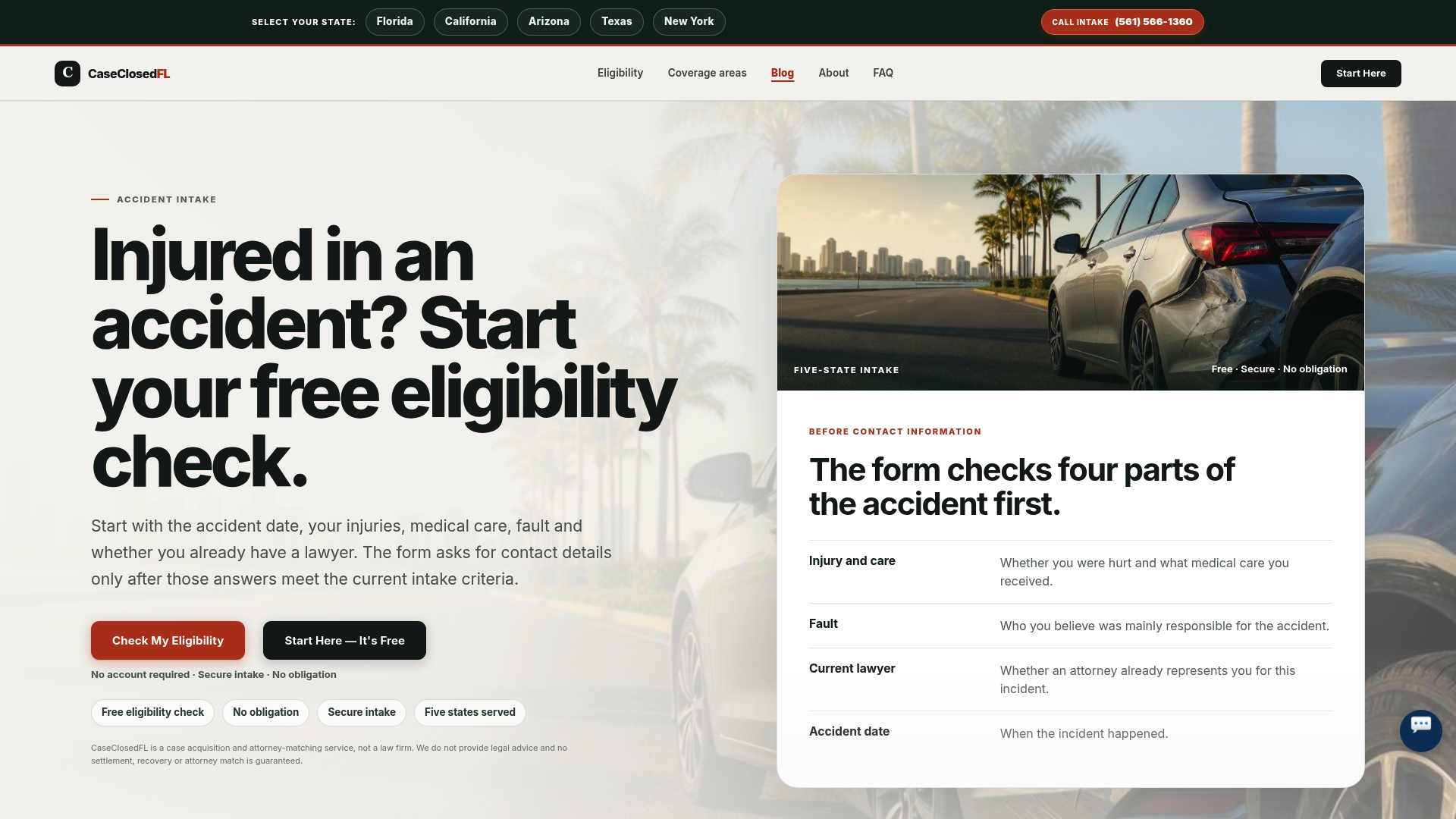
There’s no obligation and no cost to check where you stand. If you’re in South Florida, start with the Fort Lauderdale case review or the general eligibility check to see whether your situation is worth a closer look from a participating attorney.
Where to Verify These Numbers Yourself
- MoneyGeek’s PIP guide breaks down state-by-state PIP requirements.
- Forbes Advisor explains when carrying both coverages makes sense.
- Investopedia covers typical MedPay limits and mechanics.
- Your state insurance department’s website has the final word on your specific requirements.
This article is general information, not a substitute for advice from a qualified financial advisor. Consult a qualified financial professional about your own circumstances before acting on anything here.
Sources
- What Is Personal Injury Protection (PIP) And Do You Need It? — Forbes Advisor
- Medical payments coverage (MedPay) — Investopedia
FAQ
Is PIP better than MedPay?
PIP is generally the stronger coverage where it’s available, since it adds lost-wage and replacement-service benefits that MedPay doesn’t offer. MedPay still has value as a low-cost, deductible-free option in states where PIP isn’t sold or required.
Can you have both MedPay and PIP?
Yes, in most states you can carry both, though doing so is often redundant since PIP already includes the medical coverage MedPay provides. Stacking both makes more sense when your state’s PIP limits are low.
Does Texas have PIP or MedPay?
Texas is a tort state, and insurers there are required to offer PIP, though drivers can reject it in writing; MedPay is also available and commonly purchased as an alternative. Check your Texas policy’s declarations page to confirm which one you carry.
Is MedPay worth it?
MedPay is worth it if you want fast, deductible-free payment for medical bills, especially if you have a high health insurance deductible. It’s less valuable if you already have strong health coverage and low out-of-pocket costs, since the benefit mostly overlaps with what your health plan would pay anyway.
Recommended
Frequently asked questions
Table of Contents MedPay vs PIP: What Each One Actually Pays For Does Your State Require PIP or MedPay? Who Pays First: Coordinating With Health Insurance How Much Coverage Do You Actually Need? MedPay, PIP, or Both? A Decision Checklist When a Coverage Gap Points to a Legal Issue An Honest Take on the MedPay vs. PIP Debate Get a Free Case Review if Your Coverage Falls Short Where to Verify These Numbers Yourself Sources FAQ MedPay vs PIP: What Each One Actually Pays For The two coverages sound similar and often get confused, but they solve different problems. PIP covers medical bills, lost wages, and replacement services such as childcare or housework for you and your passengers, no matter who caused the crash. MedPay is narrower by design. It pays medical and funeral expenses up to your policy limit, and nothing else. The difference shows up fast in real claims. A driver with a broken wrist who needs an ambulance ride and an ER visit might see MedPay handle the whole bill. A driver with a herniated disc who misses ten weeks of work needs the lost-wage and rehab benefits that only PIP provides. PIP: medical bills, lost wages (a percentage, not full pay), replacement services, rehabilitation, sometimes death benefits. MedPay: medical and funeral expenses only, typically first dollar with no deductible. PIP quirk: some states allow deductibles or copays that delay full reimbursement. MedPay quirk: limits are low, so serious injuries burn through it fast. Does Your State Require PIP or MedPay?
Where you live determines whether this comparison even matters. Roughly a dozen states run on a no-fault system that mandates PIP in some form, including Florida, New York, and Michigan. In these states, your own insurer pays your medical bills and lost wages first, regardless of fault, and that structure usually comes with a lawsuit threshold. You typically cannot sue the at-fault driver for pain and suffering unless your injury clears a state-defined severity bar.
Who Pays First: Coordinating With Health Insurance PIP and MedPay generally pay before your health insurance kicks in for accident-related treatment, but the exact order depends on your state and your policy language. Confirm this with your insurer before assuming one will cover a bill the other already denied. Subrogation is the part most drivers never see coming. If your auto insurer pays your medical bills through PIP or MedPay and you later win a settlement or judgment from the at-fault driver, the insurer may have the right to reclaim what it paid out of your recovery. That can shrink a settlement you were counting on to cover the gaps insurance never touched. Notify both your auto and health insurers as soon as you’re injured, and keep every bill and payment record. If your PIP or MedPay limits run out before treatment ends, talk to an attorney before you sign a settlement release. Once you sign, you generally cannot go back for more. How Much Coverage Do You Actually Need?
MedPay limits typically run between $1,000 and $10,000 , which sounds reasonable until you compare it to a single night in the hospital. PIP limits vary far more by state, from a few thousand dollars in minimum-coverage states to six-figure policies for drivers who buy up.
MedPay, PIP, or Both? A Decision Checklist Work through these questions in order, and the right answer usually becomes obvious by the third one. Does your state require PIP? If yes, you likely already have it, and the real decision is whether to raise the limit. What’s your health insurance deductible? A high-deductible plan makes MedPay or PIP more valuable as first-dollar protection. Are you paid hourly, salaried, or self-employed? Hourly and self-employed workers should favor PIP for the wage-replacement benefit; salaried workers with strong sick leave may find MedPay sufficient. Do you have dependents who rely on you for childcare or household work? If yes, PIP’s replacement-services benefit matters more than it looks on paper. Buying both usually creates overlap rather than better protection , since PIP already includes most of what MedPay offers. Stacking both makes sense mainly when your state’s PIP limits are low and you want extra first-dollar cushion for a fast-moving claim. Pro Tip: Before you count on MedPay as backup coverage, read the subrogation clause in your policy. Some insurers can claw back what they paid you if you later win a settlement, which quietly reduces the safety net you thought you had. When a Coverage Gap Points to a Legal Issue If your MedPay or PIP limits run out before your treatment does, or your insurer disputes a claim tied to subrogation, that’s usually the point where a conversation with an attorney pays for itself. Caseclosedfl’s eligibility intake walks you through a brief set of questions about your injury, fault, and current coverage, with no obligation and no pressure. A human reviews your answers before anyone requests your contact information, and the process covers Florida along with several other states. An Honest Take on the MedPay vs. PIP Debate Most drivers treat this choice as a coin flip when it usually isn’t. PIP wins on paper almost every time it’s available, because wage replacement is the benefit people underestimate until they’re the ones missing paychecks. MedPay earns its keep in tort states and as a fast, deductible-free backstop, not as a substitute for real income protection. Pull your declarations page today. If the numbers look thin against a real hospital stay, that’s your answer. — Luis Get a Free Case Review if Your Coverage Falls Short If a gap between what your insurance actually pays and what your treatment actually costs is starting to show, a service gives you a faster path to answers than calling around law firms one by one. The intake takes a few minutes, asks about your injury, fault, and current coverage, and never asks for your contact information until a real person has reviewed your answers. There’s no obligation and no cost to check where you stand. If you’re in South Florida, start with the Fort Lauderdale case review or the general eligibility check to see whether your situation is worth a closer look from a participating attorney. Where to Verify These Numbers Yourself MoneyGeek’s PIP guide breaks down state-by-state PIP requirements. Forbes Advisor explains when carrying both coverages makes sense. Investopedia covers typical MedPay limits and mechanics. Your state insurance department’s website has the final word on your specific requirements. This article is general information, not a substitute for advice from a qualified financial advisor. Consult a qualified financial professional about your own circumstances before acting on anything here. Sources What Is Personal Injury Protection (PIP) And Do You Need It? — Forbes Advisor Medical payments coverage (MedPay) — Investopedia FAQ Is PIP better than MedPay?
PIP is generally the stronger coverage where it’s available, since it adds lost-wage and replacement-service benefits that MedPay doesn’t offer. MedPay still has value as a low-cost, deductible-free option in states where PIP isn’t sold or required.
Can you have both MedPay and PIP?
Yes, in most states you can carry both, though doing so is often redundant since PIP already includes the medical coverage MedPay provides. Stacking both makes more sense when your state’s PIP limits are low.
Does Texas have PIP or MedPay?
Texas is a tort state, and insurers there are required to offer PIP, though drivers can reject it in writing; MedPay is also available and commonly purchased as an alternative. Check your Texas policy’s declarations page to confirm which one you carry.
Is MedPay worth it?
MedPay is worth it if you want fast, deductible-free payment for medical bills, especially if you have a high health insurance deductible. It’s less valuable if you already have strong health coverage and low out-of-pocket costs, since the benefit mostly overlaps with what your health plan would pay anyway.
Ready to enter the accident details?
The eligibility form asks about the accident, injury, treatment, fault and representation before contact information.
Start Eligibility Check