6 Steps After a Florida Crash to Secure Your $10,000 PIP
After a Florida crash, take six steps to protect $10,000 in PIP: get care within 14 days, document an EMC, file PIP claims, and check eligibility for...
Yes, Florida is a no-fault state: your own Personal Injury Protection (PIP) pays initial medical bills and lost wages up to statutory limits, regardless of who caused the crash. State law requires $10,000 in PIP and $10,000 in property damage liability (PDL) coverage. You can sue an at-fault driver for pain and suffering only if your injuries meet Florida’s serious-injury threshold.
TL;DR:
- PIP covers 80% of medical expenses and 60% of lost wages up to $10,000, but a treatment evaluation within 14 days is crucial for full benefits.
- Failing to document an Emergency Medical Condition by day 20 or missing the treatment window risks significant benefit caps and claim denials.
- Property damage is fault-based, paid by the at-fault driver’s liability coverage, while PIP only covers injuries regardless of fault.
- A serious injury claim depends on permanent loss or injury verified by medical records, not just injury severity or out-of-pocket costs.
- Motorcycle riders must have separate medical-payments coverage, as PIP does not extend to two-wheel vehicles in Florida.
Table of Contents
- What PIP Covers and How Payments Work
- Required Coverages: Florida’s Minimums and Compliance Rules
- The 14-Day Rule, EMC Test, and What Insurers Require
- When You Can Sue: Florida’s Serious-Injury Threshold
- Property Damage and Vehicle Repairs: Who Actually Pays
- Common Misconceptions That Lead to Denied Claims
- After a Crash: A Practical Checklist to Protect Your Benefits
- How Caseclosedfl Approaches PIP and Serious-Injury Questions
- Get Clarity on Your Case Without the Guesswork
- Sources
- FAQ
What PIP Covers and How Payments Work
Personal Injury Protection pays regardless of fault, but the payout formula has fixed percentages you need to know before you assume a bill is covered. Under FLHSMV guidance, PIP pays 80% of reasonable and necessary medical expenses and 60% of lost wages, up to a combined $10,000 limit per person, per accident.
That 80/20 split matters. A $5,000 emergency room visit means your insurer pays $4,000, and you’re responsible for the remaining $1,000 unless other coverage fills the gap.
PIP also includes smaller, often-overlooked benefits:
- Replacement services, covering costs like hiring help for household tasks you can’t perform while injured
- A $5,000 death benefit paid to survivors in fatal accident cases
- Coverage extends to household members and some passengers, not just the policyholder
What PIP does not pay for: pain and suffering, emotional distress, or damage to your vehicle. Many insurers also deny massage therapy and acupuncture claims outright under the exclusions written into Florida’s no-fault statute.
Required Coverages: Florida’s Minimums and Compliance Rules
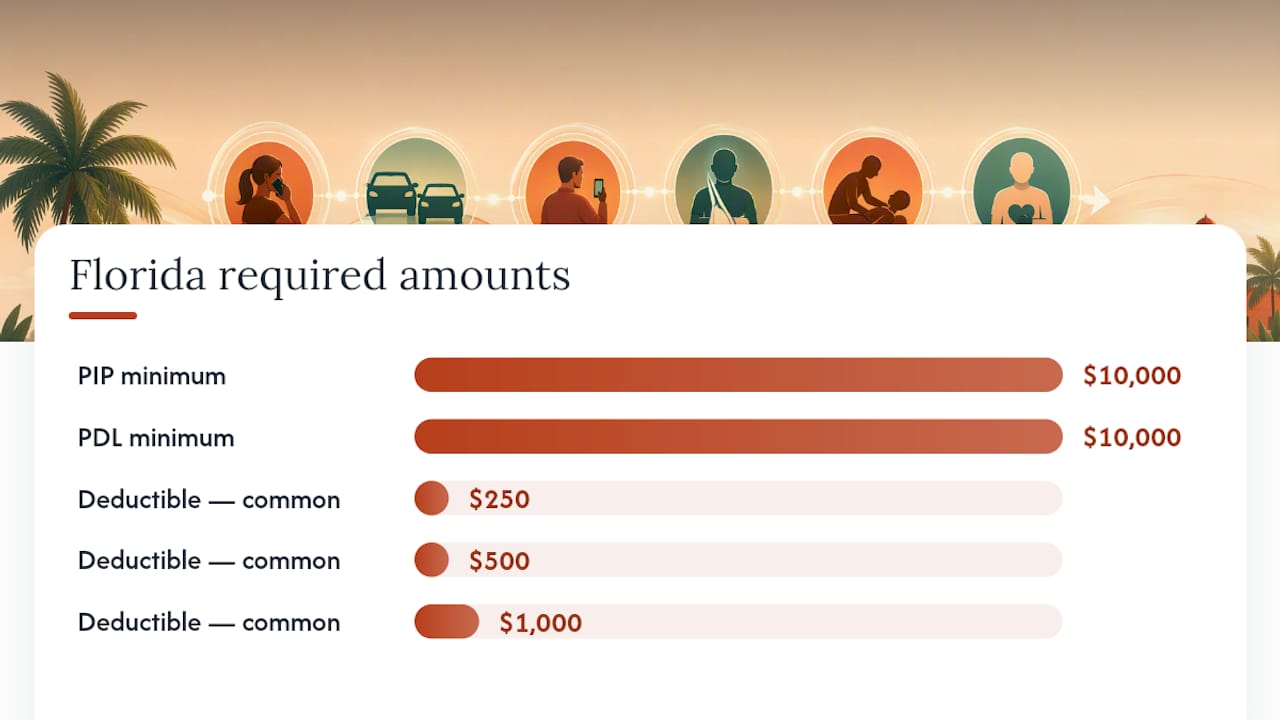
Every registered vehicle with four or more wheels must carry at least $10,000 in PIP and $10,000 in PDL to stay legally on the road. This isn’t optional liability insurance you can decline. It’s tied directly to vehicle registration through the Florida Highway Safety and Motor Vehicles system.
A few compliance points drivers frequently miss:
- Insurers can offer a PIP deductible (commonly $250, $500, or $1,000), which lowers your premium but increases your out-of-pocket exposure after a crash
- Letting coverage lapse can trigger registration suspension and reinstatement fees
- Florida does not require bodily injury liability coverage by default, which is why many drivers voluntarily add it
- You can verify your policy’s compliance status directly through your insurer or the FLHSMV portal
The 14-Day Rule, EMC Test, and What Insurers Require
Florida’s no-fault system runs on a strict clock, and missing it can cost you thousands in benefits. Under Florida Statute §627.736, you must receive initial medical treatment within 14 days of the crash to remain eligible for PIP benefits at all.
Here’s how the process typically unfolds:
- Get evaluated within 14 days. A physician, osteopath, chiropractor, or licensed advanced practice provider must see you.
- The provider determines if you have an Emergency Medical Condition (EMC). This finding unlocks the full $10,000 medical benefit.
- Without an EMC finding, benefits often cap at $2,500, leaving a significant gap if your treatment ends up costing more.
- Submit documentation. Insurers typically want medical records, itemized billing codes, and wage statements from your employer to process the claim.
- Track your timeline. Delays in filing or in submitting requested records are among the most common reasons cited for denials, according to practitioner analyses of Florida PIP disputes.
Pro Tip: Don’t wait to “see how you feel.” Even if symptoms seem minor after a fender-bender, get evaluated within the 14-day window. An EMC determination made on day 20 doesn’t count, no matter how legitimate the injury turns out to be.
When You Can Sue: Florida’s Serious-Injury Threshold
PIP is designed to keep minor accident claims out of court, but Florida law carves out exceptions for genuinely serious injuries. You can step outside the no-fault system and sue an at-fault driver for pain and suffering only if you meet one of these criteria under the state’s no-fault statute:
- Significant and permanent loss of an important bodily function
- Permanent injury, within reasonable medical probability, beyond scarring
- Significant and permanent scarring or disfigurement
- Death
Meeting this threshold isn’t self-evident. It usually requires medical documentation showing permanence, not just a diagnosis. If your injuries seem serious, preserve every record, photograph, and provider note from day one. PIP exhaustion (using up your $10,000) doesn’t automatically qualify you for a tort claim, but it often coincides with cases severe enough to meet the threshold.
Property Damage and Vehicle Repairs: Who Actually Pays
Property damage liability works differently from PIP. It’s fault-based, not no-fault. The at-fault driver’s PDL coverage pays for damage to your vehicle and other property, while your own collision coverage (if you carry it) pays regardless of fault, according to property-damage financial responsibility rules.
Practical steps after a crash:
- Exchange insurance information and take photos of all vehicle damage
- File a police report, especially for anything beyond minor damage
- Get a repair estimate from a licensed shop before accepting an insurer’s first offer
- If the at-fault driver is uninsured or flees the scene, your own uninsured motorist coverage (if purchased) or collision policy becomes your primary path to repair funds
Common Misconceptions That Lead to Denied Claims
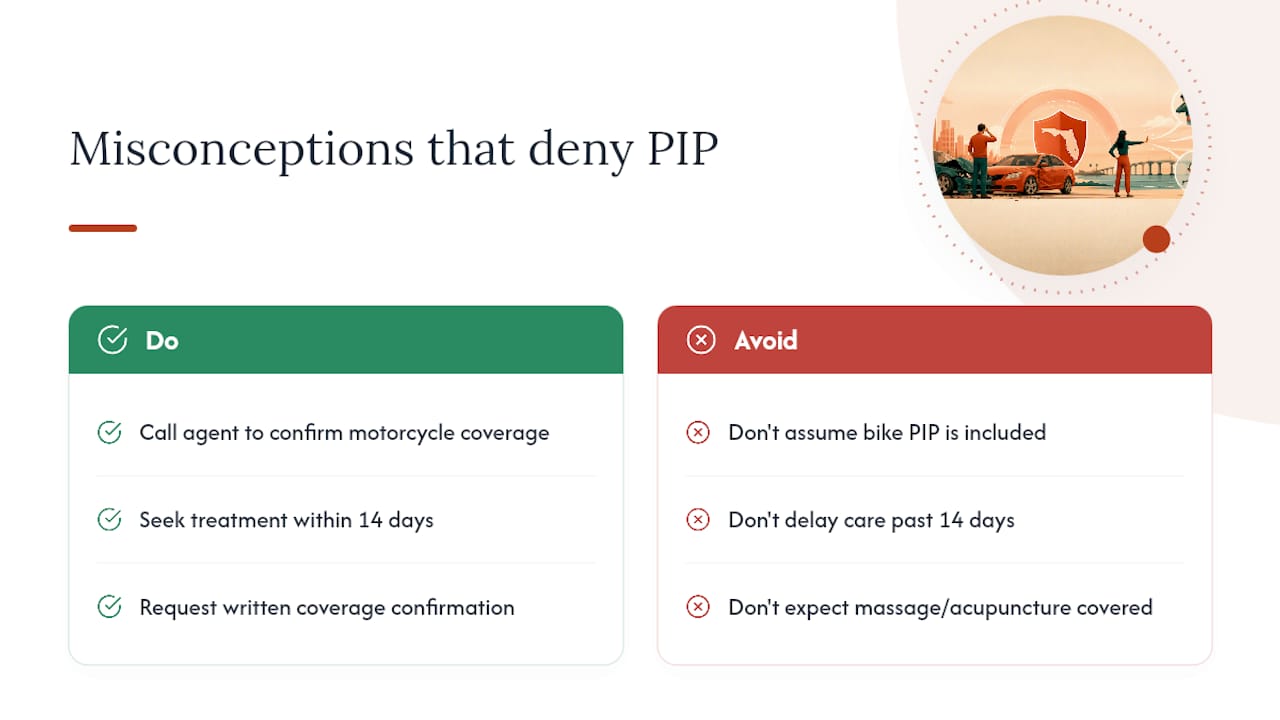
Standard PIP policies exclude motorcycle riders entirely, a detail that catches many Florida drivers off guard until they’re filing a claim. Riders need separate medical-payment coverage, since §627.736 doesn’t extend the four-wheel vehicle requirement to motorcycles.
Two other frequent denial triggers: waiting past the 14-day treatment window, and seeking therapies like massage or acupuncture that insurers routinely exclude under the statute.
Pro Tip: If you ride a motorcycle in Florida, call your agent today and ask specifically whether you have medical-payments coverage. “I have full coverage” is not the same as having PIP-equivalent protection on two wheels.
After a Crash: A Practical Checklist to Protect Your Benefits
Acting fast after an accident protects both your PIP benefits and any future tort claim. Follow this sequence:
- Seek medical care within 14 days, even if injuries seem mild at first.
- Ask your provider directly whether they’re documenting an Emergency Medical Condition. This single note can be worth thousands in coverage.
- Report the crash to your insurer and file your PIP claim promptly.
- Save every bill, wage statement, and receipt for replacement services you paid for during recovery.
- Collect evidence at the scene, including photos, witness contact information, and a copy of the police report.
- Consider an eligibility check if your PIP claim gets denied or your injuries appear serious enough to meet the tort threshold.
Roughly 80% of your medical bills and 60% of lost wages flow through PIP when everything goes smoothly. When it doesn’t, documentation from these early steps becomes the foundation of any dispute or legal claim that follows.
How Caseclosedfl Approaches PIP and Serious-Injury Questions
A no-obligation eligibility check service exists for Florida drivers navigating denied PIP claims or injuries that may meet the serious-injury threshold. The intake process gathers details about the crash, treatment, fault, and existing legal representation before requesting personal contact information.
This works as a diagnostic first step, not a commitment. A human review follows the automated screening, and eligible cases get routed toward attorneys who handle Florida no-fault and tort claims. Expect a straightforward process focused on privacy rather than sales pressure.
— Luis
Get Clarity on Your Case Without the Guesswork
This service provides Florida drivers a faster way to find out where they stand than calling law firms one by one after a PIP denial or a serious injury. Instead of researching attorneys from scratch, users answer a short set of questions about their accident, treatment, and current coverage, and the intake handles the screening.
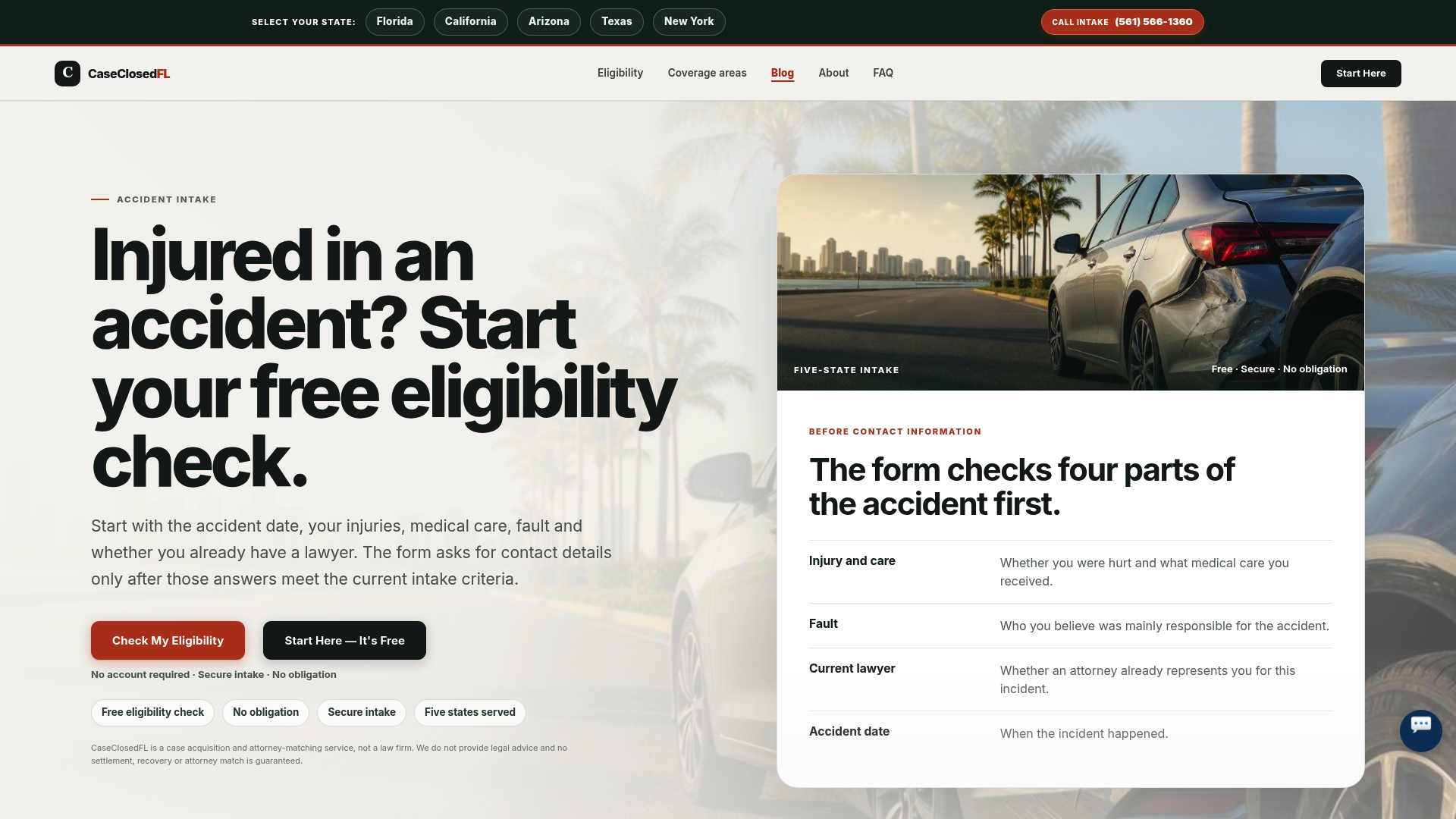
The process asks about your injury, fault, treatment history, and whether you already have legal representation, all before requesting your contact details. If your case appears eligible, a participating attorney may follow up to discuss next steps. Drivers dealing with a denied PIP claim, an EMC dispute, or injuries that might meet Florida’s serious-injury threshold can start the Florida eligibility check directly. Fort Lauderdale drivers can also review a localized example through the Fort Lauderdale accident case review to see how the intake applies to a specific area.
Sources
Verify these claims directly through FLHSMV’s insurance page, the Florida Motor Vehicle No-Fault Law statute, and the Florida Bar’s consumer pamphlet on automobile insurance.
This article is general information, not a substitute for advice from a qualified financial advisor. Consult a qualified financial professional about your own circumstances before acting on anything here.
- FLHSMV — Insurance (Florida Highway Safety and Motor Vehicles)
- Florida Senate — 627.730 Florida Motor Vehicle No-Fault Law (2025)
FAQ
How much does no-fault insurance pay in Florida?
PIP pays 80% of reasonable medical expenses and 60% of lost wages, up to a combined $10,000 limit per person per accident.
Who pays for car repairs in a no-fault state like Florida?
Property damage liability (PDL) from the at-fault driver typically pays for repairs; your own collision coverage, if purchased, pays regardless of fault.
Who pays if someone hits your car in Florida?
The at-fault driver’s PDL coverage generally pays for your vehicle damage, while your own PIP covers your medical bills and lost wages regardless of who caused the crash.
In Florida, is it automatically your fault if you rear-end someone?
Rear-end collisions often create a presumption of fault against the trailing driver, but it isn’t automatic. Evidence like sudden stops or mechanical failure can shift liability, which is separate from how PIP pays medical claims.
What happens if my PIP claim gets denied?
Common causes include missing the 14-day treatment window or lacking an Emergency Medical Condition finding; drivers in this situation often benefit from an eligibility check through a service like Caseclosedfl to see if legal help applies to their case.
Recommended
Frequently asked questions
Table of Contents What PIP Covers and How Payments Work Required Coverages: Florida’s Minimums and Compliance Rules The 14-Day Rule, EMC Test, and What Insurers Require When You Can Sue: Florida’s Serious-Injury Threshold Property Damage and Vehicle Repairs: Who Actually Pays Common Misconceptions That Lead to Denied Claims After a Crash: A Practical Checklist to Protect Your Benefits How Caseclosedfl Approaches PIP and Serious-Injury Questions Get Clarity on Your Case Without the Guesswork Sources FAQ What PIP Covers and How Payments Work Personal Injury Protection pays regardless of fault, but the payout formula has fixed percentages you need to know before you assume a bill is covered. Under FLHSMV guidance , PIP pays 80% of reasonable and necessary medical expenses and 60% of lost wages, up to a combined $10,000 limit per person, per accident. That 80/20 split matters. A $5,000 emergency room visit means your insurer pays $4,000, and you’re responsible for the remaining $1,000 unless other coverage fills the gap. PIP also includes smaller, often-overlooked benefits: Replacement services, covering costs like hiring help for household tasks you can’t perform while injured A $5,000 death benefit paid to survivors in fatal accident cases Coverage extends to household members and some passengers, not just the policyholder What PIP does not pay for: pain and suffering, emotional distress, or damage to your vehicle. Many insurers also deny massage therapy and acupuncture claims outright under the exclusions written into Florida’s no-fault statute . Required Coverages: Florida’s Minimums and Compliance Rules Every registered vehicle with four or more wheels must carry at least $10,000 in PIP and $10,000 in PDL to stay legally on the road. This isn’t optional liability insurance you can decline. It’s tied directly to vehicle registration through the Florida Highway Safety and Motor Vehicles system. A few compliance points drivers frequently miss: Insurers can offer a PIP deductible (commonly $250, $500, or $1,000), which lowers your premium but increases your out-of-pocket exposure after a crash Letting coverage lapse can trigger registration suspension and reinstatement fees Florida does not require bodily injury liability coverage by default, which is why many drivers voluntarily add it You can verify your policy’s compliance status directly through your insurer or the FLHSMV portal The 14-Day Rule, EMC Test, and What Insurers Require Florida’s no-fault system runs on a strict clock, and missing it can cost you thousands in benefits. Under Florida Statute §627.736, you must receive initial medical treatment within 14 days of the crash to remain eligible for PIP benefits at all. Here’s how the process typically unfolds: Get evaluated within 14 days. A physician, osteopath, chiropractor, or licensed advanced practice provider must see you. The provider determines if you have an Emergency Medical Condition (EMC). This finding unlocks the full $10,000 medical benefit. Without an EMC finding, benefits often cap at $2,500 , leaving a significant gap if your treatment ends up costing more. Submit documentation. Insurers typically want medical records, itemized billing codes, and wage statements from your employer to process the claim. Track your timeline. Delays in filing or in submitting requested records are among the most common reasons cited for denials, according to practitioner analyses of Florida PIP disputes. Pro Tip: Don’t wait to “see how you feel.” Even if symptoms seem minor after a fender-bender, get evaluated within the 14-day window. An EMC determination made on day 20 doesn’t count, no matter how legitimate the injury turns out to be. When You Can Sue: Florida’s Serious-Injury Threshold PIP is designed to keep minor accident claims out of court, but Florida law carves out exceptions for genuinely serious injuries. You can step outside the no-fault system and sue an at-fault driver for pain and suffering only if you meet one of these criteria under the state’s no-fault statute: Significant and permanent loss of an important bodily function Permanent injury, within reasonable medical probability, beyond scarring Significant and permanent scarring or disfigurement Death Meeting this threshold isn’t self-evident. It usually requires medical documentation showing permanence, not just a diagnosis. If your injuries seem serious, preserve every record, photograph, and provider note from day one. PIP exhaustion (using up your $10,000) doesn’t automatically qualify you for a tort claim, but it often coincides with cases severe enough to meet the threshold. Property Damage and Vehicle Repairs: Who Actually Pays Property damage liability works differently from PIP. It’s fault-based, not no-fault. The at-fault driver’s PDL coverage pays for damage to your vehicle and other property, while your own collision coverage (if you carry it) pays regardless of fault, according to property-damage financial responsibility rules. Practical steps after a crash: Exchange insurance information and take photos of all vehicle damage File a police report, especially for anything beyond minor damage Get a repair estimate from a licensed shop before accepting an insurer’s first offer If the at-fault driver is uninsured or flees the scene, your own uninsured motorist coverage (if purchased) or collision policy becomes your primary path to repair funds Common Misconceptions That Lead to Denied Claims Standard PIP policies exclude motorcycle riders entirely, a detail that catches many Florida drivers off guard until they’re filing a claim. Riders need separate medical-payment coverage, since §627.736 doesn’t extend the four-wheel vehicle requirement to motorcycles. Two other frequent denial triggers: waiting past the 14-day treatment window, and seeking therapies like massage or acupuncture that insurers routinely exclude under the statute. Pro Tip: If you ride a motorcycle in Florida, call your agent today and ask specifically whether you have medical-payments coverage. “I have full coverage” is not the same as having PIP-equivalent protection on two wheels. After a Crash: A Practical Checklist to Protect Your Benefits Acting fast after an accident protects both your PIP benefits and any future tort claim. Follow this sequence: Seek medical care within 14 days , even if injuries seem mild at first. Ask your provider directly whether they’re documenting an Emergency Medical Condition. This single note can be worth thousands in coverage. Report the crash to your insurer and file your PIP claim promptly. Save every bill, wage statement, and receipt for replacement services you paid for during recovery. Collect evidence at the scene , including photos, witness contact information, and a copy of the police report. Consider an eligibility check if your PIP claim gets denied or your injuries appear serious enough to meet the tort threshold. Roughly 80% of your medical bills and 60% of lost wages flow through PIP when everything goes smoothly. When it doesn’t, documentation from these early steps becomes the foundation of any dispute or legal claim that follows. How Caseclosedfl Approaches PIP and Serious-Injury Questions A no-obligation eligibility check service exists for Florida drivers navigating denied PIP claims or injuries that may meet the serious-injury threshold. The intake process gathers details about the crash, treatment, fault, and existing legal representation before requesting personal contact information. This works as a diagnostic first step, not a commitment. A human review follows the automated screening, and eligible cases get routed toward attorneys who handle Florida no-fault and tort claims. Expect a straightforward process focused on privacy rather than sales pressure. — Luis Get Clarity on Your Case Without the Guesswork This service provides Florida drivers a faster way to find out where they stand than calling law firms one by one after a PIP denial or a serious injury. Instead of researching attorneys from scratch, users answer a short set of questions about their accident, treatment, and current coverage, and the intake handles the screening. The process asks about your injury, fault, treatment history, and whether you already have legal representation, all before requesting your contact details. If your case appears eligible, a participating attorney may follow up to discuss next steps. Drivers dealing with a denied PIP claim, an EMC dispute, or injuries that might meet Florida’s serious-injury threshold can start the Florida eligibility check directly. Fort Lauderdale drivers can also review a localized example through the Fort Lauderdale accident case review to see how the intake applies to a specific area. Sources Verify these claims directly through FLHSMV’s insurance page, the Florida Motor Vehicle No-Fault Law statute, and the Florida Bar’s consumer pamphlet on automobile insurance. This article is general information, not a substitute for advice from a qualified financial advisor. Consult a qualified financial professional about your own circumstances before acting on anything here. FLHSMV — Insurance (Florida Highway Safety and Motor Vehicles) Florida Senate — 627.730 Florida Motor Vehicle No-Fault Law (2025) FAQ How much does no-fault insurance pay in Florida?
PIP pays 80% of reasonable medical expenses and 60% of lost wages, up to a combined $10,000 limit per person per accident.
Who pays for car repairs in a no-fault state like Florida?
Property damage liability (PDL) from the at-fault driver typically pays for repairs; your own collision coverage, if purchased, pays regardless of fault.
Who pays if someone hits your car in Florida?
The at-fault driver’s PDL coverage generally pays for your vehicle damage, while your own PIP covers your medical bills and lost wages regardless of who caused the crash.
In Florida, is it automatically your fault if you rear-end someone?
Rear-end collisions often create a presumption of fault against the trailing driver, but it isn’t automatic. Evidence like sudden stops or mechanical failure can shift liability, which is separate from how PIP pays medical claims.
What happens if my PIP claim gets denied?
Common causes include missing the 14-day treatment window or lacking an Emergency Medical Condition finding; drivers in this situation often benefit from an eligibility check through a service like Caseclosedfl to see if legal help applies to their case.
Ready to enter the accident details?
The eligibility form asks about the accident, injury, treatment, fault and representation before contact information.
Start Eligibility Check