Protect Your Pedestrian Accident Claim (U.S.), Free Eligibility Check
Protect a pedestrian accident claim in the U.S. Learn immediate steps, evidence to preserve, filing deadlines, and how to use a free privacy-first...


Yes, you can typically file a pedestrian accident claim when a driver’s negligence caused your injuries, and that claim can recover medical bills, lost wages, and pain and suffering. The strength of the claim depends on the evidence connecting the driver’s conduct to your injuries and on the insurance or other coverage available to pay it. Start with medical care, then preserve every scrap of evidence from the scene before it disappears. A free eligibility check can quickly tell you whether the facts support a case worth pursuing.
TL;DR:
- Clear liability is more likely to be established if the driver violated a traffic law, such as failing to yield in a crosswalk, which simplifies the negligence case.
- Injuries like traumatic brain injuries or permanent impairments significantly increase settlement value and require thorough medical documentation and expert testimony.
- Most states limit pedestrian injury claims to between one and six years, making early filing crucial to avoid losing your right to sue.
- Waiting to see if injuries improve or delaying treatment can reduce the chances of maximizing your compensation, especially if gaps in medical care are poorly explained.
- Hiring an attorney is recommended for complex cases involving disputed fault, multiple insurance policies, or serious injuries, to ensure proper evidence collection and negotiations.
Table of Contents
- What Are the First Steps After a Pedestrian Accident Claim Begins?
- How Do You Prove Negligence in a Pedestrian Accident?
- What Compensation Can You Recover From a Pedestrian Injury Lawsuit?
- How Long Do You Have to File a Pedestrian Accident Claim?
- How Do You File a Claim Without Hurting Your Case?
- When Should You Hire an Attorney for a Pedestrian Injury Lawsuit?
- What Should You Prioritize First After a Pedestrian Accident?
- Ready to Check Your Eligibility for a Pedestrian Accident Claim?
- Where Can You Find Authoritative Pedestrian Accident Resources?
- Sources
- FAQ
What Are the First Steps After a Pedestrian Accident Claim Begins?
The first few days shape everything that follows. Insurance adjusters look for gaps in treatment, missing documentation, and inconsistent accounts, and those gaps are hardest to fill after the fact.
Handle these in order:
- Call 911 and get evaluated, even if you feel fine. Adrenaline masks pain, and soft-tissue injuries, concussions, and internal bleeding often show no symptoms for hours or days.
- Follow up with a doctor within 24 to 48 hours if you weren’t transported by ambulance. A documented gap between the crash and your first treatment is one of the easiest excuses an insurer uses to dispute your pedestrian accident claim.
- Photograph everything before it’s cleaned up or moved: the vehicle’s position, skid marks, traffic signals, crosswalk markings, weather conditions, your torn or bloodied clothing, and your visible injuries.
- Get the driver’s name, license plate, insurance information, and the responding officer’s badge number and report number.
- Collect witness names and phone numbers on the spot. People who stop to help rarely stick around, and witnesses are nearly impossible to track down a week later.
The NAIC recommends using a structured checklist like its WRECKCHECK app to make sure you don’t forget a detail under stress, and state insurance departments frequently point consumers to similar tools.
Say only what’s necessary at the scene. Avoid phrases like “I didn’t see the car” or “I’m sorry,” which insurers later twist into admissions of fault.
Pro Tip: Take a video walk-through of the scene, narrating what you see, rather than relying only on still photos. Video captures lighting, traffic flow, and sightlines that a photo can miss entirely.
How Do You Prove Negligence in a Pedestrian Accident?
Every pedestrian accident claim rests on four legal elements: duty, breach, causation, and damages. Cornell Law’s Legal Information Institute defines negligence as a failure to exercise the care a reasonable person would under similar circumstances, and each element has to be proven separately.
Drivers owe pedestrians a duty of care, whether that’s stopping at a crosswalk, yielding when turning, or slowing down near a school zone. A breach happens when the driver falls short of that duty: running a red light, speeding through a residential street, or turning right without checking for someone in the walkway. Causation ties the breach directly to your injury. Damages are the measurable harm, medical bills, lost income, and pain, that resulted.
When a driver violates a specific traffic law, such as failing to stop for a pedestrian in a marked crosswalk, many states treat that violation as negligence per se. That shifts the legal fight from “was the driver careless?” to “did the driver break the law?”, which is a much easier question to answer with a citation.
Evidence maps directly to these elements:
- Police reports and citations establish breach.
- Video footage, vehicle damage, and skid marks establish causation.
- Medical records establish damages.
- Witness statements corroborate the whole sequence.
More than 71,000 pedestrians were injured nationwide in 2024 alone, and 7,080 died, numbers that make clear how often these four elements end up litigated or negotiated every day in claims offices across the country.
State law also decides how fault gets divided. Some states use pure comparative negligence, where you can recover damages even if you were 90% at fault, just reduced proportionally. Because this varies so much by state, checking your state’s specific rule early changes how you should approach settlement talks.

What Compensation Can You Recover From a Pedestrian Injury Lawsuit?
Damages split into two categories: economic and non-economic. Economic damages are the costs you can put a number on, medical bills, future care, lost wages, and reduced earning capacity if you can’t return to your prior job. Non-economic damages cover pain and suffering, loss of enjoyment of life, and, in severe cases, loss of consortium for a spouse.
Your recovery ceiling is often set by the at-fault driver’s insurance policy limits. If those limits are too low to cover your losses, your own uninsured or underinsured motorist coverage may fill the gap. The NAIC’s guidance on uninsured motorist issues explains that UM/UIM coverage frequently extends to pedestrians, not just drivers and passengers, though how it stacks with other policies depends on state law and the specific policy language.
Settlement value swings widely based on a handful of factors:
- Clarity of liability. A driver cited for failing to yield settles faster and higher than a contested “he stepped into traffic” dispute.
- Documented lost wages. Pay stubs and employer letters carry more weight than a verbal claim about missed work.
- Permanent impairment. A fracture that heals fully settles differently than one leaving lasting mobility loss.
- Injury severity. Catastrophic injuries, including traumatic brain injuries, often require expert medical testimony to project future care costs, which raises both the complexity and the value of the claim.
Two pedestrians with similar fractures can walk away with very different settlements purely because one had a clean liability picture and consistent treatment records, and the other didn’t.
How Long Do You Have to File a Pedestrian Accident Claim?
Every state sets its own statute of limitations for personal injury claims, and most fall somewhere between one and six years from the date of the accident. Missing that deadline typically bars you from suing entirely, regardless of how strong your evidence is, so confirm your state’s specific window early rather than assuming you have years to decide.

Filing an insurance claim and filing a lawsuit are different actions. You can (and should) notify insurers quickly, but you generally must file suit before the statute of limitations expires if a fair settlement hasn’t been reached.
Timelines vary just as much as deadlines:
- Quick, medical-only claims with clear liability and minor injuries can resolve in a few months.
- Moderate injury claims with ongoing treatment often take six months to a year, since most attorneys wait until you reach maximum medical improvement before settling.
- Litigated cases, especially those involving disputed fault or catastrophic injuries, can stretch one to three years or longer.
Delaying treatment or letting your file sit while a deadline approaches are two of the fastest ways to shrink a recovery that should otherwise be straightforward.
How Do You File a Claim Without Hurting Your Case?
Order matters. Get medical care first, then notify the at-fault driver’s insurer, and finally your own insurer if UM/UIM coverage might apply.
- Report the accident to the relevant insurers promptly, sticking to basic facts: date, location, and that you were injured.
- Assemble a documentation packet: medical records and bills, wage verification from your employer, the police report, and your scene photos.
- Limit recorded statements. Adjusters often ask for one early, hoping you’ll downplay your injuries or make an offhand comment about fault. You’re not obligated to give one before speaking with counsel.
- Never sign a release or accept a settlement check until you understand the full scope of your injuries and future costs. A signed release almost always ends your right to seek more later.
- Evaluate early offers skeptically. A fast, low offer usually means the insurer is betting you don’t know your claim’s real value.
Pro Tip: Keep a dated log of every call with an adjuster, including who you spoke with and what was said. Insurers keep detailed notes on you; you should keep the same on them.
When Should You Hire an Attorney for a Pedestrian Injury Lawsuit?
Serious injuries, disputed fault, multiple insurance policies, or an adjuster’s lowball offer are all signs it’s time for legal representation. A lawyer handles the work that’s hardest to do alone: gathering and preserving evidence, retaining accident reconstruction or medical experts, negotiating with insurers who negotiate for a living, resolving medical liens, and preparing for trial if a fair settlement never materializes.
A pedestrian injury intake service can connect injured pedestrians with attorneys through a free eligibility check that starts by asking about your injury, fault, treatment, and any existing legal representation, before requesting contact information. Submissions typically go through human review before routing to legal professionals, which helps prevent a flood of unsolicited calls. Have your accident date, injury details, and any insurance correspondence ready before you start, and expect a straightforward next step once your submission is reviewed.
What Should You Prioritize First After a Pedestrian Accident?
Get treated immediately, photograph and video the scene before it changes, and collect witness contact information before people disperse. Keep every medical appointment on schedule; unexplained gaps in treatment are one of the most common reasons adjusters undervalue a claim.
Avoid the mistakes that quietly shrink settlements: admitting fault at the scene, posting about the accident on social media, letting treatment lapse, and losing track of your state’s filing deadline. None of these are dramatic errors, which is exactly why they’re so common.
If you’re unsure whether your case is strong enough to pursue, a privacy-preserving legal intake is a low-risk way to find out before you commit to anything.
— Luis
Ready to Check Your Eligibility for a Pedestrian Accident Claim?
Hiring a personal injury attorney the traditional way often means cold-calling firms, sitting through sales pitches, and handing over your phone number before you know if your case is even worth pursuing. Caseclosedfl works differently: it collects your accident details first, injury, fault, treatment, and any existing representation, and only asks for your contact information if your case meets intake criteria for referral to a participating attorney.
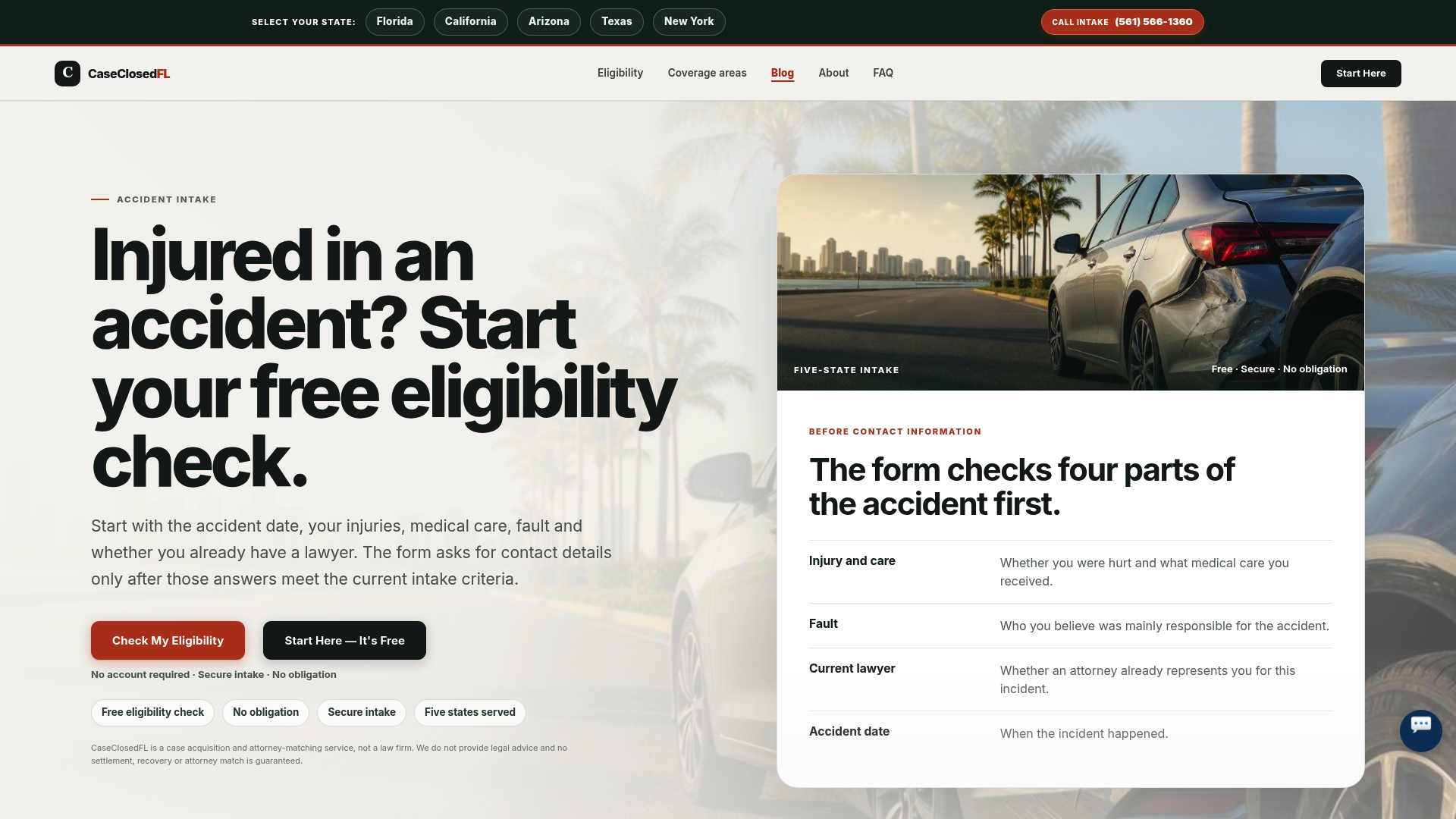
Every submission goes through human review before it’s routed anywhere, which means you’re not adding your name to a list of leads sold to whoever bids highest. Caseclosedfl serves pedestrian accident claimants across Florida, California, Arizona, Texas, and New York, and if you’re in the Miami area, the Miami accident case review page walks through what local claimants can expect from the intake process. Start the free eligibility check once your medical care is underway and your evidence is documented. It takes a few minutes and costs nothing to find out where you stand.
Where Can You Find Authoritative Pedestrian Accident Resources?
- NHTSA Pedestrian Safety: national crash data and prevention resources.
- NAIC crash documentation guidance and the WRECKCHECK app.
- Cornell Law Wex: Negligence and Compensation.
- HHS guidance on accessing medical records.
This article is general information, not a substitute for advice from a qualified lawyer. Consult a qualified legal professional about your own circumstances before acting on anything here.
Sources
- Pedestrian Safety | NHTSA
- Negligence | Legal Information Institute (Cornell Law)
- Don’t be a crash dummy | NAIC
- Medical records and your HIPAA privacy rights | HHS
FAQ
How Much Is a Pedestrian Injury Lawsuit Typically Worth?
Value depends heavily on injury severity, liability clarity, and available insurance coverage, so there’s no single figure that applies across cases. Minor injuries with clear fault often settle for medical costs plus a multiple for pain and suffering, while catastrophic injuries requiring future care can be worth substantially more once expert testimony documents long-term needs.
What Is the Average Settlement for a Foot or Ankle Injury?
Foot and ankle injuries vary widely depending on whether they require surgery, leave permanent mobility limitations, or heal fully within a few months. A claim with well-documented medical treatment, consistent follow-up care, and clear liability tends to settle higher than one with treatment gaps or disputed fault.
What Happens Legally if a Driver Hits a Pedestrian?
Depending on the circumstances, a driver can face civil liability for a pedestrian accident claim, criminal charges if reckless or impaired driving was involved, or both. Civil claims focus on compensating the injured pedestrian, while criminal charges are handled separately by prosecutors and don’t guarantee any payment to the victim.
How Long Does a Pedestrian Accident Settlement Take?
Straightforward claims with clear liability and minor injuries can resolve in a few months, while cases involving serious injuries, disputed fault, or litigation often take one to three years. Consistent medical treatment and complete documentation tend to move a pedestrian accident claim toward resolution faster than a case with gaps or missing evidence.
How Do You Start a Pedestrian Accident Claim?
Get medical care immediately, document the scene and your injuries, and notify the relevant insurers with basic facts only. From there, a free eligibility check through Caseclosedfl can help determine whether your case qualifies for review by a participating attorney.
Recommended
Frequently asked questions
Table of Contents What Are the First Steps After a Pedestrian Accident Claim Begins? How Do You Prove Negligence in a Pedestrian Accident? What Compensation Can You Recover From a Pedestrian Injury Lawsuit? How Long Do You Have to File a Pedestrian Accident Claim? How Do You File a Claim Without Hurting Your Case? When Should You Hire an Attorney for a Pedestrian Injury Lawsuit? What Should You Prioritize First After a Pedestrian Accident? Ready to Check Your Eligibility for a Pedestrian Accident Claim? Where Can You Find Authoritative Pedestrian Accident Resources? Sources FAQ What Are the First Steps After a Pedestrian Accident Claim Begins?
The first few days shape everything that follows. Insurance adjusters look for gaps in treatment, missing documentation, and inconsistent accounts, and those gaps are hardest to fill after the fact.
How Do You Prove Negligence in a Pedestrian Accident?
Every pedestrian accident claim rests on four legal elements: duty, breach, causation, and damages. Cornell Law’s Legal Information Institute defines negligence as a failure to exercise the care a reasonable person would under similar circumstances, and each element has to be proven separately.
What Compensation Can You Recover From a Pedestrian Injury Lawsuit?
Damages split into two categories: economic and non-economic. Economic damages are the costs you can put a number on, medical bills, future care, lost wages, and reduced earning capacity if you can’t return to your prior job. Non-economic damages cover pain and suffering, loss of enjoyment of life, and, in severe cases, loss of consortium for a spouse.
How Long Do You Have to File a Pedestrian Accident Claim?
Every state sets its own statute of limitations for personal injury claims, and most fall somewhere between one and six years from the date of the accident. Missing that deadline typically bars you from suing entirely, regardless of how strong your evidence is, so confirm your state’s specific window early rather than assuming you have years to decide.
How Do You File a Claim Without Hurting Your Case?
Order matters. Get medical care first, then notify the at-fault driver’s insurer, and finally your own insurer if UM/UIM coverage might apply.
When Should You Hire an Attorney for a Pedestrian Injury Lawsuit?
Serious injuries, disputed fault, multiple insurance policies, or an adjuster’s lowball offer are all signs it’s time for legal representation. A lawyer handles the work that’s hardest to do alone: gathering and preserving evidence, retaining accident reconstruction or medical experts, negotiating with insurers who negotiate for a living, resolving medical liens, and preparing for trial if a fair settlement never materializes.
What Should You Prioritize First After a Pedestrian Accident?
Get treated immediately, photograph and video the scene before it changes, and collect witness contact information before people disperse. Keep every medical appointment on schedule; unexplained gaps in treatment are one of the most common reasons adjusters undervalue a claim.
Ready to Check Your Eligibility for a Pedestrian Accident Claim?
Hiring a personal injury attorney the traditional way often means cold-calling firms, sitting through sales pitches, and handing over your phone number before you know if your case is even worth pursuing. Caseclosedfl works differently: it collects your accident details first, injury, fault, treatment, and any existing representation, and only asks for your contact information if your case meets intake criteria for referral to a participating attorney.
Ready to enter the accident details?
The eligibility form asks about the accident, injury, treatment, fault and representation before contact information.
Start Eligibility Check