How Much You Keep: 33% vs 40% Personal Injury Lawyer Fees (U.S.)
See how 33% vs 40% fees, costs, and liens affect U.S. personal injury settlements, and when negotiating fees boosts what you take home.


That fee comes out of your recovery, not your pocket upfront, but case costs and medical liens also get deducted before you see a check. Before signing anything, read the fee agreement line by line and ask exactly how costs and liens will be handled.
TL;DR:
- Personal injury cases typically involve contingency fees ranging from 33.33% before filing suit to 40% after, with the calculation method (gross or net) impacting your final payout.
- Case costs, such as court fees and expert witness expenses, are often recouped from settlement funds and can vary from a few hundred to over twenty thousand dollars, depending on case complexity.
- Medical liens and subrogation claims from insurers and medical providers are paid after attorney fees and costs, often reducing the final settlement amount significantly.
- State laws may cap contingency fees or impose sliding scales in medical malpractice cases, so fee limits differ depending on jurisdiction.
- Negotiating fee structures, such as lowering pre-suit percentages or setting caps, can increase your net recovery, but understanding how costs and liens are calculated is crucial before signing any agreement.
Table of Contents
- Personal Injury Lawyer Fees: The Main Fee Models
- How Do Contingency Fee Percentages Actually Work?
- What Case Costs Get Deducted From Your Settlement?
- How Do Medical Liens and Subrogation Affect Your Payout?
- Do State Laws Cap Personal Injury Lawyer Fees?
- Can You Negotiate Personal Injury Attorney Fees?
- What Would You Actually Keep From a Settlement?
- Is It Worth Hiring a Personal Injury Lawyer for Your Claim?
- CaseClosedFL’s Free Eligibility Check: What It Actually Does
- A Final Word on Fee Transparency
- Ready to Find Out If You Have a Case?
- Sources
- FAQ
Personal Injury Lawyer Fees: The Main Fee Models
Contingency fees dominate personal injury cases for a simple reason: they let injured people hire a lawyer without paying anything out of pocket. The attorney only gets paid if you win or settle, which is why this model exists at all. It gives access to legal representation to someone who just had a wage-earner sidelined by a broken leg and can’t front a retainer.
That said, contingency isn’t the only arrangement you’ll encounter.
- Contingency fee: the standard for car accidents, slip-and-falls, and most negligence claims. No fee unless you recover money.
- Hourly billing: rare in personal injury, but sometimes used for smaller advisory tasks or by attorneys defending insurance companies.
- Flat fee: occasionally used for narrow, predictable tasks like reviewing a settlement offer before you sign.
- Hybrid arrangements: a reduced contingency percentage paired with a modest hourly or flat component, sometimes offered for cases with clear liability and fast resolution.
If a lawyer quotes you an hourly rate for a straightforward car crash claim, that’s worth questioning. It’s not how the industry typically prices this type of case.
How Do Contingency Fee Percentages Actually Work?
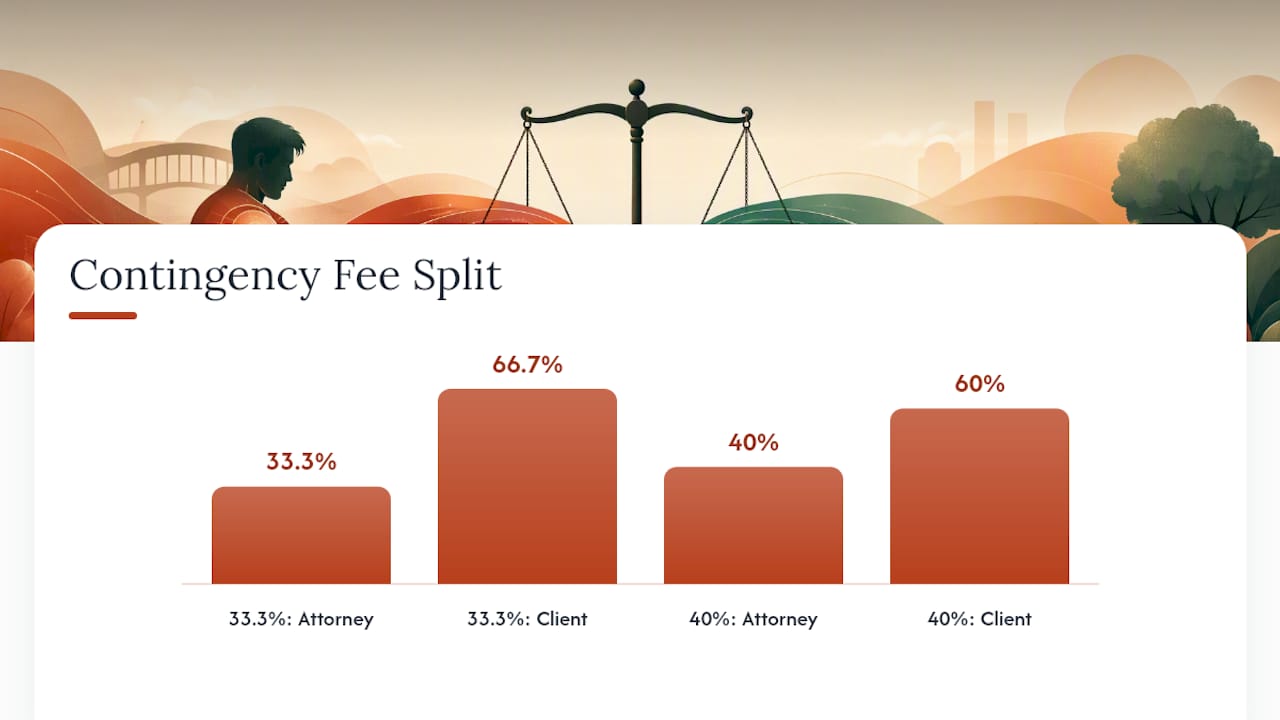
Contingency agreements usually scale with how much work the case requires. A claim that settles before a lawsuit is filed typically costs about 33.33%, while one that requires filing suit commonly jumps to around 40%. Trial work sometimes pushes that percentage even higher, since the attorney is taking on more risk and more hours.
The math also depends on whether the fee is calculated on the gross settlement or the net amount after costs are subtracted.
- Gross method: the attorney’s percentage is calculated on the full settlement before costs come out. This is the more common approach.
- Net method: costs are deducted first, then the percentage is applied to what remains, which usually leaves the client with more money.
A contingency fee calculator comparing 33.3% and 40% scenarios shows that the gross-versus-net decision can shift a client’s take-home by thousands of dollars on an otherwise identical settlement. Before signing, check three things: which calculation method the agreement uses, whether the percentage escalates at specific stages (filing suit, trial, appeal), and who covers costs if there’s no recovery at all.
What Case Costs Get Deducted From Your Settlement?
Case costs are separate from attorney fees, and they cover the actual expenses of building your claim. Most firms front these costs and recoup them from the settlement, but the amounts vary enormously depending on how contested the case becomes.
- Court filing fees
- Medical record requests
- Expert witness fees
- Deposition transcripts
- Accident reconstruction or investigator fees
A simple claim that settles early might rack up only a few hundred dollars in costs, while a litigated case with expert testimony can run $10,000 to $20,000 or more before it’s over. Ask your attorney upfront whether the firm advances these costs and, critically, whether you’re on the hook to reimburse them if the case is lost. Policies differ, and this single clause can matter more than the percentage itself if your case doesn’t pan out.
How Do Medical Liens and Subrogation Affect Your Payout?
Liens and subrogation claims get paid out of your settlement, usually after attorney fees and costs are subtracted, though the order can shift depending on state law and the type of lienholder involved. This is often the part of a settlement that surprises people most, because the number they hear in a phone call isn’t the number that ends up in their bank account.
- Health insurers can assert subrogation rights to recover what they paid for your treatment.
- Medicare and Medicaid carry statutory recovery rights that can apply depending on the case, and Medicaid outlines how those recovery rules function.
- Hospitals and medical providers may file liens directly against the settlement for unpaid bills.
Liens aren’t always fixed at face value. Under Cornell Law School’s overview of lien law, many liens are negotiable, and reducing a lien is one of the more concrete ways an attorney adds value beyond simply winning the case. Before you sign any release, ask for a full lien accounting in writing.
Do State Laws Cap Personal Injury Lawyer Fees?
Contingency percentages aren’t uniform across the country. Several states impose caps or sliding scales, particularly in medical malpractice cases, and federal claims carry their own limits entirely.
- California applies a sliding-scale cap on contingency fees in medical malpractice cases under the state’s MICRA statute.
- New York uses a similar sliding scale for medical malpractice claims, reducing the percentage as the recovery amount increases.
- Federal Tort Claims Act (FTCA) cases, such as claims against a federal employee or agency, cap attorney fees at 20% to 25% depending on whether the case settled administratively or went to court.
These are pointers, not a substitute for checking your own state’s bar rules or statute. Florida residents can also review CaseClosedFL’s consumer disclosures for state-specific context on how fee and intake rules apply locally.
Can You Negotiate Personal Injury Attorney Fees?
Fee agreements aren’t set in stone. State bar rules require fees to be reasonable, and attorneys frequently adjust terms for cases with clear liability, well-documented damages, or a client who’s comparing multiple firms.
- Ask for a lower pre-suit percentage. Some attorneys will drop to 25% to 30% for cases with strong, undisputed liability.
- Request a sliding scale or fee cap. This protects you on unusually large settlements.
- Clarify cost responsibility if you lose. Get this in writing, not as a verbal assurance.
- Confirm gross versus net calculation. This single detail changes your final number more than people expect.
Pro Tip: Bring a specific question to your consultation: “Is your fee calculated before or after case costs are deducted?” The answer tells you more about your eventual take-home than the percentage itself.
What Would You Actually Keep From a Settlement?
Numbers make this concrete.
- $25,000 settlement, pre-suit (33.33%): attorney fee around $8,333, plus roughly $1,500 in costs, leaving about $15,167 before any liens.
- $50,000 settlement, post-filing (40%): attorney fee around $20,000, plus roughly $4,000 in costs, leaving about $26,000 before liens.
- $100,000 settlement, post-filing (40%): attorney fee around $40,000, plus roughly $6,000 in costs, leaving about $54,000 before liens.
Negotiating a lien down by even a few thousand dollars, or securing a net-fee calculation instead of gross, can move these final numbers meaningfully in your favor.
Is It Worth Hiring a Personal Injury Lawyer for Your Claim?
Claim size and complexity should drive this decision more than gut instinct. As a rough guideline, claims under roughly $5,000 often don’t justify the cost of representation, claims around $10,000 sit in a gray zone, and anything above that, or involving surgery, lasting disability, or disputed liability, tends to strongly favor hiring counsel.
- Liability is disputed or unclear
- Multiple parties or insurers are involved
- Medical treatment is ongoing or involves surgery
- Liens or subrogation claims are likely
- The insurer’s initial offer feels low relative to your medical bills
Bring your accident report, medical records, and any settlement offer to your first consultation so an attorney can give you a realistic read on value.
CaseClosedFL’s Free Eligibility Check: What It Actually Does
Before you commit to any attorney, CaseClosedFL’s free eligibility check gathers basic details about your accident, injury, fault, and whether you already have representation. The intake runs across multiple states, including Florida, California, Arizona, Texas, and New York, and every submission goes through human review before it’s routed anywhere. There’s no guarantee of attorney contact, and no legal advice is given during intake. It’s a reasonable first step once you’ve read this article and decided you want to explore representation.
A Final Word on Fee Transparency
The gap between what people expect from “one third” and what they actually receive after costs and liens is where most frustration with personal injury settlements comes from. Read the fee agreement before you sign it, and ask directly how costs and liens are calculated. Those two habits protect your net recovery more than any negotiating tactic ever will. If you’ve done that and you’re ready to look for representation, a free eligibility check is a low-commitment way to start.
— Luis
Ready to Find Out If You Have a Case?
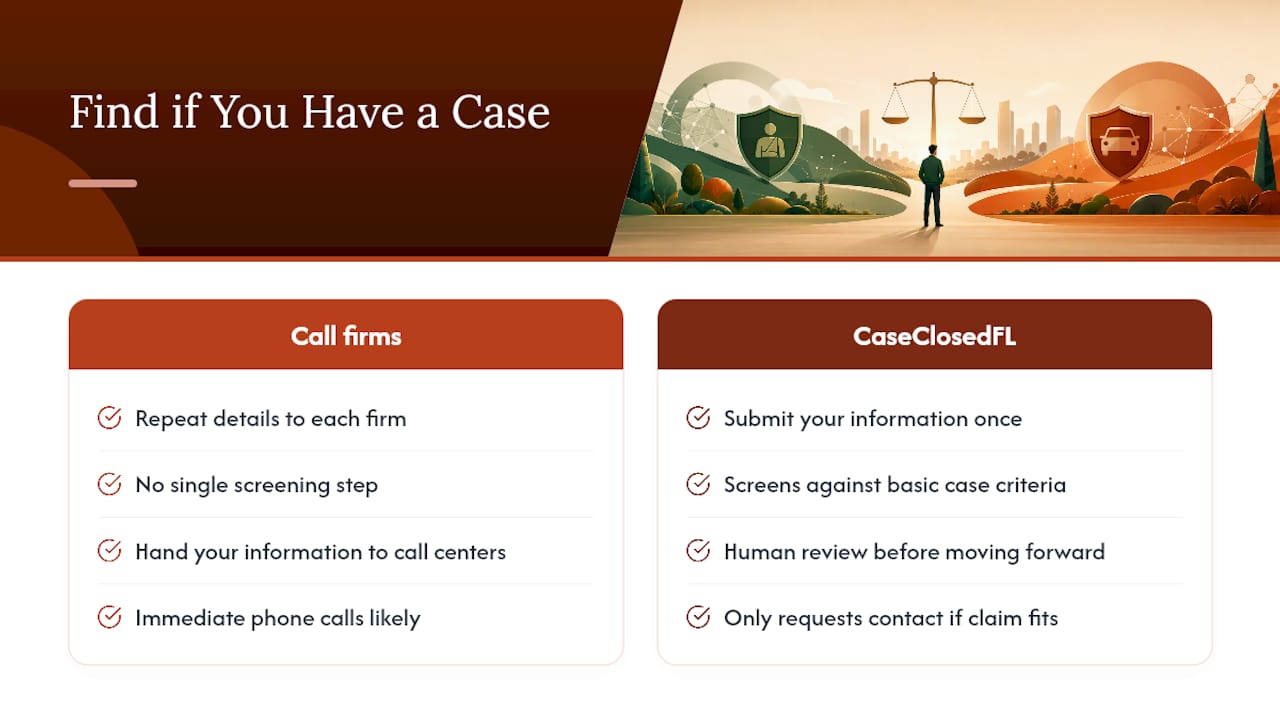
Unlike calling law firms one by one and repeating your accident details to each intake coordinator, CaseClosedFL’s free eligibility check collects your information once, screens it against basic case criteria, and only requests your contact details if your claim looks like a fit. Every submission gets a human review before anything moves forward, so you’re not handing your information to a call center. CaseClosedFL doesn’t charge you anything and doesn’t guarantee attorney contact. It simply gives you a private, no-pressure way to find out whether your case is worth pursuing before you commit to a phone call with anyone. If you’re in Florida, California, Arizona, Texas, or New York and you’ve already reviewed how fees and liens work, the eligibility check takes a few minutes and starts the process without any obligation.
Sources
The figures and rules referenced above come from established legal and consumer sources: Settlement Insight on typical contingency percentages, Super Lawyers on cost and fee negotiation norms, AllLaw on case cost ranges, and Cornell Law School’s Legal Information Institute on lien law. Always verify current rules against your own state’s bar association or statutes, since fee caps and sliding scales change by jurisdiction.
- How Much Does a Lawyer Take from a Settlement? | Settlement Insight
- Personal Injury Lawyer Fees: Contingency Fee Calculator (33% vs 40%) | Legal Tank
- AllLaw — Personal injury resources
FAQ
How much of a $25,000 settlement will I actually get?
Medical liens or insurer subrogation could reduce that further depending on your treatment costs.
What percentage do most personal injury lawyers charge?
Most personal injury lawyers charge about 33.33% for cases that settle before a lawsuit is filed and around 40% once suit is filed or the case heads to trial. Some states cap these percentages in specific case types like medical malpractice.
How much of a $50,000 settlement would I get?
A pre-suit settlement at 33.33% would leave you with more, since both the fee percentage and typical costs tend to be lower.
Is it worth suing for personal injury?
It depends heavily on claim size and complexity. Claims involving significant medical treatment, disputed liability, or damages above roughly $10,000 generally justify hiring a lawyer, while very small, clear-cut claims sometimes don’t need one. A free eligibility check can help you get a sense of where your claim falls before you decide.
Do I owe anything if my personal injury case loses?
Under most contingency agreements, you owe no attorney fee if you don’t recover money, but case cost responsibility varies by firm. Some firms absorb costs entirely on a loss, while others require reimbursement, so this is a critical question to ask and get in writing before you sign.
Recommended
Frequently asked questions
What Case Costs Get Deducted From Your Settlement?
Case costs are separate from attorney fees, and they cover the actual expenses of building your claim. Most firms front these costs and recoup them from the settlement, but the amounts vary enormously depending on how contested the case becomes.
How Do Medical Liens and Subrogation Affect Your Payout?
Liens and subrogation claims get paid out of your settlement, usually after attorney fees and costs are subtracted, though the order can shift depending on state law and the type of lienholder involved. This is often the part of a settlement that surprises people most, because the number they hear in a phone call isn’t the number that ends up in their bank account.
Do State Laws Cap Personal Injury Lawyer Fees?
Contingency percentages aren’t uniform across the country. Several states impose caps or sliding scales, particularly in medical malpractice cases, and federal claims carry their own limits entirely.
Can You Negotiate Personal Injury Attorney Fees?
Fee agreements aren’t set in stone. State bar rules require fees to be reasonable, and attorneys frequently adjust terms for cases with clear liability, well-documented damages, or a client who’s comparing multiple firms.
What Would You Actually Keep From a Settlement?
Numbers make this concrete.
Is It Worth Hiring a Personal Injury Lawyer for Your Claim?
Claim size and complexity should drive this decision more than gut instinct. As a rough guideline, claims under roughly $5,000 often don’t justify the cost of representation, claims around $10,000 sit in a gray zone, and anything above that, or involving surgery, lasting disability, or disputed liability, tends to strongly favor hiring counsel.
CaseClosedFL’s Free Eligibility Check: What It Actually Does Before you commit to any attorney, CaseClosedFL’s free eligibility check gathers basic details about your accident, injury, fault, and whether you already have representation. The intake runs across multiple states, including Florida, California, Arizona, Texas, and New York, and every submission goes through human review before it’s routed anywhere. There’s no guarantee of attorney contact, and no legal advice is given during intake. It’s a reasonable first step once you’ve read this article and decided you want to explore representation. A Final Word on Fee Transparency The gap between what people expect from “one third” and what they actually receive after costs and liens is where most frustration with personal injury settlements comes from. Read the fee agreement before you sign it, and ask directly how costs and liens are calculated. Those two habits protect your net recovery more than any negotiating tactic ever will. If you’ve done that and you’re ready to look for representation, a free eligibility check is a low-commitment way to start. — Luis Ready to Find Out If You Have a Case?
Unlike calling law firms one by one and repeating your accident details to each intake coordinator, CaseClosedFL’s free eligibility check collects your information once, screens it against basic case criteria, and only requests your contact details if your claim looks like a fit. Every submission gets a human review before anything moves forward, so you’re not handing your information to a call center. CaseClosedFL doesn’t charge you anything and doesn’t guarantee attorney contact. It simply gives you a private, no-pressure way to find out whether your case is worth pursuing before you commit to a phone call with anyone. If you’re in Florida, California, Arizona, Texas, or New York and you’ve already reviewed how fees and liens work, the eligibility check takes a few minutes and starts the process without any obligation.
Sources The figures and rules referenced above come from established legal and consumer sources: Settlement Insight on typical contingency percentages, Super Lawyers on cost and fee negotiation norms, AllLaw on case cost ranges, and Cornell Law School’s Legal Information Institute on lien law. Always verify current rules against your own state’s bar association or statutes, since fee caps and sliding scales change by jurisdiction. How Much Does a Lawyer Take from a Settlement? | Settlement Insight Personal Injury Lawyer Fees: Contingency Fee Calculator (33% vs 40%) | Legal Tank AllLaw — Personal injury resources FAQ How much of a $25,000 settlement will I actually get?
Medical liens or insurer subrogation could reduce that further depending on your treatment costs.
Ready to enter the accident details?
The eligibility form asks about the accident, injury, treatment, fault and representation before contact information.
Start Eligibility Check