Preserve Proof in 48–72 Hours After a Phantom Vehicle Accident
Preserve dashcam, witness and EDR proof within 48–72 hours after a phantom vehicle accident. See how UM and contact rules affect recovery.
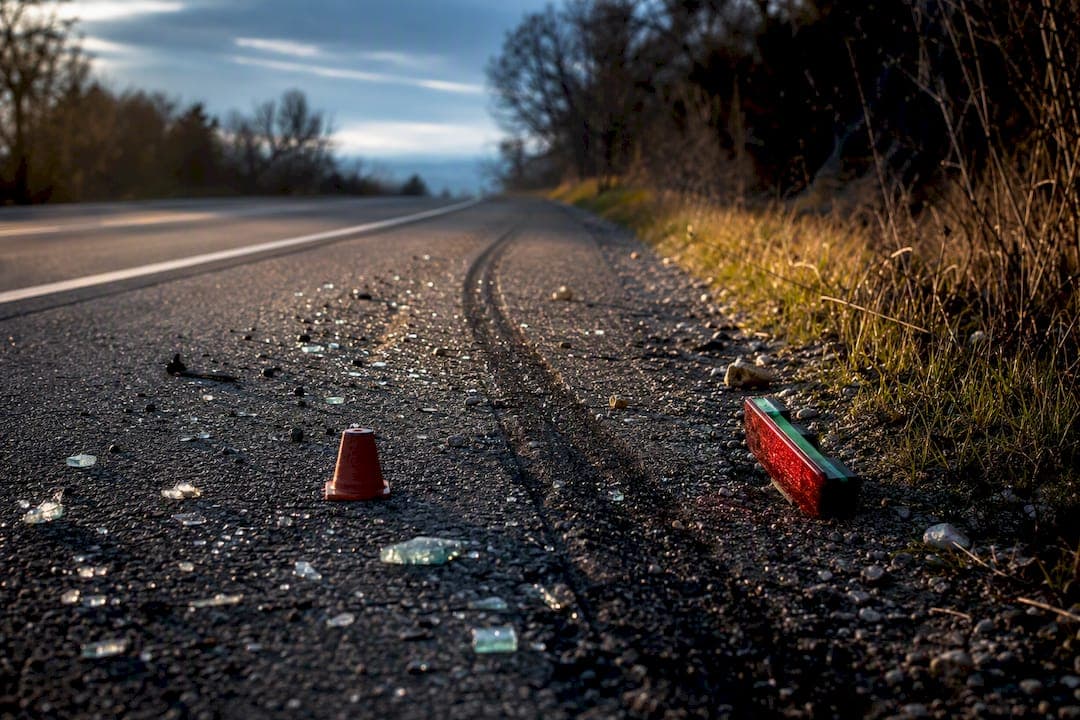
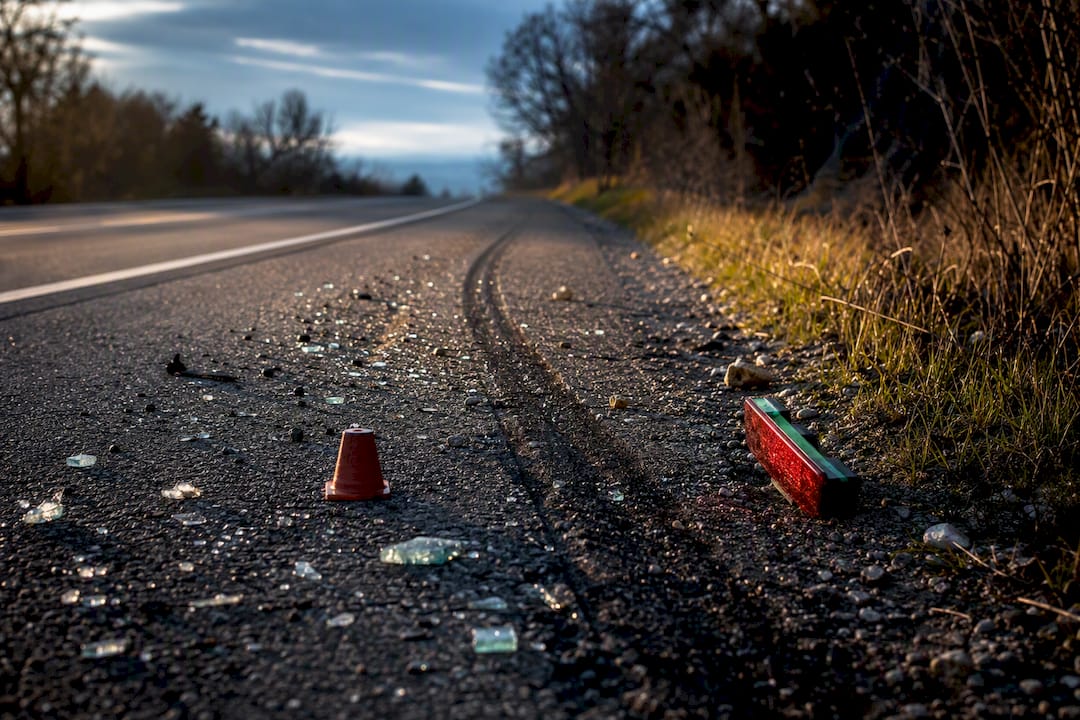
A phantom vehicle accident happens when another driver’s actions cause your crash without any physical contact between vehicles, and that driver leaves the scene or is never identified. Recovery is possible, but the outcome depends on independent evidence and your state’s insurance rules, particularly the physical-contact rule. This guide covers the proof that matters, how coverage typically applies, and what to do in the hours after the crash.
TL;DR:
- Evidence like dashcam footage, eyewitness accounts, and event data recorders are the strongest proof of a no-contact phantom vehicle crash.
- Insurers often dismiss these claims unless there is physical contact or independent evidence, especially in states with strict corroboration rules.
- Reporting windows for damage and evidence preservation typically close within 24 to 72 hours, making timely action crucial.
- Uninsured motorist coverage generally covers injuries when a phantom driver cannot be identified, but eligibility depends heavily on your state’s laws and policy language.
- Gathering and preserving evidence immediately after the crash is essential to strengthen your claim, with legal help recommended if evidence is scarce or disputed.
Table of Contents
- How Phantom Vehicle Accidents Typically Happen
- Why Phantom Vehicle Claims Are So Hard to Prove
- What Evidence Actually Moves the Needle
- How Insurance Coverage Usually Applies
- What to Do in the Hours After the Crash
- When to Get Legal Help With a Phantom Vehicle Claim
- What This Guide Gets Right That Most Advice Misses
- Get a No-Obligation Eligibility Check From Caseclosedfl
- Sources
- FAQ
How Phantom Vehicle Accidents Typically Happen
A phantom vehicle causes a crash through its actions, not its bumper. The driver forces you into a maneuver that results in damage or injury, then disappears before anyone gets a plate number.
The most common scenarios include:
- Cut-offs: a driver merges into your lane too closely, forcing a swerve or hard brake.
- Lane encroachment: a vehicle drifts across the centerline, pushing you toward the shoulder or oncoming traffic.
- Phantom braking: a car ahead stops abruptly for no visible reason, triggering a chain reaction behind it.
- Forced evasive maneuvers: a motorcyclist or cyclist swerves to avoid a car that never actually touches them.
This is different from a hit-and-run, which usually leaves paint transfer, dents, or debris tying a specific vehicle to the collision. A phantom vehicle crash often leaves nothing but skid marks and a single damaged car. Fault can still exist under the law even without contact. Proving it is the hard part.
Why Phantom Vehicle Claims Are So Hard to Prove
Insurers tend to treat a no-contact crash as a single-vehicle accident until you show them otherwise. Without a second car’s paint on your bumper, the burden shifts almost entirely to you to prove another driver caused the wreck.
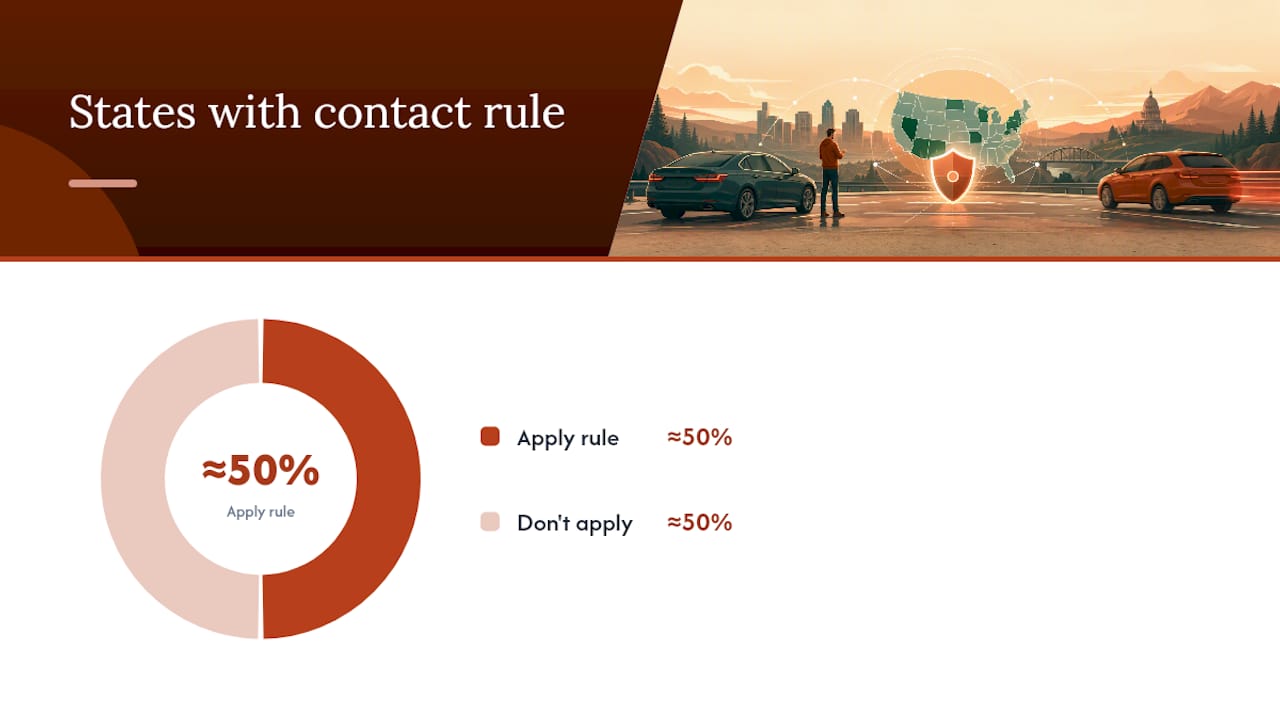
That skepticism has legal teeth in a lot of states. At least two dozen U.S. states enforce a physical-contact rule or a strict corroboration standard that can bar an uninsured motorist claim unless there was actual contact or independent evidence backing your account. The rule started as an anti-fraud measure, since a driver could otherwise claim any single-vehicle wreck was caused by a car that was never there.
Statistic Callout: Roughly half the states in the country apply some version of the physical-contact or corroboration requirement to uninsured-motorist claims, according to USLegal’s overview of phantom vehicle law. Whether that rule applies to your policy often decides the entire case before you even file.
A few other hurdles compound the problem:
- Policy reporting windows are often just 24 to 72 hours, and missing that window can void your claim entirely.
- Corroboration clauses in the policy language may require a named witness, not just your recorded statement.
- Insurers may request a recorded statement early, before you have gathered supporting evidence.
Knowing whether your state applies the physical-contact rule should be one of your first calls after the crash.
What Evidence Actually Moves the Needle
Not all evidence carries equal weight in a no-contact claim. Crash events are rare and poorly documented by nature, which is why research on crash and near-miss prediction points to video and sensor data as the most reliable way to reconstruct what happened when no one collided.
Rank your evidence-gathering effort in this order:
- Dashcam or CCTV footage. Traffic cameras, nearby businesses, and your own dashcam are the strongest proof a phantom vehicle existed, according to insurance industry explainers on phantom vehicle claims.
- Disinterested eyewitnesses. A stranger with no stake in the outcome carries far more credibility with an adjuster than a passenger in your car.
- Event Data Recorder (EDR) output. Your vehicle’s black box logs braking, speed, and steering input in the seconds before impact, and it can corroborate your version of events.
- Nearby surveillance and phone or GPS logs. Gas stations, doorbell cameras, and your own phone’s location history can place a phantom vehicle at the scene.
- Photos, skid marks, and damage patterns. These support the story but rarely prove it alone.
- Medical records. Documentation created the same day you were treated adds credibility to your timeline.
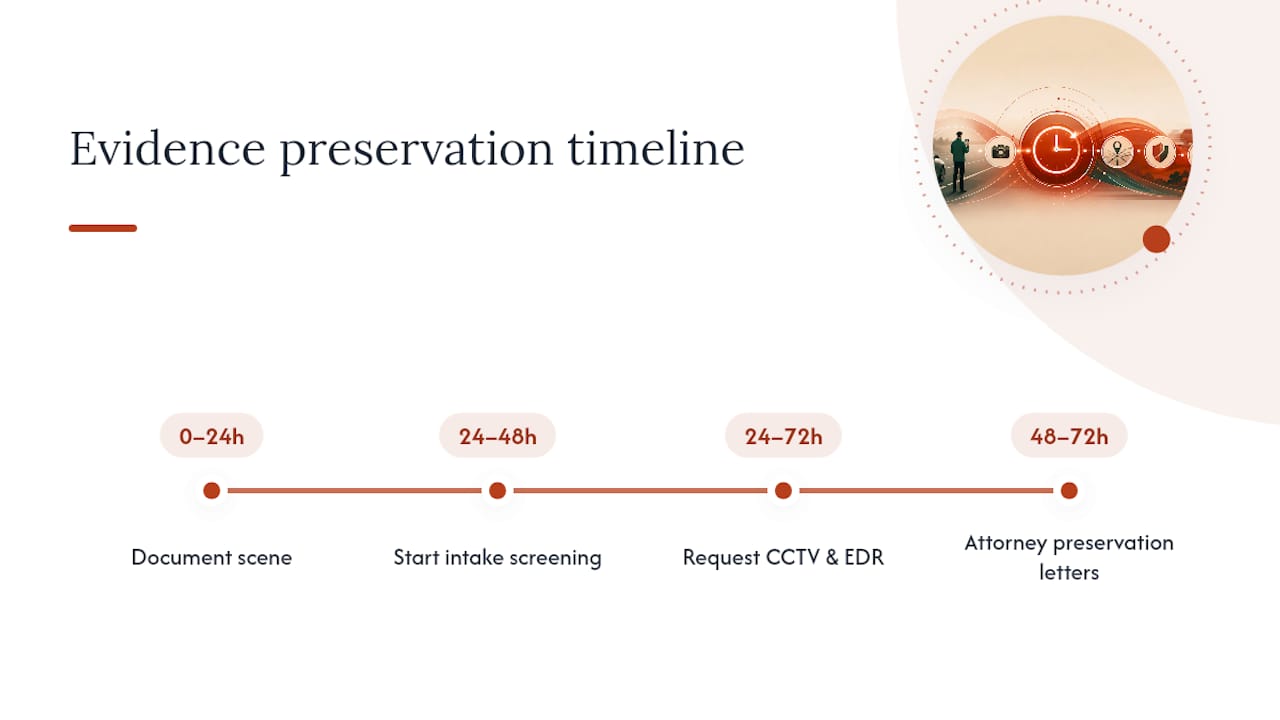
Pro Tip: Request CCTV preservation in writing within 24 to 48 hours. Most commercial systems overwrite footage on a rolling loop, sometimes within a week, and once it’s gone, it’s gone for good.
How Insurance Coverage Usually Applies
Uninsured/underinsured motorist coverage, or UM/UIM, is generally the primary path to recovery when the at-fault driver can’t be identified. Requirements vary significantly by state, and this is exactly where the physical-contact rule tends to surface.
- UM/UIM coverage: pays for injuries and sometimes damage caused by an unidentified driver, subject to your state’s contact or corroboration rules.
- Collision coverage: falls back to cover vehicle damage (not medical costs) if UM is blocked, minus your deductible.
- PIP or MedPay: often covers medical expenses regardless of who caused the crash, making it useful even when fault is unclear.
Statistic Callout: Kemper’s guidance on phantom vehicle claims notes that coverage applicability hinges entirely on your specific policy language and state, which is why two drivers with seemingly identical crashes can get very different outcomes from the same insurer.
If you were riding a motorcycle or driving in Miami traffic and got forced off the road by a driver who vanished, the claim path usually runs through UM first. A Miami uninsured driver accident claim often hinges on whether independent corroboration exists, not just your account of the crash.
What to Do in the Hours After the Crash
The evidence window closes fast. A phantom vehicle accident that isn’t documented within days is a much harder case to win weeks later.
- Get medical attention first. Injuries take priority, and a same-day medical record also becomes evidence.
- Call 911 and request a police report. Get the case number before the officer leaves. It anchors every future request for footage or records.
- Photograph everything. The scene, your damage, skid marks, and the surrounding area, including any businesses with visible cameras.
- Collect witness information. Names and phone numbers, not just a nod that someone “saw it happen.”
- Ask about surveillance immediately. Nearby stores and homes may erase footage within days.
- Report to your insurer the same day if possible. Note your policy’s exact reporting deadline in writing.
Pro Tip: Write down the officer’s name, badge number, and the case number in your phone before you leave the scene. Adjusters and attorneys will ask for it first, and it speeds up every records request that follows.
When to Get Legal Help With a Phantom Vehicle Claim
Serious injury, thin evidence, or an early insurer denial are strong signals that this isn’t a claim to handle alone. A lawyer can move fast where you can’t: sending preservation letters and subpoenas for EDR data or CCTV before it’s overwritten.
Caseclosedfl’s intake process screens the details of your crash and routes qualified cases for human review before connecting you with an attorney. It doesn’t provide legal advice or guarantee an outcome. It protects your privacy by requesting contact information only after the initial screening, so you aren’t fielding unwanted solicitation while you’re still gathering evidence.
What This Guide Gets Right That Most Advice Misses
Most articles on phantom vehicle accidents lead with sympathy and end with vague advice to “call a lawyer.” That undersells the actual leverage point: timing. The physical-contact rule and reporting windows mean the outcome of your claim is often decided in the first 48 to 72 hours, not in a courtroom months later.
Conventional wisdom treats the police report as the finish line. It’s the starting line. A case number without CCTV, an EDR request, or a witness statement is just a formality that documents your loss without proving who caused it.
If I had to tell someone one thing, it would be this: stop treating the claim like a story you tell your insurer and start treating it like an evidence-collection sprint. The driver who caused your crash isn’t coming back to confess. Your proof has to survive without them, and most of that proof has an expiration date measured in days, not months. Prioritize the video and the witness before you prioritize the paperwork.
— Luis
Get a No-Obligation Eligibility Check From Caseclosedfl
If you’re weighing whether a phantom vehicle case is worth pursuing, Caseclosedfl gives you a faster read than guessing alone. The intake asks for details about your injury, fault, current treatment, and any existing legal representation, then routes qualified cases for human review before anyone asks for your contact information. Nothing about the process locks you into hiring a specific attorney.
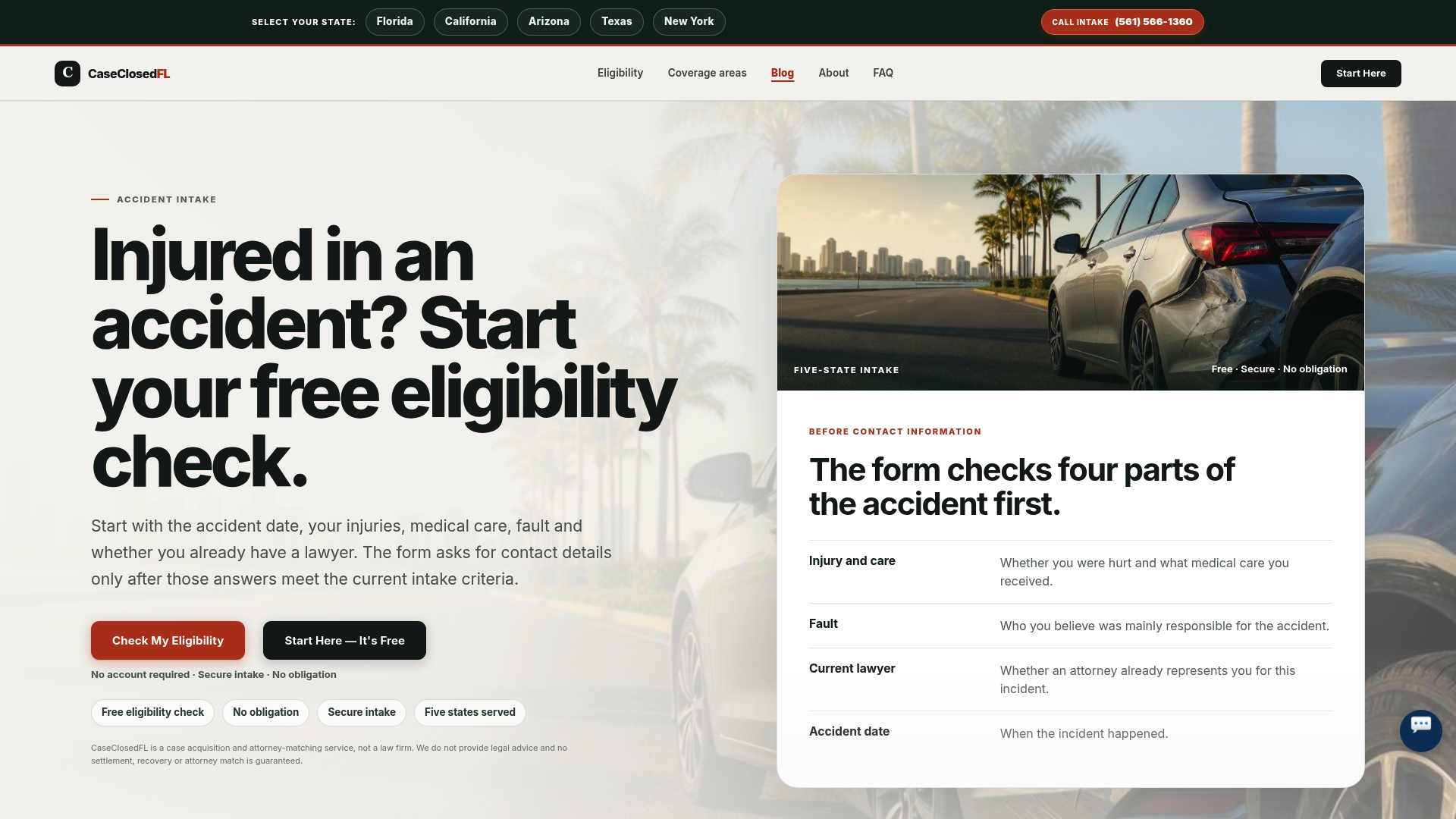
Caseclosedfl covers accident intake across Florida, California, Arizona, Texas, and New York, so wherever your phantom vehicle crash happened, there’s likely a state-specific path built for it. If you’re in South Florida, the Fort Lauderdale case review walks through what local claims typically need. Arizona residents can start with the Arizona intake page instead. Submit your details through Caseclosedfl’s eligibility check and find out where your case stands before evidence like dashcam footage or CCTV disappears for good.
This article is general information, not a substitute for advice from a qualified lawyer. Consult a qualified legal professional about your own circumstances before acting on anything here.
Sources
- Phantom Vehicle Law and Legal Definition | USLegal, Inc.
- Counterfactual and near-miss approaches to crash prediction (arXiv 2025)
- What is a phantom vehicle accident? | Infinity Insurance Agency
FAQ
What is a phantom accident?
A phantom accident, or phantom vehicle accident, is a crash caused by another driver’s actions, like a swerve or sudden stop, without any physical contact between vehicles. The at-fault driver is often unidentified because they left the scene or were never seen clearly.
What is the deadliest state to drive in?
Fatality rates vary by year and by how they’re measured (per mile driven versus per capita), and no single state holds that title consistently across every dataset. State transportation and traffic safety agencies publish updated annual figures, and checking your specific state’s most recent report gives a more accurate picture than a general ranking.
Has a Waymo ever hit a pedestrian?
This falls outside the scope of phantom vehicle claims covered here, and autonomous vehicle incident data is tracked separately by manufacturers and regulators. Check the National Highway Traffic Safety Administration’s incident reporting database for verified, up-to-date information on specific autonomous vehicle events.
What should I not tell my insurance company after a phantom vehicle accident?
Avoid speculating about fault, guessing at speeds or distances, or giving a recorded statement before you’ve gathered evidence like witness contacts or CCTV footage. Stick to the facts you’re certain of, and consider having an attorney review your statement first if the insurer is pushing back on the claim.
Can Caseclosedfl guarantee I’ll win my phantom vehicle claim?
No. Caseclosedfl’s intake process screens your case details and routes qualified leads for human review to connect you with a participating attorney, but it does not provide legal advice or guarantee any outcome. Whether you recover ultimately depends on your evidence, your state’s rules, and your policy language.
Recommended
Frequently asked questions
Table of Contents How Phantom Vehicle Accidents Typically Happen Why Phantom Vehicle Claims Are So Hard to Prove What Evidence Actually Moves the Needle How Insurance Coverage Usually Applies What to Do in the Hours After the Crash When to Get Legal Help With a Phantom Vehicle Claim What This Guide Gets Right That Most Advice Misses Get a No-Obligation Eligibility Check From Caseclosedfl Sources FAQ How Phantom Vehicle Accidents Typically Happen A phantom vehicle causes a crash through its actions, not its bumper. The driver forces you into a maneuver that results in damage or injury, then disappears before anyone gets a plate number. The most common scenarios include: Cut-offs : a driver merges into your lane too closely, forcing a swerve or hard brake. Lane encroachment : a vehicle drifts across the centerline, pushing you toward the shoulder or oncoming traffic. Phantom braking : a car ahead stops abruptly for no visible reason, triggering a chain reaction behind it. Forced evasive maneuvers : a motorcyclist or cyclist swerves to avoid a car that never actually touches them. This is different from a hit-and-run, which usually leaves paint transfer, dents, or debris tying a specific vehicle to the collision. A phantom vehicle crash often leaves nothing but skid marks and a single damaged car. Fault can still exist under the law even without contact. Proving it is the hard part. Why Phantom Vehicle Claims Are So Hard to Prove Insurers tend to treat a no-contact crash as a single-vehicle accident until you show them otherwise. Without a second car’s paint on your bumper, the burden shifts almost entirely to you to prove another driver caused the wreck. That skepticism has legal teeth in a lot of states. At least two dozen U.S. states enforce a physical-contact rule or a strict corroboration standard that can bar an uninsured motorist claim unless there was actual contact or independent evidence backing your account. The rule started as an anti-fraud measure, since a driver could otherwise claim any single-vehicle wreck was caused by a car that was never there. Statistic Callout: Roughly half the states in the country apply some version of the physical-contact or corroboration requirement to uninsured-motorist claims, according to USLegal’s overview of phantom vehicle law. Whether that rule applies to your policy often decides the entire case before you even file. A few other hurdles compound the problem: Policy reporting windows are often just 24 to 72 hours, and missing that window can void your claim entirely. Corroboration clauses in the policy language may require a named witness, not just your recorded statement. Insurers may request a recorded statement early, before you have gathered supporting evidence. Knowing whether your state applies the physical-contact rule should be one of your first calls after the crash. What Evidence Actually Moves the Needle Not all evidence carries equal weight in a no-contact claim. Crash events are rare and poorly documented by nature, which is why research on crash and near-miss prediction points to video and sensor data as the most reliable way to reconstruct what happened when no one collided. Rank your evidence-gathering effort in this order: Dashcam or CCTV footage. Traffic cameras, nearby businesses, and your own dashcam are the strongest proof a phantom vehicle existed, according to insurance industry explainers on phantom vehicle claims . Disinterested eyewitnesses. A stranger with no stake in the outcome carries far more credibility with an adjuster than a passenger in your car. Event Data Recorder (EDR) output. Your vehicle’s black box logs braking, speed, and steering input in the seconds before impact, and it can corroborate your version of events. Nearby surveillance and phone or GPS logs. Gas stations, doorbell cameras, and your own phone’s location history can place a phantom vehicle at the scene. Photos, skid marks, and damage patterns. These support the story but rarely prove it alone. Medical records. Documentation created the same day you were treated adds credibility to your timeline. Pro Tip: Request CCTV preservation in writing within 24 to 48 hours. Most commercial systems overwrite footage on a rolling loop, sometimes within a week, and once it’s gone, it’s gone for good. How Insurance Coverage Usually Applies Uninsured/underinsured motorist coverage, or UM/UIM, is generally the primary path to recovery when the at-fault driver can’t be identified. Requirements vary significantly by state, and this is exactly where the physical-contact rule tends to surface. UM/UIM coverage : pays for injuries and sometimes damage caused by an unidentified driver, subject to your state’s contact or corroboration rules. Collision coverage : falls back to cover vehicle damage (not medical costs) if UM is blocked, minus your deductible. PIP or MedPay : often covers medical expenses regardless of who caused the crash, making it useful even when fault is unclear. Statistic Callout: Kemper’s guidance on phantom vehicle claims notes that coverage applicability hinges entirely on your specific policy language and state, which is why two drivers with seemingly identical crashes can get very different outcomes from the same insurer. If you were riding a motorcycle or driving in Miami traffic and got forced off the road by a driver who vanished, the claim path usually runs through UM first. A Miami uninsured driver accident claim often hinges on whether independent corroboration exists, not just your account of the crash. What to Do in the Hours After the Crash The evidence window closes fast. A phantom vehicle accident that isn’t documented within days is a much harder case to win weeks later. Get medical attention first. Injuries take priority, and a same-day medical record also becomes evidence. Call 911 and request a police report. Get the case number before the officer leaves. It anchors every future request for footage or records. Photograph everything. The scene, your damage, skid marks, and the surrounding area, including any businesses with visible cameras. Collect witness information. Names and phone numbers, not just a nod that someone “saw it happen.” Ask about surveillance immediately. Nearby stores and homes may erase footage within days. Report to your insurer the same day if possible. Note your policy’s exact reporting deadline in writing. Pro Tip: Write down the officer’s name, badge number, and the case number in your phone before you leave the scene. Adjusters and attorneys will ask for it first, and it speeds up every records request that follows. When to Get Legal Help With a Phantom Vehicle Claim Serious injury, thin evidence, or an early insurer denial are strong signals that this isn’t a claim to handle alone. A lawyer can move fast where you can’t: sending preservation letters and subpoenas for EDR data or CCTV before it’s overwritten. Caseclosedfl’s intake process screens the details of your crash and routes qualified cases for human review before connecting you with an attorney. It doesn’t provide legal advice or guarantee an outcome. It protects your privacy by requesting contact information only after the initial screening, so you aren’t fielding unwanted solicitation while you’re still gathering evidence. What This Guide Gets Right That Most Advice Misses Most articles on phantom vehicle accidents lead with sympathy and end with vague advice to “call a lawyer.” That undersells the actual leverage point: timing. The physical-contact rule and reporting windows mean the outcome of your claim is often decided in the first 48 to 72 hours, not in a courtroom months later. Conventional wisdom treats the police report as the finish line. It’s the starting line. A case number without CCTV, an EDR request, or a witness statement is just a formality that documents your loss without proving who caused it. If I had to tell someone one thing, it would be this: stop treating the claim like a story you tell your insurer and start treating it like an evidence-collection sprint. The driver who caused your crash isn’t coming back to confess. Your proof has to survive without them, and most of that proof has an expiration date measured in days, not months. Prioritize the video and the witness before you prioritize the paperwork. — Luis Get a No-Obligation Eligibility Check From Caseclosedfl If you’re weighing whether a phantom vehicle case is worth pursuing, Caseclosedfl gives you a faster read than guessing alone. The intake asks for details about your injury, fault, current treatment, and any existing legal representation, then routes qualified cases for human review before anyone asks for your contact information. Nothing about the process locks you into hiring a specific attorney. Caseclosedfl covers accident intake across Florida, California, Arizona, Texas, and New York, so wherever your phantom vehicle crash happened, there’s likely a state-specific path built for it. If you’re in South Florida, the Fort Lauderdale case review walks through what local claims typically need. Arizona residents can start with the Arizona intake page instead. Submit your details through Caseclosedfl’s eligibility check and find out where your case stands before evidence like dashcam footage or CCTV disappears for good. This article is general information, not a substitute for advice from a qualified lawyer. Consult a qualified legal professional about your own circumstances before acting on anything here. Sources Phantom Vehicle Law and Legal Definition | USLegal, Inc. Counterfactual and near-miss approaches to crash prediction (arXiv 2025) What is a phantom vehicle accident? | Infinity Insurance Agency FAQ What is a phantom accident?
A phantom accident, or phantom vehicle accident, is a crash caused by another driver’s actions, like a swerve or sudden stop, without any physical contact between vehicles. The at-fault driver is often unidentified because they left the scene or were never seen clearly.
What is the deadliest state to drive in?
Fatality rates vary by year and by how they’re measured (per mile driven versus per capita), and no single state holds that title consistently across every dataset. State transportation and traffic safety agencies publish updated annual figures, and checking your specific state’s most recent report gives a more accurate picture than a general ranking.
Has a Waymo ever hit a pedestrian?
This falls outside the scope of phantom vehicle claims covered here, and autonomous vehicle incident data is tracked separately by manufacturers and regulators. Check the National Highway Traffic Safety Administration’s incident reporting database for verified, up-to-date information on specific autonomous vehicle events.
What should I not tell my insurance company after a phantom vehicle accident?
Avoid speculating about fault, guessing at speeds or distances, or giving a recorded statement before you’ve gathered evidence like witness contacts or CCTV footage. Stick to the facts you’re certain of, and consider having an attorney review your statement first if the insurer is pushing back on the claim.
Can Caseclosedfl guarantee I’ll win my phantom vehicle claim?
No. Caseclosedfl’s intake process screens your case details and routes qualified leads for human review to connect you with a participating attorney, but it does not provide legal advice or guarantee any outcome. Whether you recover ultimately depends on your evidence, your state’s rules, and your policy language.
Ready to enter the accident details?
The eligibility form asks about the accident, injury, treatment, fault and representation before contact information.
Start Eligibility Check