Win Your Rental Reimbursement Claim: Docs, Appeals, Free U.S. Check
Exactly which documents speed U.S. rental car reimbursement, how to file written demands and use DOI or small claims, plus a free CaseClosedFL check.


Rental car reimbursement pays for a replacement vehicle only if you added that coverage to your policy before the accident, or if the at-fault driver’s insurer agrees to cover your loss of use. Most policies that include it cap payments with a daily dollar limit and a per-claim ceiling, often tied to a 30-day window. If your repair is taking longer than expected, get the repair shop’s timeline in writing and send it to the adjuster right away.
TL;DR:
- Rental reimbursement coverage typically caps payments around $40 to $65 per day for up to 30 days, depending on the policy limit and vehicle size.
- Confirm in writing that your rental limit matches the repair timeline and avoid upgrading beyond your policy’s daily cap to prevent out-of-pocket costs.
- When another driver is at fault, you can pursue a loss of use claim against their insurer, but using your own coverage often speeds up the process.
- Keep detailed records of repair timelines, rental invoices, and communications to strengthen any dispute over caps or denials.
- Adding rental reimbursement usually costs less than a week of rental fees annually, making it a worthwhile safeguard if you have limited vehicle options.
Table of Contents
- What rental reimbursement actually covers and when it applies
- How rental reimbursement works step by step during a claim
- How much rental reimbursement typically pays
- Your coverage versus the at-fault driver’s loss of use
- What to do if your rental coverage is capped or denied
- Is it worth adding rental reimbursement to your policy?
- Exclusions and rental-company fees to watch for
- Practical steps to avoid gaps and speed up payment
- When a rental dispute calls for legal help
- What we’d prioritize after an accident
- Start a free eligibility check with CaseClosedFL
- FAQ
- Sources
What rental reimbursement actually covers and when it applies
Rental reimbursement appears on auto policies under various terms such as rental reimbursement, transportation expense coverage, or loss of use, all referring to payment toward a substitute vehicle while yours is out of service for a covered reason.
The coverage applies for specific covered events like collision repairs, comprehensive claims due to theft or vandalism, or a total loss during the settlement period.
It does not cover routine maintenance, mechanical breakdowns, or personal decisions not to drive. To confirm coverage, check your policy declarations for a rental reimbursement or transportation expense line with stated limits.

How rental reimbursement works step by step during a claim
Once you’ve confirmed the coverage exists, the process generally follows a predictable sequence.
- File your collision or comprehensive claim and ask the adjuster to confirm your rental reimbursement limits in writing.
- Get a written repair estimate and timeline from the shop and forward it to the adjuster so the authorized rental period matches the actual repair schedule.
- Arrange the rental, either through the insurer’s direct billing relationship with a rental company or by paying out of pocket and submitting receipts for reimbursement.
Insurer-arranged rentals are usually simpler because the rental desk bills the carrier directly, within your daily limit. Paying yourself means you front the cost and wait for reimbursement, so keep every receipt.
Documents worth keeping: the repair estimate with a dated timeline, all rental receipts, and copies of adjuster emails or claim notes.
Pro Tip: Ask the adjuster to confirm your rental limit and expected coverage end date in writing before you pick up the keys, not after.
How much rental reimbursement typically pays
Rental reimbursement works as a capped pool of money, not an open-ended benefit. Most policies set a daily dollar limit and a separate per-claim maximum, and coverage is usually capped around a 30-day repair window.
- A common structure pairs a daily limit with a per-claim cap, such as $40 per day up to $1,200 total.
- At $40 a day, that $1,200 cap lasts exactly 30 days if you rent an economy car within the limit.
- Choosing a larger vehicle that costs $65 a day burns through the same $1,200 cap in about 18 days.
Typical add-on premiums for this coverage run about $2 to $15 per month, a small cost compared to a week of rental bills. Fuel, optional upgrades, and extra rental-company coverage products are generally excluded and billed separately, while taxes are sometimes included in the daily rate and sometimes added on top, so confirm this with your adjuster before you sign the rental agreement.
Your coverage versus the at-fault driver’s loss of use
When someone else caused the accident, you have two paths to a replacement car: your own rental reimbursement coverage, or a loss-of-use demand against the at-fault driver’s insurer.
Loss of use is the legal principle that the at-fault insurer owes you the value of transportation for the reasonable repair period, separate from any coverage you personally carry.
- Using your own coverage is usually faster, since you don’t have to wait for the other insurer to accept liability.
- Your insurer can later recover those costs from the at-fault carrier through subrogation, so you aren’t penalized for acting quickly.
- To pursue loss of use directly, send the at-fault insurer a written repair timeline along with documentation of comparable local rental costs.
What to do if your rental coverage is capped or denied
Disputes usually come down to documentation. Start building a paper trail the moment a disagreement appears.
- Collect the repair shop’s written timeline, every rental invoice, and copies of all communication with the adjuster, including dates.
- Send a written demand that attaches the repair timeline and asks the insurer to state, in writing, the specific reason for any cap or denial.
- If the response is unsatisfactory, file a complaint with your state’s Department of Insurance, since most states accept consumer complaints online and investigate unreasonable claim handling.
- For smaller disputed amounts, small claims court is often faster than litigation.
- If you suspect bad-faith denial or a pattern of unreasonable caps, a consultation with an attorney who handles insurance disputes is worth the time.
Is it worth adding rental reimbursement to your policy?
Rental reimbursement is optional, and Experian notes it typically runs about $2 to $15 per month, or roughly $20 to $60 a year, depending on the limits you choose.
- A week of rental costs alone often exceeds a full year of this add-on, which is why rental and insurance guidance frames it as inexpensive relative to what renters actually pay out of pocket.
- It’s especially worth carrying if you have one car per household, commute daily, or have no backup vehicle available.
- Choose a daily limit close to what an economy rental actually costs in your area, rather than the policy’s default minimum, so a real claim doesn’t leave you paying the difference.
Exclusions and rental-company fees to watch for
A few recurring traps catch people off guard after an accident.
- A Loss Damage Waiver purchased at the counter protects the rental car itself, but your personal auto policy may still exclude damage to a rental you’re driving, so check both before declining the waiver.
- Rental companies separately bill for their own “loss of use” and administrative fees while the damaged rental is out of service, and claim administrators for companies like Avis and Budget pursue these charges from the responsible party or their insurer.
- Peer-to-peer rental platforms and credit-card rental coverage carry their own contractual terms that differ from a traditional rental counter, so confirm the fine print before assuming either one fills the gap.
Practical steps to avoid gaps and speed up payment
A few habits consistently shorten disputes and keep more money in your pocket.
- Email the shop’s written repair estimate and timeline to the adjuster the same day you receive it.
- Rent an economy or compact vehicle that fits inside your daily limit, or ask the insurer to arrange the rental directly.
- Log every call and email, and if the insurer reduces or denies coverage, ask for that decision in writing.
Pro Tip: A detailed shop timeline that separates labor delays from parts-and-paint delays often resolves disputes faster than a phone call, since adjusters frequently calculate rental days from productive labor hours rather than the calendar.
When a rental dispute calls for legal help
Most rental reimbursement disagreements resolve with documentation and a written demand. Legal help becomes worth considering when the shortfall is large, when an insurer repeatedly shortens your rental period without a clear reason, or when a denial looks like bad faith rather than a simple coverage limit.
We gather the basic accident facts, including injury, fault, and existing legal representation, before requesting any contact information, then route qualifying cases for human review and possible attorney referral.
What we’d prioritize after an accident
Documentation beats negotiation every time. We’d keep the repair shop’s written timeline, every rental receipt, and a dated log of adjuster calls from day one, and we’d rent an economy car within the policy limit rather than upgrading and hoping the difference gets reimbursed.
Confirming your daily and per-claim limits before you need them avoids most disputes outright. When a denial or repeated cap doesn’t add up, a free eligibility check is a low-risk way to find out whether legal help makes sense.
— Luis
Start a free eligibility check with CaseClosedFL
If a rental reimbursement dispute has stalled and the shortfall is adding up, we offer a free, no-obligation eligibility check that reviews your accident details, including injury, fault, and any existing legal representation, before ever asking for your personal contact information.
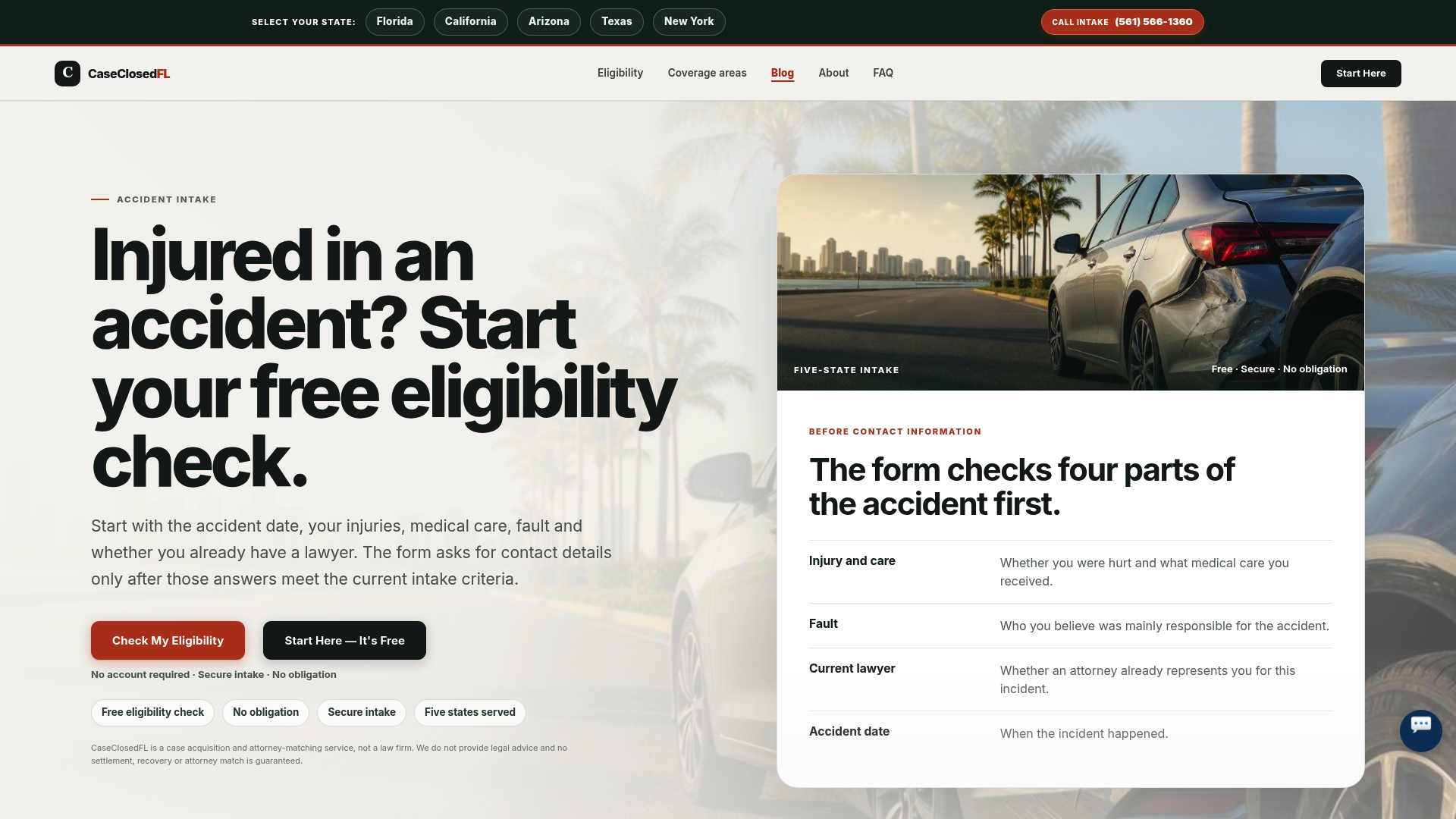
The intake covers multiple states, and every submission goes through human review before any attorney referral is made. Start the free eligibility check to see where you stand.
This article is general information, not a substitute for advice from a qualified financial advisor. Consult a qualified financial professional about your own circumstances before acting on anything here.

FAQ
How do I get reimbursed for a rental car after an accident?
File your collision or comprehensive claim, confirm your rental reimbursement limits with the adjuster, and send the repair shop’s written timeline as soon as you have it. You’ll either rent through the insurer’s direct billing arrangement or pay out of pocket and submit receipts for reimbursement.
Does my car insurance cover me in a rental car in another country?
Coverage for a rental car abroad depends entirely on your specific policy’s terms, and many U.S. auto policies limit or exclude coverage outside the United States and Canada. Check your declarations page or call your insurer directly before renting internationally, since this varies by carrier and policy.
What are the hidden fees when renting a car?
Common extra charges include fuel refueling fees, optional upgrade costs, and additional rental-company coverage products that sit outside your personal policy’s rental reimbursement. If you’re involved in an accident while renting, the rental company may also separately bill for its own loss-of-use and administrative fees while the vehicle is out of service.
Do you get money back after renting a car?
You get money back only if you paid out of pocket for a rental covered by your reimbursement coverage or an at-fault insurer’s loss-of-use payment, and you submit valid receipts. Without that coverage in place before the loss, there’s no retroactive reimbursement for a rental you already paid for.
Sources
Frequently asked questions
Table of Contents What rental reimbursement actually covers and when it applies How rental reimbursement works step by step during a claim How much rental reimbursement typically pays Your coverage versus the at-fault driver’s loss of use What to do if your rental coverage is capped or denied Is it worth adding rental reimbursement to your policy? Exclusions and rental-company fees to watch for Practical steps to avoid gaps and speed up payment When a rental dispute calls for legal help What we’d prioritize after an accident Start a free eligibility check with CaseClosedFL FAQ Sources What rental reimbursement actually covers and when it applies Rental reimbursement appears on auto policies under various terms such as rental reimbursement, transportation expense coverage, or loss of use, all referring to payment toward a substitute vehicle while yours is out of service for a covered reason. The coverage applies for specific covered events like collision repairs, comprehensive claims due to theft or vandalism, or a total loss during the settlement period. It does not cover routine maintenance, mechanical breakdowns, or personal decisions not to drive. To confirm coverage, check your policy declarations for a rental reimbursement or transportation expense line with stated limits. How rental reimbursement works step by step during a claim Once you’ve confirmed the coverage exists, the process generally follows a predictable sequence. File your collision or comprehensive claim and ask the adjuster to confirm your rental reimbursement limits in writing. Get a written repair estimate and timeline from the shop and forward it to the adjuster so the authorized rental period matches the actual repair schedule. Arrange the rental, either through the insurer’s direct billing relationship with a rental company or by paying out of pocket and submitting receipts for reimbursement. Insurer-arranged rentals are usually simpler because the rental desk bills the carrier directly, within your daily limit. Paying yourself means you front the cost and wait for reimbursement, so keep every receipt. Documents worth keeping: the repair estimate with a dated timeline, all rental receipts, and copies of adjuster emails or claim notes. Pro Tip: Ask the adjuster to confirm your rental limit and expected coverage end date in writing before you pick up the keys, not after. How much rental reimbursement typically pays Rental reimbursement works as a capped pool of money, not an open-ended benefit. Most policies set a daily dollar limit and a separate per-claim maximum, and coverage is usually capped around a 30-day repair window . A common structure pairs a daily limit with a per-claim cap, such as $40 per day up to $1,200 total. At $40 a day, that $1,200 cap lasts exactly 30 days if you rent an economy car within the limit. Choosing a larger vehicle that costs $65 a day burns through the same $1,200 cap in about 18 days. Typical add-on premiums for this coverage run about $2 to $15 per month , a small cost compared to a week of rental bills. Fuel, optional upgrades, and extra rental-company coverage products are generally excluded and billed separately, while taxes are sometimes included in the daily rate and sometimes added on top, so confirm this with your adjuster before you sign the rental agreement. Your coverage versus the at-fault driver’s loss of use When someone else caused the accident, you have two paths to a replacement car: your own rental reimbursement coverage, or a loss-of-use demand against the at-fault driver’s insurer. Loss of use is the legal principle that the at-fault insurer owes you the value of transportation for the reasonable repair period, separate from any coverage you personally carry. Using your own coverage is usually faster, since you don’t have to wait for the other insurer to accept liability. Your insurer can later recover those costs from the at-fault carrier through subrogation, so you aren’t penalized for acting quickly. To pursue loss of use directly, send the at-fault insurer a written repair timeline along with documentation of comparable local rental costs. What to do if your rental coverage is capped or denied Disputes usually come down to documentation. Start building a paper trail the moment a disagreement appears. Collect the repair shop’s written timeline, every rental invoice, and copies of all communication with the adjuster, including dates. Send a written demand that attaches the repair timeline and asks the insurer to state, in writing, the specific reason for any cap or denial. If the response is unsatisfactory, file a complaint with your state’s Department of Insurance, since most states accept consumer complaints online and investigate unreasonable claim handling. For smaller disputed amounts, small claims court is often faster than litigation. If you suspect bad-faith denial or a pattern of unreasonable caps, a consultation with an attorney who handles insurance disputes is worth the time. Is it worth adding rental reimbursement to your policy?
Rental reimbursement is optional, and Experian notes it typically runs about $2 to $15 per month, or roughly $20 to $60 a year, depending on the limits you choose.
Exclusions and rental-company fees to watch for A few recurring traps catch people off guard after an accident. A Loss Damage Waiver purchased at the counter protects the rental car itself, but your personal auto policy may still exclude damage to a rental you’re driving, so check both before declining the waiver. Rental companies separately bill for their own “loss of use” and administrative fees while the damaged rental is out of service, and claim administrators for companies like Avis and Budget pursue these charges from the responsible party or their insurer. Peer-to-peer rental platforms and credit-card rental coverage carry their own contractual terms that differ from a traditional rental counter, so confirm the fine print before assuming either one fills the gap. Practical steps to avoid gaps and speed up payment A few habits consistently shorten disputes and keep more money in your pocket. Email the shop’s written repair estimate and timeline to the adjuster the same day you receive it. Rent an economy or compact vehicle that fits inside your daily limit, or ask the insurer to arrange the rental directly. Log every call and email, and if the insurer reduces or denies coverage, ask for that decision in writing. Pro Tip: A detailed shop timeline that separates labor delays from parts-and-paint delays often resolves disputes faster than a phone call, since adjusters frequently calculate rental days from productive labor hours rather than the calendar. When a rental dispute calls for legal help Most rental reimbursement disagreements resolve with documentation and a written demand. Legal help becomes worth considering when the shortfall is large, when an insurer repeatedly shortens your rental period without a clear reason, or when a denial looks like bad faith rather than a simple coverage limit. We gather the basic accident facts, including injury, fault, and existing legal representation, before requesting any contact information, then route qualifying cases for human review and possible attorney referral. What we’d prioritize after an accident Documentation beats negotiation every time. We’d keep the repair shop’s written timeline, every rental receipt, and a dated log of adjuster calls from day one, and we’d rent an economy car within the policy limit rather than upgrading and hoping the difference gets reimbursed. Confirming your daily and per-claim limits before you need them avoids most disputes outright. When a denial or repeated cap doesn’t add up, a free eligibility check is a low-risk way to find out whether legal help makes sense. — Luis Start a free eligibility check with CaseClosedFL If a rental reimbursement dispute has stalled and the shortfall is adding up, we offer a free, no-obligation eligibility check that reviews your accident details, including injury, fault, and any existing legal representation, before ever asking for your personal contact information. The intake covers multiple states, and every submission goes through human review before any attorney referral is made. Start the free eligibility check to see where you stand. This article is general information, not a substitute for advice from a qualified financial advisor. Consult a qualified financial professional about your own circumstances before acting on anything here. FAQ How do I get reimbursed for a rental car after an accident?
File your collision or comprehensive claim, confirm your rental reimbursement limits with the adjuster, and send the repair shop’s written timeline as soon as you have it. You’ll either rent through the insurer’s direct billing arrangement or pay out of pocket and submit receipts for reimbursement.
Does my car insurance cover me in a rental car in another country?
Coverage for a rental car abroad depends entirely on your specific policy’s terms, and many U.S. auto policies limit or exclude coverage outside the United States and Canada. Check your declarations page or call your insurer directly before renting internationally, since this varies by carrier and policy.
What are the hidden fees when renting a car?
Common extra charges include fuel refueling fees, optional upgrade costs, and additional rental-company coverage products that sit outside your personal policy’s rental reimbursement. If you’re involved in an accident while renting, the rental company may also separately bill for its own loss-of-use and administrative fees while the vehicle is out of service.
Do you get money back after renting a car?
You get money back only if you paid out of pocket for a rental covered by your reimbursement coverage or an at-fault insurer’s loss-of-use payment, and you submit valid receipts. Without that coverage in place before the loss, there’s no retroactive reimbursement for a rental you already paid for.
Ready to enter the accident details?
The eligibility form asks about the accident, injury, treatment, fault and representation before contact information.
Start Eligibility Check