Seat Belt Injuries: What Crash Victims Must Watch for in 24–72 Hours
After a crash, learn the warning signs, why 24–72 hours matter, common scans and recovery timelines, plus how CaseClosedFL can document your claim and...
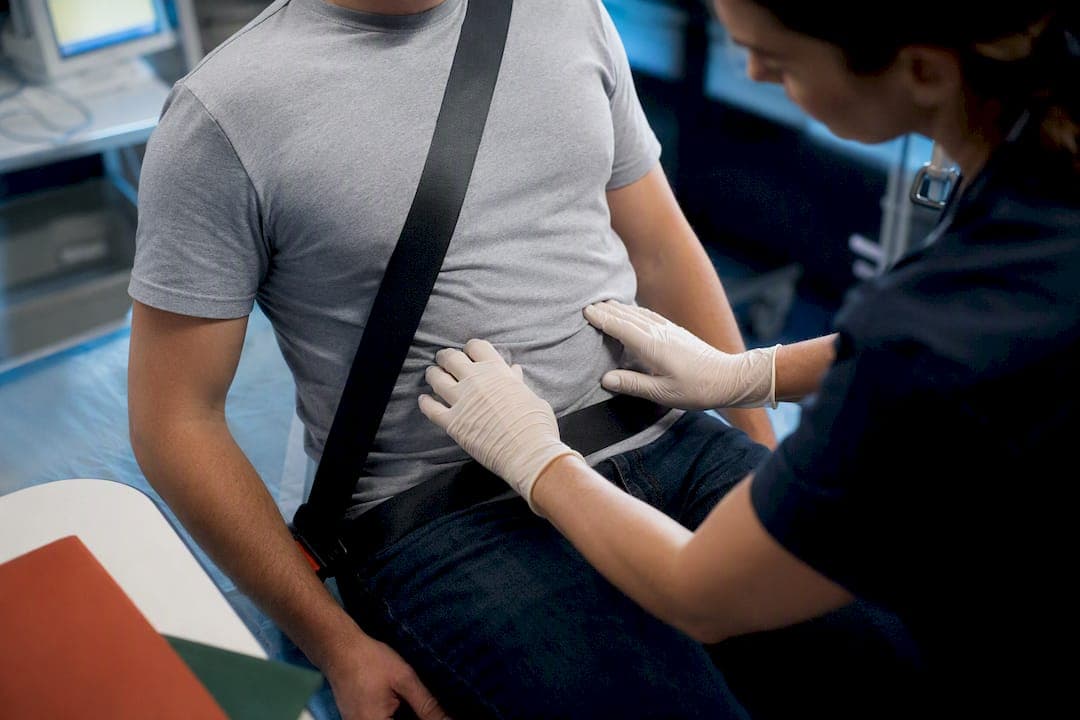
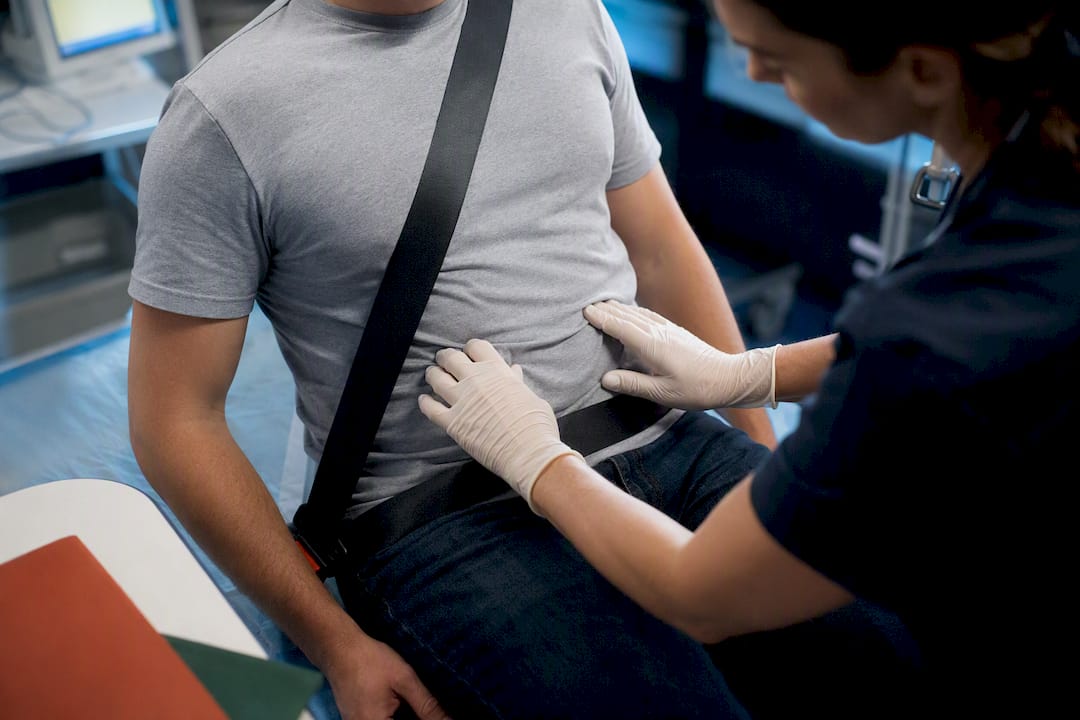
Seat belts reduce fatal and severe injuries in a crash, but they can also cause specific, identifiable injury patterns that sometimes need urgent care. Bruising across the abdomen or chest, known as the “seat belt sign,” can point to internal damage that is not visible from the outside. Anyone in a crash involving noticeable force should get evaluated promptly, photograph any belt marks, and keep every medical record. That documentation protects both recovery and any later injury claim.
TL;DR:
- Visible seat belt bruising indicates a higher risk of internal injuries, especially bowel perforation, and warrants prompt evaluation within 24 to 72 hours.
- Common injury patterns include rib and sternal fractures, abdominal organ damage, and Chance spinal fractures, often influenced by restraint fit and crash dynamics.
- Internal injuries can develop without external signs, making ongoing symptom monitoring critical during the first three days after a crash.
- Proper documentation, including photographs and detailed medical records, significantly improves legal claims following seat belt-related injuries.
- Age, body size, and restraint fit influence injury risk, with children, smaller adults, and seniors facing higher chances of severe or complex trauma.
Table of Contents
- What Is a Seat Belt Injury and Seat Belt Syndrome?
- What Body Parts Do Seat Belts Commonly Injure?
- How Do Seat Belts Actually Cause These Injuries?
- What Are the Warning Signs of a Hidden Seat Belt Injury?
- What Tests and Scans Diagnose Seat Belt Injuries?
- How Is a Seat Belt Injury Treated, and How Long Is Recovery?
- How Do You Document a Seat Belt Injury for a Legal Claim?
- How Can an Intake Service Like CaseClosedFL Help?
- How Common Are Seat Belt Injuries, and How Severe Are They?
- Do Seat Belt Injuries Differ by Age Group?
- Do Lap Belts and Three-Point Belts Cause Different Injuries?
- Why Vigilance Still Matters Even Though Seat Belts Save Lives
- How to Check Eligibility for a Seat Belt Injury Claim
- Sources
- FAQ
What Is a Seat Belt Injury and Seat Belt Syndrome?
A seat belt injury covers any harm caused by the restraint itself during a collision, ranging from a mild bruise to a fractured spine. The clinical term “seat belt sign” refers to linear bruising, or ecchymosis, that traces the path of the lap or shoulder belt across the body. When that mark shows up alongside internal organ damage or a vertebral fracture, physicians call the combination seat belt syndrome.
That distinction matters because the mark itself is a diagnostic clue, not just cosmetic damage. Research on trauma patients has found that a visible seat belt contusion is tied to a significantly higher incidence of intestinal perforation, which is why trauma teams treat the bruise as a warning sign rather than a minor detail. The pattern shows up often enough in abdominal and spinal trauma that emergency physicians are trained to look for it specifically.
Here is what makes seat belt injuries tricky to manage:
- A visible bruise raises suspicion for internal injury, but it is not required for one to exist.
- Bowel and mesenteric injuries can take 24 to 72 hours to fully declare themselves.
- Spinal injuries linked to lap belts, called Chance fractures, do not always cause immediate, obvious pain.
- The absence of any mark does not clear a patient. Internal trauma can present with no external bruising at all.
That last point is the one accident victims miss most. Feeling fine an hour after a crash does not rule out an injury that develops over the following days.
What Body Parts Do Seat Belts Commonly Injure?
Seat belt injuries follow the belt’s physical path across the body, and each region carries its own pattern of damage.
- Neck. The shoulder strap can cause cervical spine fractures, vascular injury to the carotid or vertebral arteries, and clavicle fractures where the belt crosses the collarbone.
- Chest. Rapid deceleration against the shoulder harness commonly causes rib fractures, sternal fractures, pulmonary contusion (bruised lung tissue), and in more severe cases, a collapsed lung or myocardial contusion affecting the heart muscle.
- Abdomen. This is where the most dangerous hidden injuries occur. The lap belt can tear the bowel or its supporting mesentery, lacerate the liver or spleen, and cause a bowel perforation that does not become obvious until it has progressed for a day or more.
- Spine. A lap belt positioned too high, or worn without the shoulder strap, can cause a Chance fracture, a flexion-distraction injury where the spine bends sharply forward around the belt during impact.
- Soft tissue. Abrasions, lacerations, and subcutaneous hematomas along the belt path are the most visible and least dangerous outcome, though some patients develop chronic pain or adhesions from tissue scarring that lingers well after the bruise fades.
Knowing which region corresponds to which symptom helps accident victims describe what they are feeling with more precision when they see a doctor, rather than a vague “everything hurts” that can delay a targeted exam.
How Do Seat Belts Actually Cause These Injuries?
A seat belt works by spreading crash force across the strongest parts of the skeleton, the pelvis and shoulder, instead of letting the body fly forward into the dashboard or windshield. In a crash, a vehicle can decelerate from highway speed to zero in a fraction of a second. The belt has to absorb that kinetic energy fast, and the same tension that keeps someone from becoming a projectile is what bruises skin, cracks ribs, and compresses abdominal organs against the spine.
Several habits and factors make these injuries more likely:
- Wearing the shoulder strap under the arm instead of across the chest, which concentrates force on the ribs and abdomen instead of the sternum.
- Positioning the lap belt across the abdomen rather than low across the hip bones, a common issue in improperly fitted restraints.
- Slouching or reclining the seat, which changes the belt’s angle across the torso.
- Riding with feet up on the dashboard, which redirects crash force through the hips and spine.
- Pregnancy, which shifts the lap belt’s ideal position and raises the stakes of abdominal injury.
Children, small adults, and people with preexisting spinal conditions face elevated risk largely because standard belts are engineered around an average adult frame. A booster seat or properly adjusted belt extender is not a formality. It is what makes the restraint fit the body it is supposed to protect.
What Are the Warning Signs of a Hidden Seat Belt Injury?
Some injuries announce themselves immediately. Others take days to surface, and that gap is exactly when people get hurt worse by assuming they are fine.
Seek emergency care right away if you notice:
- Severe or worsening pain localized to the chest, abdomen, or back.
- An abdomen that looks or feels increasingly swollen or distended.
- Numbness, tingling, or weakness in the arms or legs.
- Lightheadedness, rapid heartbeat, or dropping blood pressure, which can signal internal bleeding.
The seat belt sign itself is one of the most useful predictors available to emergency physicians. Its presence has been linked to a roughly threefold higher incidence of intestinal perforation compared with patients showing no bruising, which is why a visible mark alone justifies a closer look even in someone who otherwise feels okay.
Delayed symptoms deserve just as much attention. Increasing abdominal pain, vomiting, fever, or a change in bowel habits over the 24 to 72 hours after a crash can indicate a slow bowel leak or a mesenteric injury that did not show up on the first scan.
Pro Tip: Set a phone reminder to check in on your own symptoms twice a day for three days after any moderate or severe crash. Bowel and spinal injuries often reveal themselves gradually, not all at once, and a symptom log gives your doctor something more useful than “I think it’s been getting worse.”
What Tests and Scans Diagnose Seat Belt Injuries?
Emergency teams start with a structured primary and secondary survey, checking airway, breathing, circulation, and then working systematically through every body region while documenting exactly how the crash happened, including seat position and belt use. That mechanism-of-injury detail shapes everything that follows.
A FAST exam, a bedside ultrasound that stands for Focused Assessment with Sonography in Trauma, is often the first imaging step because it can detect free fluid in the abdomen within minutes. For anyone with a significant mechanism of injury or a visible seat belt sign, a contrast CT pan-scan covering the head, cervical spine, chest, abdomen, and pelvis has become the standard next step, and it speeds diagnosis of blunt trauma compared with ordering scans one region at a time.
A few specific circumstances push clinicians further:
- Suspected vascular injury, especially when belt marks sit higher than the iliac crests, can prompt CT angiography to check for arterial damage that standard CT might miss.
- Small bowel or mesenteric tears are sometimes missed on the first scan, so serial physical exams and repeat imaging over the following hours matter as much as the initial workup.
- Patients with unstable vital signs, evidence of major vascular injury, or complex spinal fractures typically get admitted or transferred to a trauma center rather than discharged for outpatient follow-up.
How Is a Seat Belt Injury Treated, and How Long Is Recovery?
Treatment splits along a fairly clear line: injuries that can heal on their own get supportive care, and injuries that threaten organ function or spinal stability get surgery.
Conservative management covers most soft-tissue injuries and many rib fractures. That typically means pain control, breathing exercises to prevent pneumonia while ribs heal, and outpatient follow-up to monitor for complications. Surgical care becomes necessary for confirmed bowel perforation, which usually requires laparotomy or laparoscopic repair, for vascular injuries needing direct repair, and for spinal fractures unstable enough to require surgical fixation.
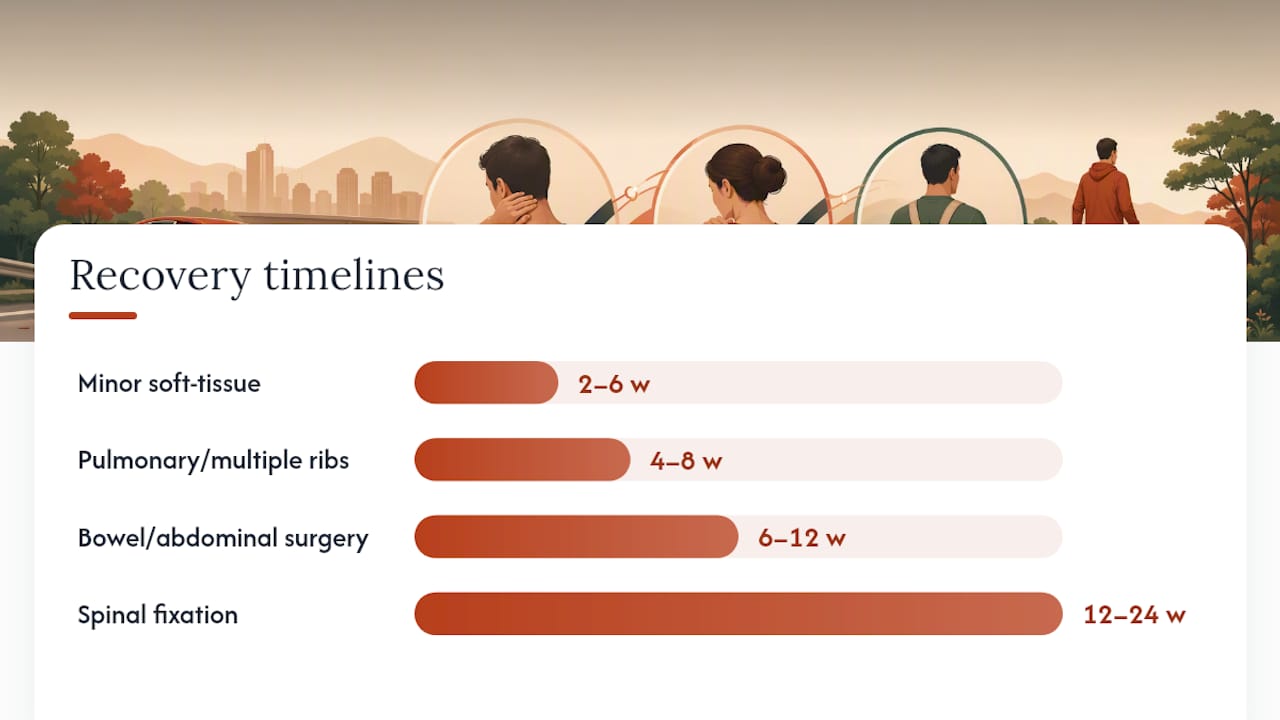
Recovery timelines vary sharply by injury type:
- Soft-tissue bruising and minor rib fractures: typically two to six weeks.
- Pulmonary contusion or multiple rib fractures: four to eight weeks, sometimes longer with breathing complications.
- Bowel repair or abdominal surgery: six to twelve weeks for initial recovery, with full return to normal activity sometimes taking longer.
- Spinal fractures requiring fixation: three to six months, occasionally longer depending on the fracture pattern and any nerve involvement.
Some patients deal with lasting effects. Chronic pain, adhesions from abdominal scarring, or ongoing nerve symptoms can persist well past the point when imaging looks normal, which is one reason seat belts still reduce injury severity overall even though they can shift the type of injury a patient sustains rather than eliminating harm entirely. Early diagnosis consistently correlates with better outcomes. A bowel injury caught on day one and repaired surgically carries a far better prognosis than the same injury discovered after 48 hours of unrecognized leakage.
How Do You Document a Seat Belt Injury for a Legal Claim?
Medical care comes first, always. But the steps taken in the days after a crash can make a real difference if a claim follows.
- Photograph everything early. Take pictures of any bruising or marks as soon as possible, and again over the following days, since seat belt bruising often darkens and becomes more visible 24 to 48 hours after the crash.
- Write down your symptom timeline. Note when pain started, how it changed, and any new symptoms, in your own words, with dates.
- Keep every medical record. That includes emergency room notes, imaging reports, specialist referrals, and discharge instructions.
- Save bills, receipts, and work-impact notes. Lost wages and out-of-pocket costs are only as credible as the paperwork behind them.
- Preserve all crash-related communications. Insurance calls, texts, and letters can matter later, even ones that seem routine at the time.
- Consider contacting an attorney or intake service early, particularly if symptoms are delayed or complex, since evidence and deadlines do not wait for a diagnosis to firm up.
Detailed medical documentation does more than support treatment. It becomes the backbone of any injury claim that follows, and gaps in that record are exactly what insurers look for when disputing a claim’s value.
How Can an Intake Service Like CaseClosedFL Help?
The intake process typically involves asking about injury type, fault, and any existing legal representation before requesting contact information, with submissions reviewed by a person. Some services offer coverage across multiple states and connect injured individuals to attorneys without providing legal advice or promising results. For victims dealing with delayed symptoms or a complicated injury picture, checking eligibility early can be worth doing before decisions become harder to reverse.
How Common Are Seat Belt Injuries, and How Severe Are They?
Seat belt use cuts the risk of fatal and severe head injury substantially, which is the core reason public safety agencies push buckling up on every trip. But that protection comes with a trade-off worth understanding clearly: restrained occupants can face a higher rate of certain injuries, such as sternal fractures, than what shows up in unrestrained occupants who instead absorb impact through head and chest trauma against the vehicle interior.
That is not an argument against seat belts. It is a reason clinicians evaluate every body region in a restrained patient rather than assuming the belt prevented harm just because it prevented the worst outcome. Visible seat belt marks show up in only a minority of crash patients overall, but when a mark is present, it correlates with meaningfully higher rates of abdominal and lumbar spine injury. That gap between “the belt worked” and “the belt caused zero harm” is where a lot of missed diagnoses happen.
The practical takeaway for anyone walking away from a crash is that surviving the collision and being injury-free are two different things. A seat belt doing its job and a passenger needing a CT scan are not contradictory outcomes. They are, in fact, one of the more common patterns in blunt trauma medicine.
Do Seat Belt Injuries Differ by Age Group?
Age changes both the likelihood and the pattern of seat belt injury, largely because standard restraints are built around an adult torso and pelvis.
Children face the highest risk of seat belt syndrome when they are prematurely moved out of booster seats into adult belts. A lap belt that rides up over a child’s abdomen instead of sitting low on the hips, because the child’s frame is too small for the belt geometry, is a leading cause of pediatric bowel and lumbar spine injury in crashes.
Adults generally see the injury patterns described throughout this article: rib and sternal fractures, abdominal organ injury, and the classic seat belt sign. Body size still matters within this group. Smaller adults face some of the same fit problems as children, while larger occupants can experience different loading patterns depending on seat position and belt slack.
Elderly occupants face a distinct risk profile because bone density and tissue elasticity decline with age. The same crash force that gives a younger adult a bruise can produce a rib fracture in an older occupant, and rib fractures in elderly patients carry a higher risk of pneumonia and prolonged hospitalization. Spinal fractures also tend to be more serious in older bone, even from moderate-force impacts.
The common thread across every age group is fit. A belt sitting in the wrong place on the body, whether because of age, height, or pregnancy, shifts crash force onto tissue that was never meant to absorb it.
Do Lap Belts and Three-Point Belts Cause Different Injuries?
The type of restraint changes the injury pattern significantly. A lap-only belt, still found in some older vehicles and certain rear or center seating positions, restrains only the pelvis and lower abdomen. Without a shoulder strap to control upper body movement, the torso jackknifes forward around the lap belt during a crash, which is exactly the mechanism behind Chance fractures and a disproportionate share of abdominal injuries.
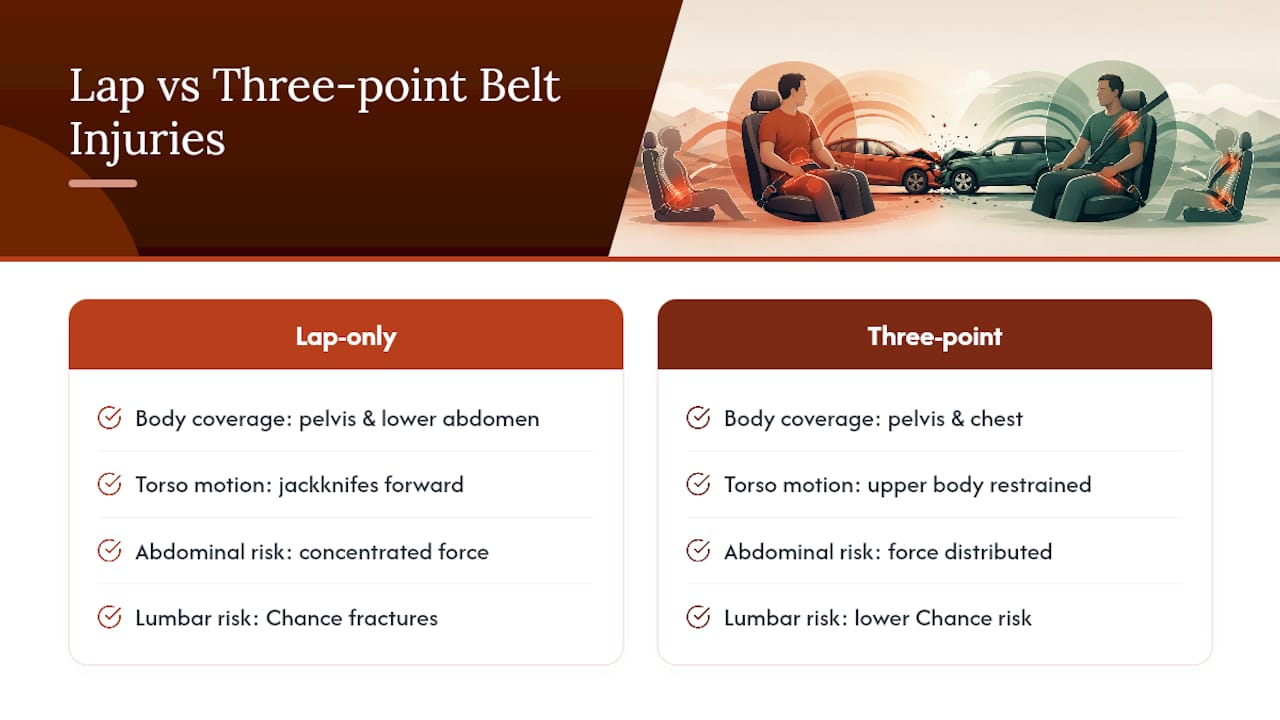
A three-point harness, combining a lap and shoulder strap, distributes force across the pelvis and chest instead of concentrating it at the abdomen. That design is a major reason three-point belts are now standard in nearly all forward-facing seating positions, and why correct positioning of both straps matters so much for the restraint to work as intended.
Vehicle factors add another layer. Seating position affects outcomes, since center rear seats in older vehicle models sometimes still have only a lap belt. Seat design, airbag deployment timing, and how much a seat reclines all change how belt force interacts with the body during impact. A seat belt paired with a properly deployed airbag distributes crash energy differently than a belt alone, which is one reason vehicle inspection and crash reconstruction details matter when piecing together how an injury occurred.
Why Vigilance Still Matters Even Though Seat Belts Save Lives
Seat belts remain one of the most effective tools against fatal crash injury, and nothing in this article argues otherwise. What deserves more attention is the trade-off nobody explains well: the same force that keeps someone alive can quietly injure organs that do not announce themselves for a day or two. Treating a clean-feeling exam as the end of the story, rather than the beginning of a 72-hour watch period, is where preventable harm slips through. Get checked, keep records, and take delayed symptoms seriously.
— Luis
How to Check Eligibility for a Seat Belt Injury Claim
If a seat belt left you with bruising, fractures, or an internal injury after someone else’s negligence caused the crash, sorting out medical bills and fault determinations on your own adds stress to an already difficult recovery. Caseclosedfl offers a no-obligation eligibility check that takes a few minutes, asking about your injuries, who was at fault, and whether you already have legal representation, before ever asking for your contact details.
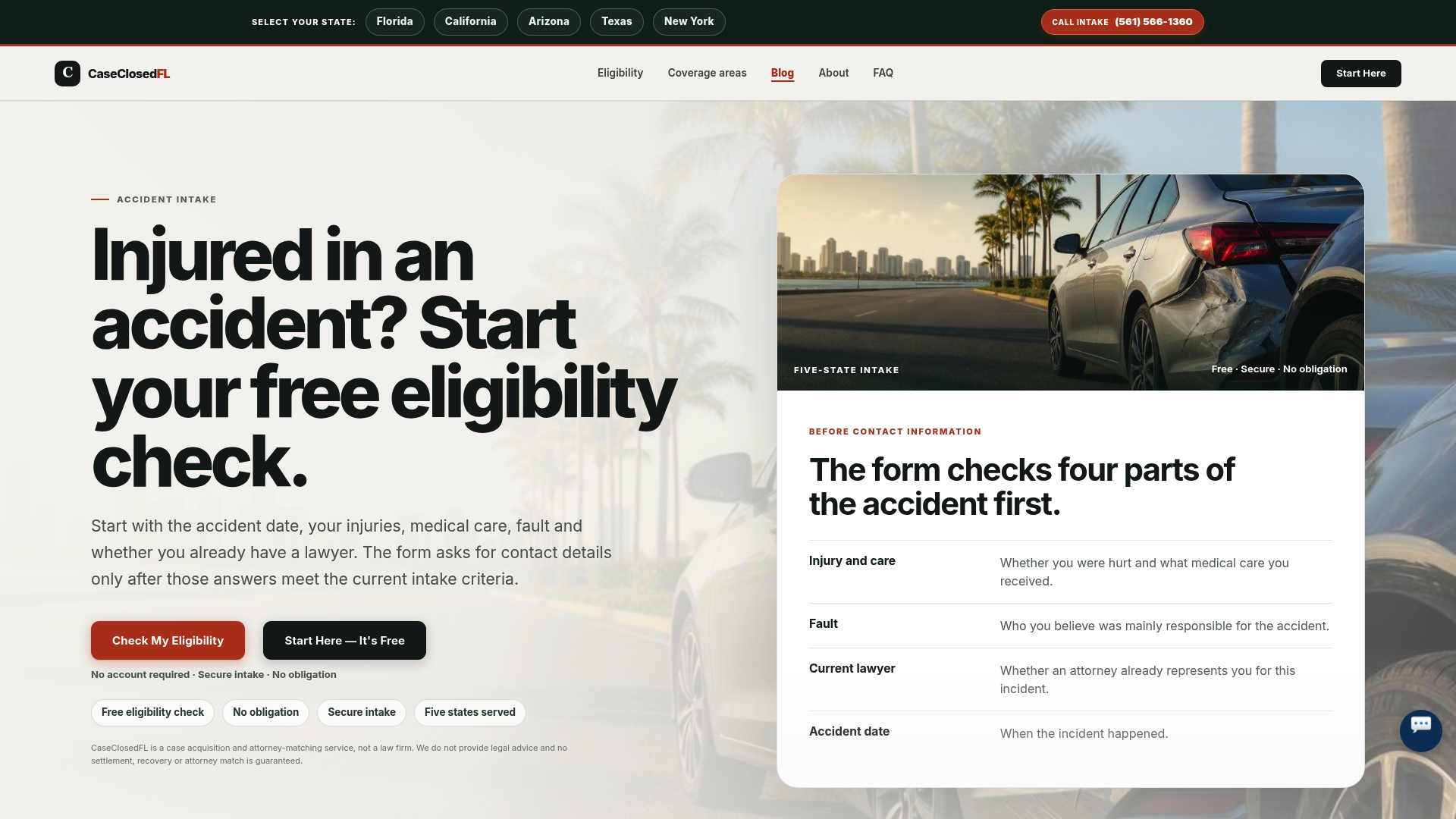
A real person reviews every submission before any attorney referral happens, so you are not handed off to a call center or bounced between offices. The service covers accident victims across multiple states, including Florida, and connects you with a participating attorney if your case qualifies. If you were injured in South Florida, guides like the Fort Lauderdale case review page and the Hialeah intake page walk through what local documentation typically looks like. None of this constitutes legal advice, and there is no guarantee of results. But if delayed symptoms or a complicated injury have you wondering whether you have a case, starting the eligibility check costs nothing and keeps your information private until you decide to move forward.
Sources
- Seat Belt Injury - StatPearls - NCBI Bookshelf
- Seat belt–related injuries: A surgical perspective - PMC
- Seat belt safety: buckling guidance - NHTSA
This article is general information, not a substitute for advice from a qualified doctor. Consult a qualified healthcare professional about your own circumstances before acting on anything here.
FAQ
What Are the Most Common Injuries Caused by Seat Belts?
The most common injuries include rib and sternal fractures, abdominal bruising, bowel or mesenteric tears, and lumbar spine fractures known as Chance fractures, along with soft-tissue bruising along the belt’s path.
How Long Does It Take to Recover From a Seat Belt Injury?
Minor bruising and rib fractures often heal within two to six weeks, while bowel surgery or spinal fixation can require three to six months of recovery, with some patients experiencing lingering pain or adhesions beyond that window.
What Are the Symptoms of Seat Belt Syndrome?
Seat belt syndrome combines a visible linear bruise along the belt path with signs of internal injury, such as worsening abdominal pain, distension, vomiting, or back pain that develops in the 24 to 72 hours after a crash.
What Is the Most Common Organ Injury Caused by a Seat Belt Injury?
Bowel and mesenteric injuries are among the most frequently cited internal injuries linked to seat belts, with a visible seat belt sign associated with a roughly threefold higher rate of intestinal perforation compared with patients who show no bruising.
Recommended
Frequently asked questions
Table of Contents What Is a Seat Belt Injury and Seat Belt Syndrome? What Body Parts Do Seat Belts Commonly Injure? How Do Seat Belts Actually Cause These Injuries? What Are the Warning Signs of a Hidden Seat Belt Injury? What Tests and Scans Diagnose Seat Belt Injuries? How Is a Seat Belt Injury Treated, and How Long Is Recovery? How Do You Document a Seat Belt Injury for a Legal Claim? How Can an Intake Service Like CaseClosedFL Help? How Common Are Seat Belt Injuries, and How Severe Are They? Do Seat Belt Injuries Differ by Age Group? Do Lap Belts and Three-Point Belts Cause Different Injuries? Why Vigilance Still Matters Even Though Seat Belts Save Lives How to Check Eligibility for a Seat Belt Injury Claim Sources FAQ What Is a Seat Belt Injury and Seat Belt Syndrome?
A seat belt injury covers any harm caused by the restraint itself during a collision, ranging from a mild bruise to a fractured spine. The clinical term “seat belt sign” refers to linear bruising, or ecchymosis, that traces the path of the lap or shoulder belt across the body. When that mark shows up alongside internal organ damage or a vertebral fracture, physicians call the combination seat belt syndrome .
What Body Parts Do Seat Belts Commonly Injure?
Seat belt injuries follow the belt’s physical path across the body, and each region carries its own pattern of damage.
How Do Seat Belts Actually Cause These Injuries?
A seat belt works by spreading crash force across the strongest parts of the skeleton, the pelvis and shoulder, instead of letting the body fly forward into the dashboard or windshield. In a crash, a vehicle can decelerate from highway speed to zero in a fraction of a second. The belt has to absorb that kinetic energy fast, and the same tension that keeps someone from becoming a projectile is what bruises skin, cracks ribs, and compresses abdominal organs against the spine.
What Are the Warning Signs of a Hidden Seat Belt Injury?
Some injuries announce themselves immediately. Others take days to surface, and that gap is exactly when people get hurt worse by assuming they are fine.
What Tests and Scans Diagnose Seat Belt Injuries?
Emergency teams start with a structured primary and secondary survey, checking airway, breathing, circulation, and then working systematically through every body region while documenting exactly how the crash happened, including seat position and belt use. That mechanism-of-injury detail shapes everything that follows.
How Is a Seat Belt Injury Treated, and How Long Is Recovery?
Treatment splits along a fairly clear line: injuries that can heal on their own get supportive care, and injuries that threaten organ function or spinal stability get surgery.
How Do You Document a Seat Belt Injury for a Legal Claim?
Medical care comes first, always. But the steps taken in the days after a crash can make a real difference if a claim follows.
How Can an Intake Service Like CaseClosedFL Help?
The intake process typically involves asking about injury type, fault, and any existing legal representation before requesting contact information, with submissions reviewed by a person. Some services offer coverage across multiple states and connect injured individuals to attorneys without providing legal advice or promising results. For victims dealing with delayed symptoms or a complicated injury picture, checking eligibility early can be worth doing before decisions become harder to reverse.
Ready to enter the accident details?
The eligibility form asks about the accident, injury, treatment, fault and representation before contact information.
Start Eligibility Check