90/180 Repeal: New Yorkers' Steps to Pass the Serious Injury Threshold
May 26, 2026: New York removed the 90/180 route. Learn which categories qualify, the $100,000 cap, and what evidence courts expect.


Under Insurance Law § 5102(d), a “serious injury” in New York now means one of eight statutory categories, and one of the old routes is gone. For actions commenced on or after May 26, 2026, the 90/180-day category was deleted from the statute entirely. No-fault basic economic loss, up to $50,000 per person, still exists separately and covers medical bills and lost wages regardless of whether you clear the threshold for pain-and-suffering damages.
TL;DR:
- The 90/180-day injury category was removed from the law effective May 26, 2026, limiting soft-tissue claims without permanent limitations.
- Courts now require objective, measurable evidence like range-of-motion tests or medical imaging to prove statutory limitation categories.
- The new procedural sequence mandates fault to be decided before establishing whether an injury qualifies as serious, with a conditional $100,000 damages cap in specific at-fault scenarios.
- Recovering non-economic damages depends heavily on documented objective impairment; vague or inconsistent treatment records often lead to dismissal.
- The basic no-fault economic loss benefit of up to $50,000 remains unaffected and is accessible regardless of the injury threshold or fault determinations.
Table of Contents
- Serious Injury Threshold New York: The Statutory Categories That Still Qualify
- What Changed in 2026: The 90/180 Repeal and the New $100,000 Cap
- How Do Courts Decide If Your Injury Meets the Threshold?
- No-Fault Benefits, Causation, and the Three-Year Filing Clock
- What To Do After a Crash To Protect a Threshold Claim
- Does the Threshold Work the Same for Every Type of Claim?
- What Do Court Decisions Actually Show About Meeting the Threshold?
- How CaseClosedFL Fits Into the Post-2026 Landscape
- Get a Free Eligibility Check Before the Clock Runs Out
- Sources
- FAQ
Serious Injury Threshold New York: The Statutory Categories That Still Qualify
New York’s no-fault law was built on a trade-off: drivers give up the right to sue for minor injuries in exchange for guaranteed no-fault benefits, but they keep that right when an injury is serious enough. Insurance Law § 5102(d) spells out exactly what counts, and after the 2026 amendment, eight categories remain.
- Death
- Dismemberment
- Significant disfigurement
- A fracture
- Loss of a fetus
- Permanent loss of use of a body organ, member, function, or system
- Permanent consequential limitation of use of a body organ or member
- Significant limitation of use of a body function or system
Separate from all of this sits “basic economic loss,” the no-fault side of the ledger. It covers up to $50,000 per person for medical treatment, hospital costs, rehabilitation, and a portion of lost earnings, and it applies no matter which category above you’re trying to prove.
Here’s where a lot of injured drivers get tripped up: a diagnosis is not the same as a qualifying injury. Courts don’t ask whether a doctor found something on an MRI. They ask whether that finding translates into a measurable, functional limitation. A herniated disc with no measured range-of-motion loss often goes nowhere in court. A herniated disc paired with a documented 30 percent loss of cervical rotation, tested and recorded, is a different case entirely.
What Changed in 2026: The 90/180 Repeal and the New $100,000 Cap
The biggest shift in New York injury law in years came through Part EE of the 2026 legislative session, and it took effect for actions commenced on or after May 26, 2026. Before that date, injured drivers had a fallback option: prove a “medically determined injury or impairment” that kept them from performing substantially all of their usual daily activities for at least 90 of the 180 days following the crash. That category is now gone for any lawsuit filed on or after the cutover date.
The practical effect hits soft-tissue and moderate-duration injury claims hardest. Someone with six weeks of missed work and ongoing physical therapy, but no permanent limitation and no fracture, used to have a real path to non-economic damages through the 90/180 route. Under the current rule, that path no longer exists for new filings.
Two other structural changes came in the same package:
- Sequencing: Under Department of Financial Services guidance, in actions seeking non-economic loss, the trier of fact must now decide who was at fault before deciding whether a serious injury exists. That order used to be more fluid; now fault comes first.
- Conditional cap: The reforms added a conditional $100,000 cap on non-economic damages in specific at-fault scenarios, such as an uninsured driver who was legally required to carry insurance, or a driver convicted of impairment or a felony connected to the crash. The cap doesn’t apply to death claims.
If your accident happened close to the May 26, 2026 line, the filing date, not just the crash date, can determine which version of the statute governs your case. That’s worth confirming with counsel rather than assuming.
How Do Courts Decide If Your Injury Meets the Threshold?
Courts and insurance adjusters don’t take your word for it, and they don’t take your doctor’s diagnosis at face value either. They want numbers.
New York appellate courts have repeatedly held that limitation-based categories, “significant limitation” and “permanent consequential limitation,” require objective, quantitative evidence, not subjective complaints of pain. A doctor writing “patient reports ongoing back pain” carries almost no weight on summary judgment. A doctor writing “range of motion measured at 45 degrees flexion versus 90 degrees normal, using a goniometer” carries real weight.
What tends to persuade a court:
- Range-of-motion testing performed with an actual instrument, not an eyeball estimate, and recorded in the chart.
- MRI or CT imaging that a physician connects, in writing, to a specific functional deficit.
- Written work restrictions from a treating physician, not a self-reported inability to work.
- Physical therapy notes that track progress or lack of progress over time.
- Specialist opinions, particularly from orthopedists or neurologists, addressing permanence.
What tends to fail: a single ER visit with no follow-up, gaps in treatment with no medical explanation, and complaints of pain with no corresponding objective test.
Pro Tip: Ask your treating provider, at every visit, to document a specific measurement, not just “improving” or “same.” Vague chart notes are the single most common reason strong-sounding injuries lose on summary judgment.
No-Fault Benefits, Causation, and the Three-Year Filing Clock
The serious injury threshold and no-fault benefits are two separate systems, and confusing them costs people money. Basic economic loss, up to $50,000 under Insurance Law § 5102(a), pays your medical bills and a share of lost wages regardless of who caused the crash or whether you ever prove a serious injury. Losing a threshold argument doesn’t touch that coverage.
The threshold only controls your access to non-economic damages, pain and suffering, in a lawsuit against the at-fault driver. To get there, you still have to prove:
- Causation — that the crash, not a prior condition, caused the specific limitation you’re claiming.
- Comparative fault — New York reduces your recovery by your percentage of fault, so a driver found 20 percent responsible for the collision loses 20 percent of the award.
- Timing — most motor-vehicle negligence claims carry a three-year statute of limitations under CPLR 214(4), counted from the accident date.
That three-year window shortens or shifts in specific situations, claims against a government entity, cases involving a minor, and wrongful-death actions all follow different rules, so don’t rely on the standard three-year figure without confirming it applies to your case.
What To Do After a Crash To Protect a Threshold Claim
The repeal of the 90/180 category makes early documentation more important than it used to be, not less. With that fallback gone, your case now rests entirely on the strength of the objective evidence you build starting the day of the crash.
- Get evaluated by a medical provider immediately, even if you feel “okay.” Adrenaline masks pain, and a same-day exam creates the first entry in your medical timeline.
- Report the crash to police and your insurer promptly, and photograph vehicle damage, the scene, and any visible injury.
- Collect witness names and contact information before people leave the scene.
- Attend every follow-up appointment, and specifically ask for range-of-motion testing and written work restrictions rather than a general “keep resting” note.
- Keep a dated log of what you can no longer do, lifting your kid, climbing stairs, sitting through a full workday, since courts weigh functional impact heavily.
- Save every medical bill, wage statement, and pharmacy receipt; these support your no-fault claim independent of the threshold fight.
If you’re unsure whether your injury clears one of the eight categories, that’s a conversation for an attorney, not a guess. The stakes changed materially on May 26, 2026, and early advice shapes what evidence gets collected while it’s still available.
Does the Threshold Work the Same for Every Type of Claim?
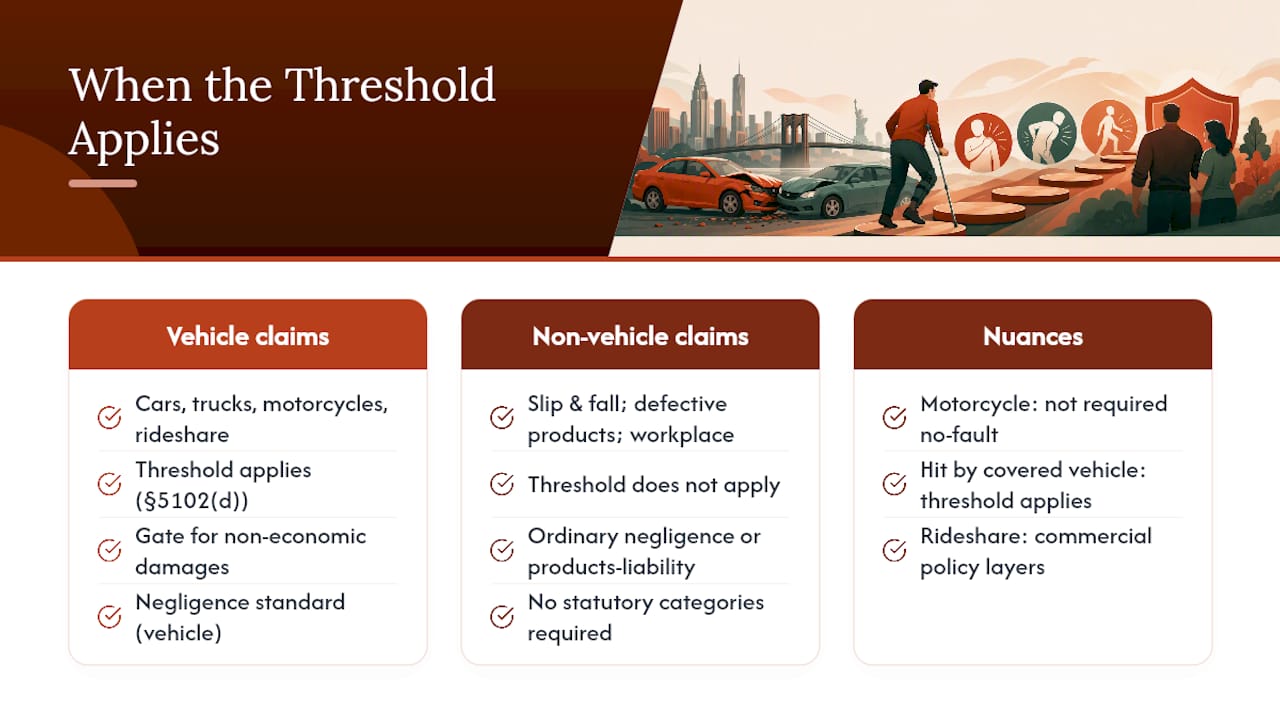
Not quite. The serious injury threshold under § 5102(d) applies specifically to claims against another driver arising from motor vehicle use, cars, trucks, motorcycles, rideshare vehicles, and similar. It does not apply to most other personal injury contexts.
If you slip and fall in a grocery store, get hurt on a defective product, or suffer a workplace injury unrelated to a vehicle, the threshold rule is irrelevant. Those claims run on ordinary negligence or products-liability standards, where you don’t need to prove one of the eight statutory categories, you just need to prove the defendant was negligent and that negligence caused compensable harm.
Motorcycle and pedestrian cases add a wrinkle: motorcyclists in New York are not required to carry no-fault coverage the same way car drivers are, but if a motorcyclist is hit by a covered vehicle, the threshold still governs whether they can pursue pain-and-suffering damages against that driver. Rideshare accidents typically layer commercial insurance policies on top of the same threshold analysis, since the underlying claim is still a motor-vehicle negligence action.
The practical takeaway: if your injury came from a car crash, § 5102(d) is the gate you have to pass through before you can collect non-economic damages. If it didn’t, a different legal framework applies, and the categories discussed throughout this piece don’t govern your case at all. Knowing which bucket your claim falls into early saves time and prevents you from building a case around the wrong legal standard.
What Do Court Decisions Actually Show About Meeting the Threshold?
New York appellate courts have built a substantial body of decisions interpreting § 5102(d), and the pattern is consistent: judges reward precise measurement and punish vague documentation.
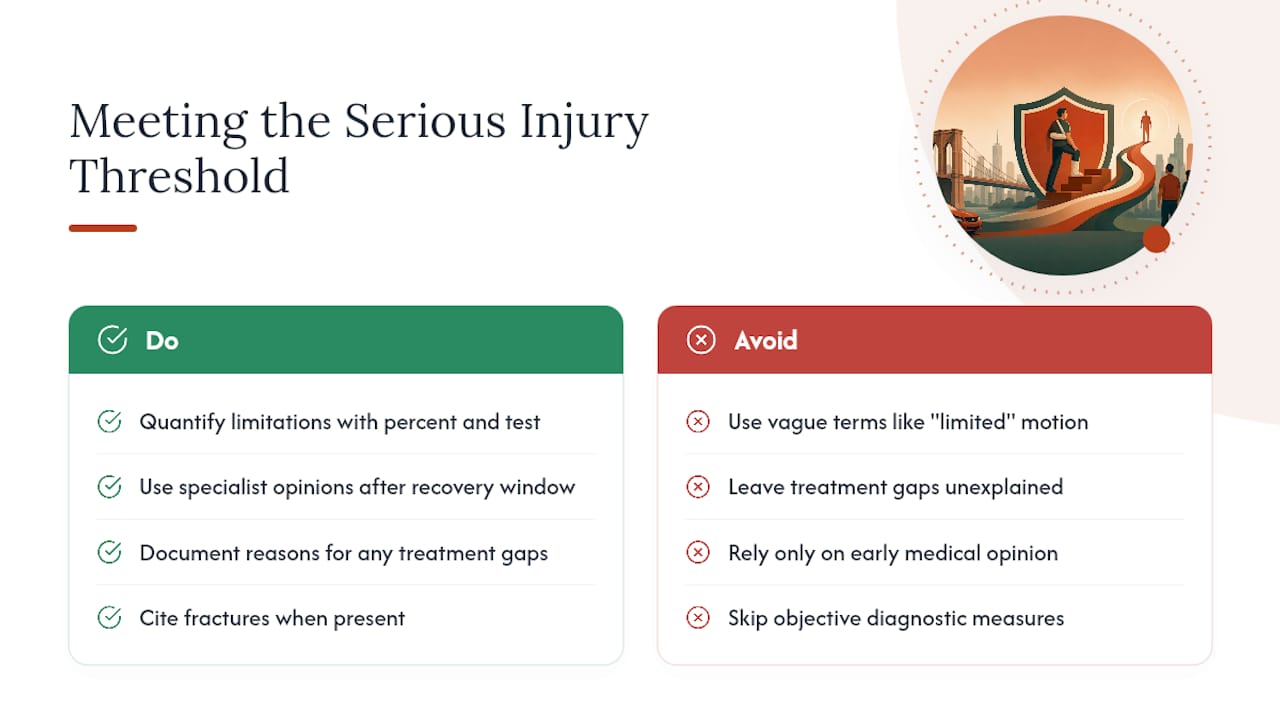
Cases addressing “significant limitation of use” turn heavily on whether a physician quantified the loss. A finding of restricted motion described only as “limited” tends to fail. A finding expressed as a percentage deficit, compared against a normal range and tied to a specific diagnostic test, tends to survive summary judgment and reach a jury. Appellate rulings on objective-evidence standards make clear that the burden sits on the injured party to produce that kind of measurement, not on the defense to disprove a vague claim.
Treatment gaps show up repeatedly as a defense weapon. Courts have scrutinized plaintiffs who stopped treatment for months and then resumed shortly before filing suit, treating the gap as evidence the injury either resolved or was never as serious as claimed. A documented explanation for a gap, insurance denial, inability to afford care, a doctor’s advice to pause, carries far more weight than silence on the issue.
Fracture cases tend to be more straightforward since a fracture is, by definition, one of the eight statutory categories. Permanent consequential limitation cases are the hardest fought, because “permanent” requires medical opinion evidence projecting the condition forward, not just describing the current state. Attorneys who build these cases lean on specialist opinions issued well after the initial treatment window, once the injury has had time to either resolve or prove itself lasting.
How CaseClosedFL Fits Into the Post-2026 Landscape
The 2026 changes make the gap between a strong claim and a weak one wider, and most injured drivers have no way to know which side of that gap they’re on. That’s precisely the kind of uncertainty a free eligibility check is built to sort through. An online intake process gathers details about injury, fault, treatment, and current representation, then routes qualifying submissions through human review before anyone requests contact information.
None of this substitutes for legal advice, and CaseClosedFL doesn’t guarantee a match with an attorney. But given how much the removal of the 90/180 category raises the evidentiary bar, getting a fast read on whether your documentation and timeline support a threshold claim, before treatment gaps or missed deadlines undercut it, matters more now than it did before May 2026.
— Luis
Get a Free Eligibility Check Before the Clock Runs Out
An alternative to guessing whether an injury clears New York’s revised threshold is a free eligibility check that asks about the accident, injuries, treatment, and any existing legal representation, then a human reviews the submission before anyone asks for contact information, helping to minimize unwanted solicitations.

This matters most right now because the 90/180 fallback is gone and the sequencing rules changed how fault and injury get decided in court. If you’re not sure whether your documented range-of-motion loss, fracture, or ongoing limitation fits one of the eight remaining categories, an early read helps you decide whether to keep building your file or bring in counsel while evidence is still fresh. New York drivers can start the free check through CaseClosedFL’s New York intake, or begin directly at Caseclosedfl.
This article is general information, not a substitute for advice from a qualified lawyer. Consult a qualified legal professional about your own circumstances before acting on anything here.
Sources
- SECTION 5102 Definitions (NYS Legislature)
- FAQ: Consumer Questions About No-Fault Insurance | Department of Financial Services
- NY appellate opinion demonstrating objective-evidence standards (NY courts reporter)
FAQ
What Qualifies as a Serious Injury in New York?
A serious injury under Insurance Law § 5102(d) means death, dismemberment, significant disfigurement, a fracture, loss of a fetus, permanent loss of use, permanent consequential limitation, or significant limitation of use. Courts require objective, measurable proof of functional impact, not just a diagnosis, to support the limitation-based categories.
What Is the New Law in New York About Car Insurance?
For actions commenced on or after May 26, 2026, New York removed the 90/180-day category from the serious injury definition. The same reform changed procedural sequencing, requiring fault to be decided before serious injury in non-economic claims, and added a conditional $100,000 cap on non-economic damages in certain at-fault scenarios.
What Is the Average Personal Injury Settlement in New York?
There’s no single average figure, since settlements depend heavily on which of the eight statutory categories applies, the strength of the objective medical evidence, and comparative fault. A case with documented permanent limitation and clear liability generally settles for more than one relying on subjective pain complaints alone.
How Much Should My Pain and Suffering Settlement Be?
Pain and suffering value depends on the severity and permanence of the injury, the quality of your medical documentation, and whether you clear the § 5102(d) threshold in the first place. A free eligibility check through CaseClosedFL can help you figure out whether your case is strong enough to warrant a conversation with an attorney about potential value.
Does Losing a Threshold Argument Affect My No-Fault Benefits?
No. Basic economic loss under Insurance Law § 5102(a) provides up to $50,000 per person for medical costs and lost wages, and it applies independently of whether you prove a serious injury. The threshold only controls your ability to pursue pain-and-suffering damages against the at-fault driver.
Recommended
Frequently asked questions
Table of Contents Serious Injury Threshold New York: The Statutory Categories That Still Qualify What Changed in 2026: The 90/180 Repeal and the New $100,000 Cap How Do Courts Decide If Your Injury Meets the Threshold? No-Fault Benefits, Causation, and the Three-Year Filing Clock What To Do After a Crash To Protect a Threshold Claim Does the Threshold Work the Same for Every Type of Claim? What Do Court Decisions Actually Show About Meeting the Threshold? How CaseClosedFL Fits Into the Post-2026 Landscape Get a Free Eligibility Check Before the Clock Runs Out Sources FAQ Serious Injury Threshold New York: The Statutory Categories That Still Qualify New York’s no-fault law was built on a trade-off: drivers give up the right to sue for minor injuries in exchange for guaranteed no-fault benefits, but they keep that right when an injury is serious enough. Insurance Law § 5102(d) spells out exactly what counts, and after the 2026 amendment, eight categories remain. Death Dismemberment Significant disfigurement A fracture Loss of a fetus Permanent loss of use of a body organ, member, function, or system Permanent consequential limitation of use of a body organ or member Significant limitation of use of a body function or system Separate from all of this sits “basic economic loss,” the no-fault side of the ledger. It covers up to $50,000 per person for medical treatment, hospital costs, rehabilitation, and a portion of lost earnings, and it applies no matter which category above you’re trying to prove. Here’s where a lot of injured drivers get tripped up: a diagnosis is not the same as a qualifying injury. Courts don’t ask whether a doctor found something on an MRI. They ask whether that finding translates into a measurable, functional limitation. A herniated disc with no measured range-of-motion loss often goes nowhere in court. A herniated disc paired with a documented 30 percent loss of cervical rotation, tested and recorded, is a different case entirely. What Changed in 2026: The 90/180 Repeal and the New $100,000 Cap The biggest shift in New York injury law in years came through Part EE of the 2026 legislative session, and it took effect for actions commenced on or after May 26, 2026. Before that date, injured drivers had a fallback option: prove a “medically determined injury or impairment” that kept them from performing substantially all of their usual daily activities for at least 90 of the 180 days following the crash. That category is now gone for any lawsuit filed on or after the cutover date. The practical effect hits soft-tissue and moderate-duration injury claims hardest. Someone with six weeks of missed work and ongoing physical therapy, but no permanent limitation and no fracture, used to have a real path to non-economic damages through the 90/180 route. Under the current rule, that path no longer exists for new filings. Two other structural changes came in the same package: Sequencing: Under Department of Financial Services guidance, in actions seeking non-economic loss, the trier of fact must now decide who was at fault before deciding whether a serious injury exists. That order used to be more fluid; now fault comes first. Conditional cap: The reforms added a conditional $100,000 cap on non-economic damages in specific at-fault scenarios, such as an uninsured driver who was legally required to carry insurance, or a driver convicted of impairment or a felony connected to the crash. The cap doesn’t apply to death claims. If your accident happened close to the May 26, 2026 line, the filing date, not just the crash date, can determine which version of the statute governs your case. That’s worth confirming with counsel rather than assuming. How Do Courts Decide If Your Injury Meets the Threshold?
Courts and insurance adjusters don’t take your word for it, and they don’t take your doctor’s diagnosis at face value either. They want numbers.
No-Fault Benefits, Causation, and the Three-Year Filing Clock The serious injury threshold and no-fault benefits are two separate systems, and confusing them costs people money. Basic economic loss, up to $50,000 under Insurance Law § 5102(a), pays your medical bills and a share of lost wages regardless of who caused the crash or whether you ever prove a serious injury. Losing a threshold argument doesn’t touch that coverage. The threshold only controls your access to non-economic damages, pain and suffering, in a lawsuit against the at-fault driver. To get there, you still have to prove: Causation — that the crash, not a prior condition, caused the specific limitation you’re claiming. Comparative fault — New York reduces your recovery by your percentage of fault, so a driver found 20 percent responsible for the collision loses 20 percent of the award. Timing — most motor-vehicle negligence claims carry a three-year statute of limitations under CPLR 214(4), counted from the accident date. That three-year window shortens or shifts in specific situations, claims against a government entity, cases involving a minor, and wrongful-death actions all follow different rules, so don’t rely on the standard three-year figure without confirming it applies to your case. What To Do After a Crash To Protect a Threshold Claim The repeal of the 90/180 category makes early documentation more important than it used to be, not less. With that fallback gone, your case now rests entirely on the strength of the objective evidence you build starting the day of the crash. Get evaluated by a medical provider immediately, even if you feel “okay.” Adrenaline masks pain, and a same-day exam creates the first entry in your medical timeline. Report the crash to police and your insurer promptly, and photograph vehicle damage, the scene, and any visible injury. Collect witness names and contact information before people leave the scene. Attend every follow-up appointment, and specifically ask for range-of-motion testing and written work restrictions rather than a general “keep resting” note. Keep a dated log of what you can no longer do, lifting your kid, climbing stairs, sitting through a full workday, since courts weigh functional impact heavily. Save every medical bill, wage statement, and pharmacy receipt; these support your no-fault claim independent of the threshold fight. If you’re unsure whether your injury clears one of the eight categories, that’s a conversation for an attorney, not a guess. The stakes changed materially on May 26, 2026, and early advice shapes what evidence gets collected while it’s still available. Does the Threshold Work the Same for Every Type of Claim?
Not quite. The serious injury threshold under § 5102(d) applies specifically to claims against another driver arising from motor vehicle use, cars, trucks, motorcycles, rideshare vehicles, and similar. It does not apply to most other personal injury contexts.
What Do Court Decisions Actually Show About Meeting the Threshold?
New York appellate courts have built a substantial body of decisions interpreting § 5102(d), and the pattern is consistent: judges reward precise measurement and punish vague documentation.
How CaseClosedFL Fits Into the Post-2026 Landscape The 2026 changes make the gap between a strong claim and a weak one wider, and most injured drivers have no way to know which side of that gap they’re on. That’s precisely the kind of uncertainty a free eligibility check is built to sort through. An online intake process gathers details about injury, fault, treatment, and current representation, then routes qualifying submissions through human review before anyone requests contact information. None of this substitutes for legal advice, and CaseClosedFL doesn’t guarantee a match with an attorney. But given how much the removal of the 90/180 category raises the evidentiary bar, getting a fast read on whether your documentation and timeline support a threshold claim, before treatment gaps or missed deadlines undercut it, matters more now than it did before May 2026. — Luis Get a Free Eligibility Check Before the Clock Runs Out An alternative to guessing whether an injury clears New York’s revised threshold is a free eligibility check that asks about the accident, injuries, treatment, and any existing legal representation, then a human reviews the submission before anyone asks for contact information, helping to minimize unwanted solicitations. This matters most right now because the 90/180 fallback is gone and the sequencing rules changed how fault and injury get decided in court. If you’re not sure whether your documented range-of-motion loss, fracture, or ongoing limitation fits one of the eight remaining categories, an early read helps you decide whether to keep building your file or bring in counsel while evidence is still fresh. New York drivers can start the free check through CaseClosedFL’s New York intake , or begin directly at Caseclosedfl . This article is general information, not a substitute for advice from a qualified lawyer. Consult a qualified legal professional about your own circumstances before acting on anything here. Sources SECTION 5102 Definitions (NYS Legislature) FAQ: Consumer Questions About No-Fault Insurance | Department of Financial Services NY appellate opinion demonstrating objective-evidence standards (NY courts reporter) FAQ What Qualifies as a Serious Injury in New York?
A serious injury under Insurance Law § 5102(d) means death, dismemberment, significant disfigurement, a fracture, loss of a fetus, permanent loss of use, permanent consequential limitation, or significant limitation of use. Courts require objective, measurable proof of functional impact, not just a diagnosis, to support the limitation-based categories.
What Is the New Law in New York About Car Insurance?
For actions commenced on or after May 26, 2026, New York removed the 90/180-day category from the serious injury definition. The same reform changed procedural sequencing, requiring fault to be decided before serious injury in non-economic claims, and added a conditional $100,000 cap on non-economic damages in certain at-fault scenarios.
What Is the Average Personal Injury Settlement in New York?
There’s no single average figure, since settlements depend heavily on which of the eight statutory categories applies, the strength of the objective medical evidence, and comparative fault. A case with documented permanent limitation and clear liability generally settles for more than one relying on subjective pain complaints alone.
How Much Should My Pain and Suffering Settlement Be?
Pain and suffering value depends on the severity and permanence of the injury, the quality of your medical documentation, and whether you clear the § 5102(d) threshold in the first place. A free eligibility check through CaseClosedFL can help you figure out whether your case is strong enough to warrant a conversation with an attorney about potential value.
Does Losing a Threshold Argument Affect My No-Fault Benefits?
No. Basic economic loss under Insurance Law § 5102(a) provides up to $50,000 per person for medical costs and lost wages, and it applies independently of whether you prove a serious injury. The threshold only controls your ability to pursue pain-and-suffering damages against the at-fault driver.
Ready to enter the accident details?
The eligibility form asks about the accident, injury, treatment, fault and representation before contact information.
Start Eligibility Check