Insurance Claim Delays: 5 Moves and U.S. State Deadlines
Spot insurer stalling, check state claim timelines, and follow five steps to respond. A free, private eligibility check can connect you with counsel.


Common insurer delay tactics include repeated document requests, indefinite “under review” statuses, slow inspection scheduling, and late lowball offers. The single best first move is to document every interaction and set a fixed follow-up cadence right away. The sections below walk through the specific tactics, why delays happen, regulatory timelines, and a prioritized action plan.
TL;DR:
- Benchmarks call for acknowledgment within 15 days, an explanation 30 days after proof of loss, and status letters every 30 to 45 days during investigations.
- Many state rules require payment within 30 days of acceptance, while late payment may trigger interest or penalties depending on the state.
- Medical stabilization, disputed liability, fraud screening, and disaster surges can justify delays; vague or changing explanations and ignored written requests point toward strategic stalling.
- Submit complete records, keep a dated contact log, and follow up every 5 to 7 business days; request a supervisor after two unanswered attempts.
- After two unanswered follow ups, request a supervisor; file a state insurance complaint if escalation stalls, and consult an attorney for continued delays or low offers.
Table of Contents
- Common delay tactics insurers use
- Why claims get delayed: legitimate reasons vs. strategic stalling
- Regulatory timelines and concrete indicators of bad-faith delay
- Action plan: step-by-step response to an insurance claim delay
- How the author and CaseClosedFL can help claimants stuck by delays
- Treat claims handling like a managed project
- Free eligibility check: a discreet next step if delays continue
- FAQ
- Sources
Common delay tactics insurers use
Recognizing a stall tactic early lets us respond with evidence instead of frustration. Adjusters and claims departments use a predictable set of moves, and most of them share one goal: buy time.
- Repeated document requests: asking for the same forms, receipts, or medical records more than once, which can reset the file’s internal clock and delay processing.
- Indefinite “under review” status: a vague label without a specific timeline, often used to avoid committing to a decision date.
- Slow inspection or IME scheduling: delaying property inspections or independent medical exams by weeks, which pushes every downstream step back.
- Nonresponse and adjuster turnover: calls and emails go unanswered, or the assigned adjuster changes repeatedly, forcing claimants to restart conversations.
- Late lowball offers: settlement offers coming late in the process, potentially aimed at pressuring claimants to accept less than owed.
- Mischaracterizing policy terms: narrowing the scope of covered damage or injury to justify a lower payout or denial.
None of these tactics are always evidence of bad faith on their own. A single delayed callback is normal. A pattern of several of these behaviors together is what should raise concern.
Pro Tip: Save every email and note the date, time, and name of anyone you speak with by phone, even for a two-minute call.
Why claims get delayed: legitimate reasons vs. strategic stalling
Some delays are genuinely unavoidable. Medical stabilization can take months before injury extent is clear, liability disputes in multi-vehicle accidents require more investigation, fraud screening adds time, and regional disaster surges can overwhelm adjusters handling hundreds of files at once.
Strategic delay is a different pattern. Research on insurer payment behavior notes that insurers sometimes use delay as a financial tool, holding funds longer when under financial pressure, a practice tied to ignored communications and explanations that shift from one call to the next. A legitimate delay usually comes with a consistent reason and a timeline. A strategic one tends to come with vague or changing justifications and little written documentation from the insurer’s side.
When a pattern includes ignored written requests, repeated duplicate paperwork demands, and shifting denial reasons, it may cross into what state law treats as bad faith, though that determination depends on the specific facts and state statute involved.
Regulatory timelines and concrete indicators of bad-faith delay
Most states follow timing benchmarks drawn from the NAIC Unfair Claims Settlement Practices model regulation, which gives claimants an objective yardstick instead of guesswork.
- Insurers should acknowledge a claim within about 15 days of notice.
- If a claim remains unresolved 30 days after proof of loss, insurers should provide a written explanation for the delay.
- Investigations that continue beyond that window typically require periodic status letters, often every 30 to 45 days, explaining why more time is needed.
- Once a claim is accepted, payment is commonly due within 30 days under many state rules.
| Milestone | Typical benchmark |
|---|---|
| Claim acknowledgment | Within 15 days of notice |
| Written explanation if unresolved | After 30 days from proof of loss |
| Follow-up status notices | Every 30 to 45 days during investigation |
| Payment after acceptance | Within 30 days |
Behaviors that typically warrant escalation include ignored written communications, requests for documents already submitted, and denial reasons that change between conversations. Some states also allow interest or penalties on late payments past these windows. A simple written request works well here: ask the insurer, in writing, for the specific reason for the delay and the date you can expect a decision.
Action plan: step-by-step response to an insurance claim delay
Treating a claim like a project with deadlines, rather than a waiting game, moves files forward faster. Proactive documentation and consistent follow-up measurably shorten claim timelines, according to practical claims guidance.
- Submit complete documentation at filing. Include photos, repair or contractor estimates, receipts, and all relevant medical records so there is no procedural excuse for a duplicate request.
- Keep a written contact log. Record the date, the name of the person you spoke with, and a one-line summary of what was said; favor email over phone calls whenever possible so there is a paper trail.
- Follow up every 5 to 7 business days. Ask plainly for a status update and a specific next step; if two follow-ups go unanswered, ask to speak with a claims supervisor.
- File a Department of Insurance complaint when internal escalation stalls. Include your claim number, a timeline of contacts from your log, and copies of any written requests you sent; this is a standard regulatory remedy available in every state.
- Contact an attorney if delay patterns continue or a lowball offer arrives. Bring your contact log, all correspondence, and any written explanations the insurer has provided.
Pro Tip: Organizing medical records into a clear chronology before you escalate makes both a Department of Insurance complaint and an attorney review faster; services like ChartInsight’s record review build exactly this kind of organized summary from multi-provider records.
How the author and CaseClosedFL can help claimants stuck by delays
This article was written by Luis, who covers insurance claim deadlines and evidence preservation for accident victims, including related guidance on claim denial deadlines and typical settlement timelines.
When a delay has been documented and escalated without resolution, or when a pattern suggests bad faith, connecting with an attorney becomes the practical next step. We offer a free eligibility check to screen accident and injury details, with submissions reviewed by a person before any attorney connection. No personal contact information is requested until a case meets intake criteria.

Treat claims handling like a managed project
A claim file does not move itself. We have found that claimants who document, follow up on schedule, and escalate deliberately see cleaner outcomes than those who wait and hope. That same organization also strengthens any later complaint or legal case, since a complete record is harder for an insurer to dispute.
— Luis
Free eligibility check: a discreet next step if delays continue
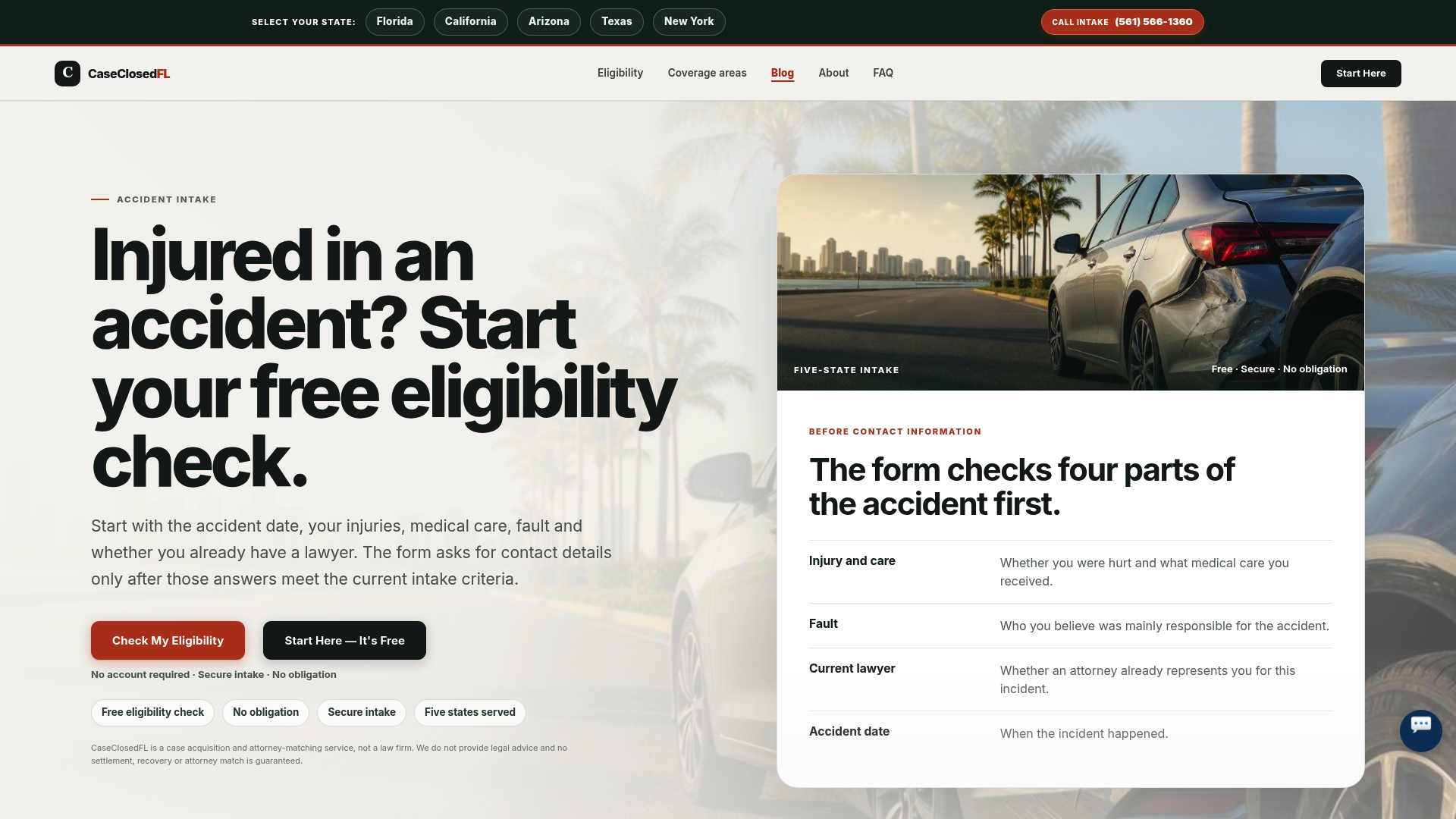
When documented follow-up and a Department of Insurance complaint have not moved a stalled claim, or when the pattern looks like bad faith, our free eligibility check offers a low-commitment way to find out where you stand.
- We ask about your accident, injury, and current legal representation before requesting any contact details.
- A person reviews every submission; we do not guarantee results, only a human review.
- There is no obligation, and your information is not shared until your case meets our intake criteria.
Readers in the Tampa area can start a case review here, and the same free eligibility check is available at Caseclosedfl for any accident or injury claim facing an unexplained delay.
This article is general information, not a substitute for advice from a qualified lawyer. Consult a qualified legal professional about your own circumstances before acting on anything here.
FAQ
How do I escalate a delayed insurance claim?
Start by requesting a written explanation and timeline from your adjuster, then ask for a claims supervisor if two follow-ups go unanswered. If internal escalation fails, file a complaint with your state Department of Insurance, including your claim number and a log of prior contacts.
What does it mean to intimate a claim?
Claim intimation simply means formally notifying your insurer that a loss or injury has occurred, usually the first written or phone notice that starts the claims process. Most insurers require this notice promptly after the incident, along with basic details like date, location, and nature of the loss.
Is it illegal for an insurer to purposefully delay a claim?
Whether a delay is illegal depends on state law and the specific facts, since legitimate investigation time is allowed while unreasonable or strategic stalling can amount to bad faith under many state statutes. Model regulations from the NAIC set acknowledgment and investigation timelines that insurers are expected to follow, and missing them without explanation can support a regulatory complaint.
Why do some insurance claims take so long?
Some delays are legitimate, including medical stabilization, complex liability disputes, fraud screening, or a surge of claims after a regional disaster. Others reflect insurer-level incentives to hold funds longer, a pattern researchers associate with ignored communications and shifting explanations rather than genuine investigative need.
Sources
- SSRN paper on insurer delay strategies
- NAIC Unfair Claims Settlement Practices model regulation
- What causes insurance claim delays and how to avoid them | Coverage Review
Recommended
Frequently asked questions
Table of Contents Common delay tactics insurers use Why claims get delayed: legitimate reasons vs. strategic stalling Regulatory timelines and concrete indicators of bad-faith delay Action plan: step-by-step response to an insurance claim delay How the author and CaseClosedFL can help claimants stuck by delays Treat claims handling like a managed project Free eligibility check: a discreet next step if delays continue FAQ Sources Common delay tactics insurers use Recognizing a stall tactic early lets us respond with evidence instead of frustration. Adjusters and claims departments use a predictable set of moves, and most of them share one goal: buy time. Repeated document requests : asking for the same forms, receipts, or medical records more than once, which can reset the file’s internal clock and delay processing. Indefinite “under review” status : a vague label without a specific timeline, often used to avoid committing to a decision date. Slow inspection or IME scheduling : delaying property inspections or independent medical exams by weeks, which pushes every downstream step back. Nonresponse and adjuster turnover : calls and emails go unanswered, or the assigned adjuster changes repeatedly, forcing claimants to restart conversations. Late lowball offers : settlement offers coming late in the process, potentially aimed at pressuring claimants to accept less than owed. Mischaracterizing policy terms : narrowing the scope of covered damage or injury to justify a lower payout or denial. None of these tactics are always evidence of bad faith on their own. A single delayed callback is normal. A pattern of several of these behaviors together is what should raise concern. Pro Tip: Save every email and note the date, time, and name of anyone you speak with by phone, even for a two-minute call. Why claims get delayed: legitimate reasons vs. strategic stalling Some delays are genuinely unavoidable. Medical stabilization can take months before injury extent is clear, liability disputes in multi-vehicle accidents require more investigation, fraud screening adds time, and regional disaster surges can overwhelm adjusters handling hundreds of files at once. Strategic delay is a different pattern. Research on insurer payment behavior notes that insurers sometimes use delay as a financial tool , holding funds longer when under financial pressure, a practice tied to ignored communications and explanations that shift from one call to the next. A legitimate delay usually comes with a consistent reason and a timeline. A strategic one tends to come with vague or changing justifications and little written documentation from the insurer’s side. When a pattern includes ignored written requests, repeated duplicate paperwork demands, and shifting denial reasons, it may cross into what state law treats as bad faith, though that determination depends on the specific facts and state statute involved. Regulatory timelines and concrete indicators of bad-faith delay Most states follow timing benchmarks drawn from the NAIC Unfair Claims Settlement Practices model regulation , which gives claimants an objective yardstick instead of guesswork. Insurers should acknowledge a claim within about 15 days of notice. If a claim remains unresolved 30 days after proof of loss, insurers should provide a written explanation for the delay. Investigations that continue beyond that window typically require periodic status letters, often every 30 to 45 days, explaining why more time is needed. Once a claim is accepted, payment is commonly due within 30 days under many state rules. Milestone Typical benchmark Claim acknowledgment Within 15 days of notice Written explanation if unresolved After 30 days from proof of loss Follow-up status notices Every 30 to 45 days during investigation Payment after acceptance Within 30 days Behaviors that typically warrant escalation include ignored written communications, requests for documents already submitted, and denial reasons that change between conversations. Some states also allow interest or penalties on late payments past these windows. A simple written request works well here: ask the insurer, in writing, for the specific reason for the delay and the date you can expect a decision. Action plan: step-by-step response to an insurance claim delay Treating a claim like a project with deadlines, rather than a waiting game, moves files forward faster. Proactive documentation and consistent follow-up measurably shorten claim timelines , according to practical claims guidance. Submit complete documentation at filing. Include photos, repair or contractor estimates, receipts, and all relevant medical records so there is no procedural excuse for a duplicate request. Keep a written contact log. Record the date, the name of the person you spoke with, and a one-line summary of what was said; favor email over phone calls whenever possible so there is a paper trail. Follow up every 5 to 7 business days. Ask plainly for a status update and a specific next step; if two follow-ups go unanswered, ask to speak with a claims supervisor. File a Department of Insurance complaint when internal escalation stalls. Include your claim number, a timeline of contacts from your log, and copies of any written requests you sent; this is a standard regulatory remedy available in every state. Contact an attorney if delay patterns continue or a lowball offer arrives. Bring your contact log, all correspondence, and any written explanations the insurer has provided. Pro Tip: Organizing medical records into a clear chronology before you escalate makes both a Department of Insurance complaint and an attorney review faster; services like ChartInsight’s record review build exactly this kind of organized summary from multi-provider records. How the author and CaseClosedFL can help claimants stuck by delays This article was written by Luis, who covers insurance claim deadlines and evidence preservation for accident victims, including related guidance on claim denial deadlines and typical settlement timelines . When a delay has been documented and escalated without resolution, or when a pattern suggests bad faith, connecting with an attorney becomes the practical next step. We offer a free eligibility check to screen accident and injury details, with submissions reviewed by a person before any attorney connection. No personal contact information is requested until a case meets intake criteria. Treat claims handling like a managed project A claim file does not move itself. We have found that claimants who document, follow up on schedule, and escalate deliberately see cleaner outcomes than those who wait and hope. That same organization also strengthens any later complaint or legal case, since a complete record is harder for an insurer to dispute. — Luis Free eligibility check: a discreet next step if delays continue When documented follow-up and a Department of Insurance complaint have not moved a stalled claim, or when the pattern looks like bad faith, our free eligibility check offers a low-commitment way to find out where you stand. We ask about your accident, injury, and current legal representation before requesting any contact details. A person reviews every submission; we do not guarantee results, only a human review. There is no obligation, and your information is not shared until your case meets our intake criteria. Readers in the Tampa area can start a case review here , and the same free eligibility check is available at Caseclosedfl for any accident or injury claim facing an unexplained delay. This article is general information, not a substitute for advice from a qualified lawyer. Consult a qualified legal professional about your own circumstances before acting on anything here. FAQ How do I escalate a delayed insurance claim?
Start by requesting a written explanation and timeline from your adjuster, then ask for a claims supervisor if two follow-ups go unanswered. If internal escalation fails, file a complaint with your state Department of Insurance, including your claim number and a log of prior contacts.
What does it mean to intimate a claim?
Claim intimation simply means formally notifying your insurer that a loss or injury has occurred, usually the first written or phone notice that starts the claims process. Most insurers require this notice promptly after the incident, along with basic details like date, location, and nature of the loss.
Is it illegal for an insurer to purposefully delay a claim?
Whether a delay is illegal depends on state law and the specific facts, since legitimate investigation time is allowed while unreasonable or strategic stalling can amount to bad faith under many state statutes. Model regulations from the NAIC set acknowledgment and investigation timelines that insurers are expected to follow, and missing them without explanation can support a regulatory complaint.
Why do some insurance claims take so long?
Some delays are legitimate, including medical stabilization, complex liability disputes, fraud screening, or a surge of claims after a regional disaster. Others reflect insurer-level incentives to hold funds longer, a pattern researchers associate with ignored communications and shifting explanations rather than genuine investigative need.
Ready to enter the accident details?
The eligibility form asks about the accident, injury, treatment, fault and representation before contact information.
Start Eligibility Check