Lost Wages Claim: 5 Records and a Free, Private Eligibility Check
Learn what lost wages you can claim after a crash, which five records support a claim, and how a free eligibility check connects you privately to an attorney.


Yes. If you can prove the time you missed from work and that your injury caused it, you can recover past wages and, with stronger evidence, future lost earning capacity. The IRS and Cornell Law School’s Legal Information Institute both outline rules that shape how these claims work, and you can use a free eligibility check service if you want help connecting with an attorney who handles them.
TL;DR:
- Claims can include regular pay, overtime, bonuses, commissions, and paid leave used during recovery; business owners must separate personal labor income from other profits.
- Request an employer wage verification letter within one to four weeks, and preserve pay records, schedules, tax returns, treatment notes, and missed work dates.
- Future earning claims need medical and vocational evidence plus economic projections of raises and retirement; present value discounting can reduce a lump sum.
- Follow medical advice and accept suitable light duty when your doctor clears you; treatment gaps or undocumented absences can give insurers grounds to cut compensation.
- Lost wage payments tied to physical injuries are generally excluded from taxable income, but punitive damages are taxable, and recovered medical costs may be taxable if previously deducted.
Table of Contents
- What Counts as Recoverable Lost Wages
- Evidence You Need to Prove a Lost Wages Claim
- How Insurers and Courts Calculate Your Losses
- Your Duty to Mitigate Damages
- Tax Treatment of Lost Wages in a Settlement
- Your Action Plan After an Accident
- Common Challenges in Lost Wages Claims
- Why a Privacy-Minded Intake Process Matters
- Start a Free Eligibility Check With CaseClosedFL
- FAQ
- Sources
What Counts as Recoverable Lost Wages
A lost wages claim generally splits into two categories: past lost wages and future lost earning capacity. Past lost wages cover the income you actually missed between the accident and the settlement or trial date, calculated from your pay rate and the days or hours you could not work. Future lost earning capacity applies when an injury creates permanent or long-term limitations that reduce what you can earn going forward, and it requires more detailed proof than past losses do.
Cornell’s Legal Information Institute notes that compensation can include regular pay, overtime, bonuses, commissions, and the value of paid time off used during recovery. In practice, this plays out differently depending on your work situation:
- An hourly worker who misses a period of shifts can calculate lost wages directly from their hourly rate and missed hours.
- A salaried employee who loses an annual bonus tied to attendance or performance can include that bonus in the claim.
- Someone who used PTO to cover missed days can still claim the economic value of that leave, since it was consumed during recovery.
- A business owner whose personal exertion drives company profits can claim lost business income, though profits tied mainly to capital or other employees carry less weight.
Evidence You Need to Prove a Lost Wages Claim
Insurers and courts weigh documentation heavily, and the strength of your evidence often determines how much of your claimed loss gets paid. The most persuasive proof ties your missed time directly to medical treatment and confirms your pay rate and schedule before the accident.
- Employer records: pay stubs, W-2s, commission statements, and attendance records that show your pre-accident earnings and missed days.
- Medical documentation: provider notes and records that connect your work restrictions and out-of-work dates to the treatment you received.
- Expert testimony: vocational experts and economists who can project future earning losses, along with treating physicians who can speak to your prognosis.
- Tax and benefit records: tax returns, 1099s, and PTO logs that corroborate your reported income and the leave you used during recovery.
- Wage verification letter: a formal letter on company letterhead confirming your pay rate, typical hours, overtime patterns, and the specific dates you missed.
Nolo’s guide to proving future lost earnings points out that past wages are relatively easy to prove with employer records, while future losses depend heavily on medical and vocational expert evidence showing reasonable certainty.
Pro Tip: Ask your employer for a wage verification letter as soon as you know you will miss work; insurers tend to dispute claims less often when pay rate and missed dates are confirmed in writing rather than pieced together from pay stubs alone.
How Insurers and Courts Calculate Your Losses
Past wages are usually the simpler calculation: documented missed pay, added up through the settlement date, using your actual pay stubs and attendance records. Future losses require more assumptions. The basic formula compares your expected pre-injury earnings against your expected post-injury earning capacity over a reasonable time horizon.
- Attorneys and economists typically build in expected raises, promotions, and the age at which you would likely have retired.
- Present-value discounting reduces lump-sum awards for future losses, since a dollar paid today is worth more than a dollar paid years from now.
- Vocational experts assess what kind of work you can realistically still perform given your injury.
- Treating physicians contribute prognosis information that anchors the entire future-loss calculation.
Present-value discounting commonly reduces lump-sum awards for future losses, which means a settlement offer for future lost earning capacity may look smaller than a simple year-by-year projection would suggest. Understanding this adjustment helps you interpret settlement numbers instead of assuming you are being shortchanged.
The math behind these numbers is rarely done by the claimant alone. Attorneys coordinate with economists and vocational experts to build a defensible projection, especially when the injury affects a specialized skill set or a business owner’s ability to generate profit.
Your Duty to Mitigate Damages
U.S. tort law requires injured parties to take reasonable steps to limit their own losses, a principle Cornell’s Legal Information Institute describes as the duty to mitigate. Failing to act reasonably can give insurers grounds to reduce what they pay, even when the underlying injury is legitimate.
Reasonable steps include:
- Seeking medical treatment promptly and following the treatment plan your provider recommends.
- Accepting suitable light-duty work when your employer offers it and your doctor clears you for it.
- Keeping records of every missed day, medical visit, and work restriction as they happen.
Insurers frequently point to skipped treatment, gaps in care, or undocumented absences as reasons to cut a claim’s value. Consistent records and follow-through on medical advice close off most of these disputes before they start.
Tax Treatment of Lost Wages in a Settlement
Most lost-wage compensation in a personal injury settlement is not taxable, but the rules depend on how the settlement is structured. Under IRS guidance tied to Revenue Ruling 85-97 and IRC Section 104, compensatory damages for physical injuries, including the portion allocated to lost wages, are generally excluded from gross income.
- Punitive damages, when awarded, remain taxable regardless of the underlying injury.
- IRS Publication 4345 explains that if you previously deducted medical expenses on your taxes and later recover those costs through a settlement, the recovered amount may be taxable to the extent it provided a prior tax benefit.
- Keep a copy of the settlement allocation showing how much was assigned to lost wages versus other categories, and talk to a tax professional before filing the year you receive the payment.
Your Action Plan After an Accident
Acting quickly after a crash protects both your health and your ability to document lost wages later. For a broader rundown of immediate steps, see our guide on what to do after a crash in Florida.
- Get medical care immediately, even if symptoms seem minor, and tell your employer about the accident and your expected absence.
- Preserve your pay stubs, schedule, and any PTO or sick leave documentation from before and after the accident.
- Within the first one to four weeks, request a formal wage verification letter from your employer and gather your recent tax returns or 1099s.
- Keep a written log of every missed workday, medical appointment, and work restriction your doctor assigns.
- Consult an attorney if your injury affects your ability to work for more than a few weeks, or run CaseClosedFL’s free eligibility check for a privacy-focused way to find out if your case qualifies for attorney review.
Our guide to free accident case evaluations walks through what to expect once you start that process.
Common Challenges in Lost Wages Claims
Insurers dispute lost wages claims for predictable reasons, and most disputes trace back to gaps in documentation rather than the legitimacy of the injury itself. Self-employed workers and business owners face particular scrutiny, since their income is harder to separate from business profits generated by capital or other employees.
Cash income that was never reported to tax authorities creates a separate problem: there is little documentary basis for an insurer or court to quantify the loss, which makes unreported earnings difficult to recover regardless of how real the income was. Workers paid partly in tips or irregular bonuses face a similar challenge if those amounts were not consistently reported.
Gaps in medical treatment are another frequent target. If you stop seeing a doctor for weeks and then resume, insurers may argue your absence from work during that gap was not medically necessary. Undocumented absences, where you missed work but have no pay stub, time-off request, or doctor’s note tied to that date, invite the same argument.
Future earning capacity claims draw the most pushback, since they rely on projections rather than historical pay records. Vocational and economic experts can address this by building a projection grounded in your specific medical restrictions and job market realities, rather than a generic percentage reduction. Psychological injuries that affect future earning potential are often the hardest to prove and typically need specialist testimony to hold up.

Why a Privacy-Minded Intake Process Matters
The intake process is designed to ask about your injury, fault, and any existing legal representation before requesting personal contact details. This order matters: it keeps your information out of circulation until your case actually meets the criteria attorneys are looking for.

Once a case moves forward, the attorney reviewing it relies on the same employer records, medical documentation, and expert input described above to build a lost wages claim that holds up against insurer pushback. Qualified cases are routed for human review before any referral happens, and the service covers claimants in multiple states.
Start a Free Eligibility Check With CaseClosedFL
There is a free eligibility check available that takes a few minutes and comes with no obligation. Every submission goes through human review before any attorney connection is made, which keeps the process private and minimizes unwanted solicitation.
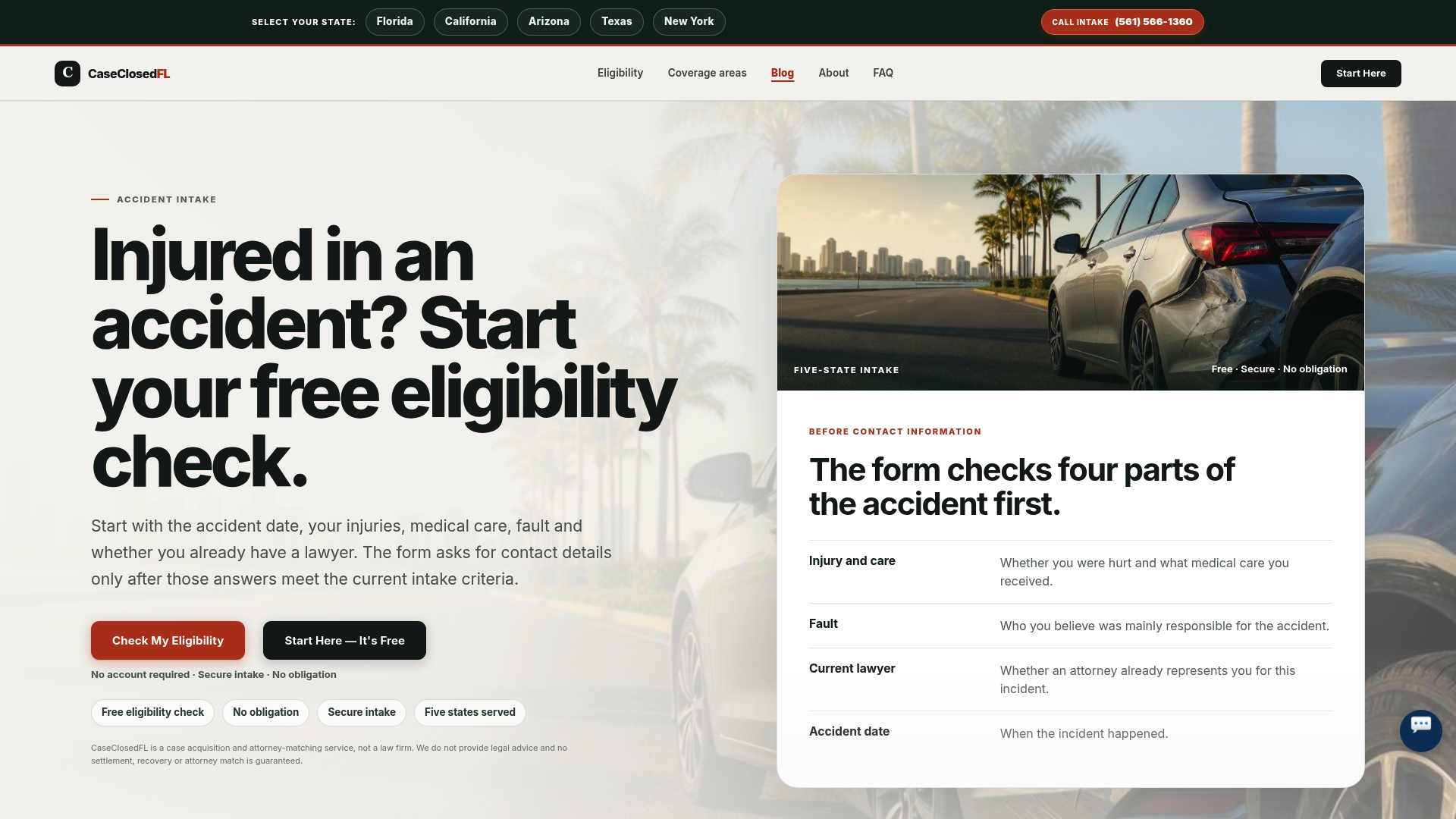
Before you start, gather what you can: recent pay stubs, your employer’s contact information, and the dates of any medical treatment tied to your injury. Having these ready speeds up the review and gives an attorney a clearer picture of your claim from the start.
- Start your free eligibility check today.
- Florida readers near Tampa, Orlando, Fort Myers, Melbourne, Lakeland, or St. Petersburg can also find localized case review options through our regional pages.
- We review every submission by hand before any attorney referral is made.
This article is general information, not a substitute for advice from a qualified lawyer. Consult a qualified legal professional about your own circumstances before acting on anything here.
FAQ
Can I claim lost wages if I’m self-employed?
Yes, but it takes more documentation than a traditional paycheck provides. You will typically need tax returns, invoices, and business records showing your income pattern before and after the accident, since profits tied to your personal labor count differently than profits from capital or other workers.
How far back can I claim lost wages after a car accident?
You can generally claim lost wages from the date of the accident through the date your case settles or goes to trial, as long as you can document the missed time. Future lost earning capacity, if applicable, extends beyond that date and requires expert projections rather than pay stubs.
Will I pay taxes on a lost wages settlement?
Compensatory lost-wage allocations tied to a physical injury are generally excluded from gross income under IRS guidance. Punitive damages remain taxable, and any portion that reimburses previously deducted medical expenses may be taxable to the extent it provided a prior tax benefit.
What happens if I don’t follow my doctor’s treatment plan?
Skipping treatment or ignoring medical advice can reduce what you recover, since U.S. tort law requires you to take reasonable steps to limit your own losses. Insurers often point to treatment gaps as a reason to argue your missed work was not medically necessary.
How does CaseClosedFL help with a lost wages claim?
A free eligibility check service is offered that asks about your injury, fault, and existing representation before requesting personal contact details, then routes qualifying cases for human review before any attorney referral. This service is offered at no cost to accident victims.
Sources
- Tax implications of settlements and judgments | Internal Revenue Service
- duty to mitigate | Wex | US Law | LII / Legal Information Institute
- Lost wages claims and personal injury damages | Nolo
Recommended
Frequently asked questions
Table of Contents What Counts as Recoverable Lost Wages Evidence You Need to Prove a Lost Wages Claim How Insurers and Courts Calculate Your Losses Your Duty to Mitigate Damages Tax Treatment of Lost Wages in a Settlement Your Action Plan After an Accident Common Challenges in Lost Wages Claims Why a Privacy-Minded Intake Process Matters Start a Free Eligibility Check With CaseClosedFL FAQ Sources What Counts as Recoverable Lost Wages A lost wages claim generally splits into two categories: past lost wages and future lost earning capacity. Past lost wages cover the income you actually missed between the accident and the settlement or trial date, calculated from your pay rate and the days or hours you could not work. Future lost earning capacity applies when an injury creates permanent or long-term limitations that reduce what you can earn going forward, and it requires more detailed proof than past losses do. Cornell’s Legal Information Institute notes that compensation can include regular pay, overtime, bonuses, commissions, and the value of paid time off used during recovery. In practice, this plays out differently depending on your work situation: An hourly worker who misses a period of shifts can calculate lost wages directly from their hourly rate and missed hours. A salaried employee who loses an annual bonus tied to attendance or performance can include that bonus in the claim. Someone who used PTO to cover missed days can still claim the economic value of that leave, since it was consumed during recovery. A business owner whose personal exertion drives company profits can claim lost business income, though profits tied mainly to capital or other employees carry less weight. Evidence You Need to Prove a Lost Wages Claim Insurers and courts weigh documentation heavily, and the strength of your evidence often determines how much of your claimed loss gets paid. The most persuasive proof ties your missed time directly to medical treatment and confirms your pay rate and schedule before the accident. Employer records : pay stubs, W-2s, commission statements, and attendance records that show your pre-accident earnings and missed days. Medical documentation : provider notes and records that connect your work restrictions and out-of-work dates to the treatment you received. Expert testimony : vocational experts and economists who can project future earning losses, along with treating physicians who can speak to your prognosis. Tax and benefit records : tax returns, 1099s, and PTO logs that corroborate your reported income and the leave you used during recovery. Wage verification letter : a formal letter on company letterhead confirming your pay rate, typical hours, overtime patterns, and the specific dates you missed. Nolo’s guide to proving future lost earnings points out that past wages are relatively easy to prove with employer records, while future losses depend heavily on medical and vocational expert evidence showing reasonable certainty. Pro Tip: Ask your employer for a wage verification letter as soon as you know you will miss work; insurers tend to dispute claims less often when pay rate and missed dates are confirmed in writing rather than pieced together from pay stubs alone. How Insurers and Courts Calculate Your Losses Past wages are usually the simpler calculation: documented missed pay, added up through the settlement date, using your actual pay stubs and attendance records. Future losses require more assumptions. The basic formula compares your expected pre-injury earnings against your expected post-injury earning capacity over a reasonable time horizon. Attorneys and economists typically build in expected raises, promotions, and the age at which you would likely have retired. Present-value discounting reduces lump-sum awards for future losses, since a dollar paid today is worth more than a dollar paid years from now. Vocational experts assess what kind of work you can realistically still perform given your injury. Treating physicians contribute prognosis information that anchors the entire future-loss calculation. Present-value discounting commonly reduces lump-sum awards for future losses , which means a settlement offer for future lost earning capacity may look smaller than a simple year-by-year projection would suggest. Understanding this adjustment helps you interpret settlement numbers instead of assuming you are being shortchanged. The math behind these numbers is rarely done by the claimant alone. Attorneys coordinate with economists and vocational experts to build a defensible projection, especially when the injury affects a specialized skill set or a business owner’s ability to generate profit. Your Duty to Mitigate Damages U.S. tort law requires injured parties to take reasonable steps to limit their own losses, a principle Cornell’s Legal Information Institute describes as the duty to mitigate. Failing to act reasonably can give insurers grounds to reduce what they pay, even when the underlying injury is legitimate. Reasonable steps include: Seeking medical treatment promptly and following the treatment plan your provider recommends. Accepting suitable light-duty work when your employer offers it and your doctor clears you for it. Keeping records of every missed day, medical visit, and work restriction as they happen. Insurers frequently point to skipped treatment, gaps in care, or undocumented absences as reasons to cut a claim’s value. Consistent records and follow-through on medical advice close off most of these disputes before they start. Tax Treatment of Lost Wages in a Settlement Most lost-wage compensation in a personal injury settlement is not taxable, but the rules depend on how the settlement is structured. Under IRS guidance tied to Revenue Ruling 85-97 and IRC Section 104, compensatory damages for physical injuries, including the portion allocated to lost wages, are generally excluded from gross income. Punitive damages, when awarded, remain taxable regardless of the underlying injury. IRS Publication 4345 explains that if you previously deducted medical expenses on your taxes and later recover those costs through a settlement, the recovered amount may be taxable to the extent it provided a prior tax benefit. Keep a copy of the settlement allocation showing how much was assigned to lost wages versus other categories, and talk to a tax professional before filing the year you receive the payment. Your Action Plan After an Accident Acting quickly after a crash protects both your health and your ability to document lost wages later. For a broader rundown of immediate steps, see our guide on what to do after a crash in Florida . Get medical care immediately, even if symptoms seem minor, and tell your employer about the accident and your expected absence. Preserve your pay stubs, schedule, and any PTO or sick leave documentation from before and after the accident. Within the first one to four weeks, request a formal wage verification letter from your employer and gather your recent tax returns or 1099s. Keep a written log of every missed workday, medical appointment, and work restriction your doctor assigns. Consult an attorney if your injury affects your ability to work for more than a few weeks, or run CaseClosedFL’s free eligibility check for a privacy-focused way to find out if your case qualifies for attorney review. Our guide to free accident case evaluations walks through what to expect once you start that process. Common Challenges in Lost Wages Claims Insurers dispute lost wages claims for predictable reasons, and most disputes trace back to gaps in documentation rather than the legitimacy of the injury itself. Self-employed workers and business owners face particular scrutiny, since their income is harder to separate from business profits generated by capital or other employees. Cash income that was never reported to tax authorities creates a separate problem: there is little documentary basis for an insurer or court to quantify the loss, which makes unreported earnings difficult to recover regardless of how real the income was. Workers paid partly in tips or irregular bonuses face a similar challenge if those amounts were not consistently reported. Gaps in medical treatment are another frequent target. If you stop seeing a doctor for weeks and then resume, insurers may argue your absence from work during that gap was not medically necessary. Undocumented absences, where you missed work but have no pay stub, time-off request, or doctor’s note tied to that date, invite the same argument. Future earning capacity claims draw the most pushback, since they rely on projections rather than historical pay records. Vocational and economic experts can address this by building a projection grounded in your specific medical restrictions and job market realities, rather than a generic percentage reduction. Psychological injuries that affect future earning potential are often the hardest to prove and typically need specialist testimony to hold up. Why a Privacy-Minded Intake Process Matters The intake process is designed to ask about your injury, fault, and any existing legal representation before requesting personal contact details. This order matters: it keeps your information out of circulation until your case actually meets the criteria attorneys are looking for. Once a case moves forward, the attorney reviewing it relies on the same employer records, medical documentation, and expert input described above to build a lost wages claim that holds up against insurer pushback. Qualified cases are routed for human review before any referral happens, and the service covers claimants in multiple states. Start a Free Eligibility Check With CaseClosedFL There is a free eligibility check available that takes a few minutes and comes with no obligation. Every submission goes through human review before any attorney connection is made, which keeps the process private and minimizes unwanted solicitation. Before you start, gather what you can: recent pay stubs, your employer’s contact information, and the dates of any medical treatment tied to your injury. Having these ready speeds up the review and gives an attorney a clearer picture of your claim from the start. Start your free eligibility check today. Florida readers near Tampa, Orlando, Fort Myers, Melbourne, Lakeland, or St. Petersburg can also find localized case review options through our regional pages. We review every submission by hand before any attorney referral is made. This article is general information, not a substitute for advice from a qualified lawyer. Consult a qualified legal professional about your own circumstances before acting on anything here. FAQ Can I claim lost wages if I’m self-employed?
Yes, but it takes more documentation than a traditional paycheck provides. You will typically need tax returns, invoices, and business records showing your income pattern before and after the accident, since profits tied to your personal labor count differently than profits from capital or other workers.
How far back can I claim lost wages after a car accident?
You can generally claim lost wages from the date of the accident through the date your case settles or goes to trial, as long as you can document the missed time. Future lost earning capacity, if applicable, extends beyond that date and requires expert projections rather than pay stubs.
Will I pay taxes on a lost wages settlement?
Compensatory lost-wage allocations tied to a physical injury are generally excluded from gross income under IRS guidance. Punitive damages remain taxable, and any portion that reimburses previously deducted medical expenses may be taxable to the extent it provided a prior tax benefit.
What happens if I don’t follow my doctor’s treatment plan?
Skipping treatment or ignoring medical advice can reduce what you recover, since U.S. tort law requires you to take reasonable steps to limit your own losses. Insurers often point to treatment gaps as a reason to argue your missed work was not medically necessary.
How does CaseClosedFL help with a lost wages claim?
A free eligibility check service is offered that asks about your injury, fault, and existing representation before requesting personal contact details, then routes qualifying cases for human review before any attorney referral. This service is offered at no cost to accident victims.
Ready to enter the accident details?
The eligibility form asks about the accident, injury, treatment, fault and representation before contact information.
Start Eligibility Check